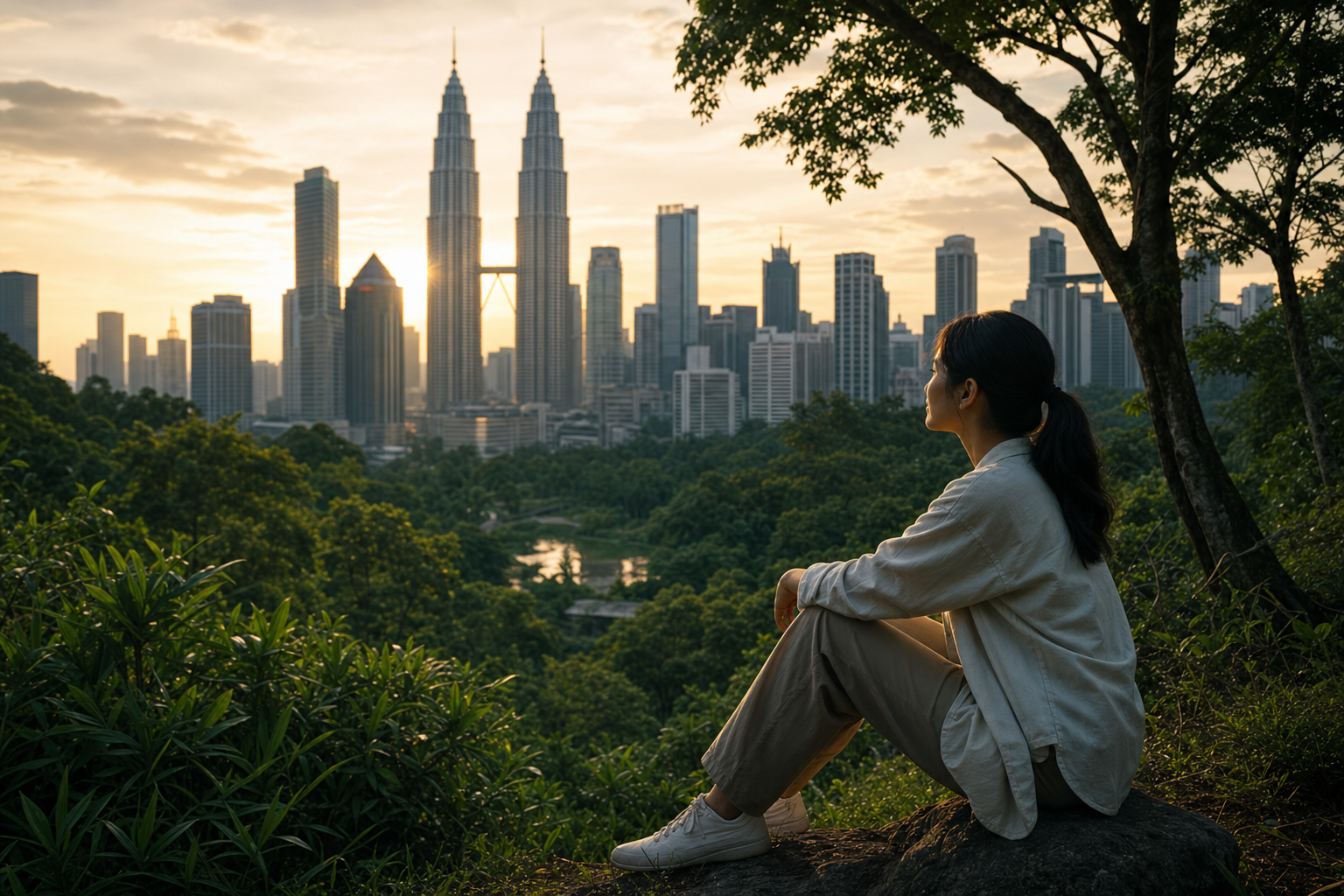
While global lifestyle headlines chase celebrity drops and K-beauty booms, Malaysia's real lifestyle story in June 2026 is quieter and far more radical. Based on Verbrol's analysis of 30+ signals, a 'Joy Economy' is emerging — one that prioritises presence over consumption and community over clout. Here's what Malaysian brand managers cannot afford to miss.
Malaysia's Lifestyle Market Is Telling a Story Nobody Expected
Here's the thing about June 2026 in Malaysia: if you're reading the global lifestyle press, you'd think the most pressing concerns are Caitlin Clark's Nike collab, Rosalía's Dior feathers, and whether ChatGPT should have access to your Visa card. Glamorous, sure. Relevant to Kuala Lumpur on a Tuesday evening? Not particularly.
Based on Verbrol's analysis of 30+ signals from news and social data collected over the past 48 hours, something far more interesting — and commercially significant — is happening inside Malaysia's lifestyle sector. Young Malaysians are not passively consuming global trend cycles. They are quietly, deliberately, building something new: a Joy Economy rooted in local experience, creative participation, and intentional disconnection from the global noise machine.
This is the counter-narrative that Malaysian brand managers and agency professionals need to sit with. The mainstream read says Malaysian consumers aspire upward toward global lifestyle benchmarks. The data says they're increasingly turning inward — and finding real joy there.
The 'Missing Out' Revolution Is a Market Signal, Not a Mood
Let's start with what should be the most-discussed lifestyle story in Malaysia right now and somehow isn't. How young Malaysians are finding joy in missing out — reported in NST Online — is not a wellness sidebar. It's a leading economic indicator.
The FOMO-to-JOMO pipeline has been talked about globally for years, but in Malaysia's context, it carries a specific texture. This isn't the burnout-driven minimalism of a post-pandemic Western millennial. It's younger — Gen Z and late-millennial Malaysians, roughly 22 to 32 — choosing depth over breadth in their lifestyle consumption. Fewer events attended, fewer brands followed, but far more invested in the experiences they do choose.
For brand managers, this is a critical recalibration. Reach metrics are becoming a vanity trap. A campaign that touches 2 million Malaysians superficially is now worth less — in conversion terms, in loyalty terms — than one that genuinely lands with 80,000 deeply engaged consumers who've chosen to be in that moment.
Verbrol's intelligence layer flags this as an early signal that will reshape influencer marketing briefs across the sector within the next two quarters. If your agency is still pitching "maximum impressions" as a KPI for lifestyle campaigns, the market has already moved past you.
DIY Culture Is Building KL's Next Lifestyle Category
The second signal is hyperlocal and telling. The emergence of Happy Hour Club in Kuala Lumpur — a café that fuses creative DIY workshops with viral croffle experiences — is more than a cute F&B concept. It's a symptom of a broader shift: Malaysians increasingly want to be participants in their lifestyle, not just consumers of it.
This tracks globally with what Tatler Asia's Prix Versailles Most Beautiful Restaurants 2026 list is highlighting — that dining and lifestyle spaces are being rewarded not just for aesthetics but for experiential agency, for giving visitors something to do, make, and feel. Malaysian operators are catching on fast.
What Verbrol's analysis identifies here is a hidden commercial winner that most lifestyle coverage is missing: the experience-retail hybrid. Spaces that blend craft, community, and consumable product — think DIY workshops anchored by a sellable takeaway — are quietly outperforming traditional café formats in dwell time and repeat visit rates. Based on Verbrol's analysis of 30+ signals from news and social data, this format is growing at a pace that will make it a mainstream lifestyle category by Q4 2026, not a niche one.
For brands thinking about physical activation in Malaysia, the implication is pointed. The question is no longer 'where do we place our product?' but 'what do we invite people to make or do with it?' Passive brand presence is losing the room.
This is equally significant for content strategy. Platforms like Creamatch, Malaysia's managed creator content platform, are already seeing creator briefs shift toward participatory, process-driven content — tutorials, builds, behind-the-scene crafting — over traditional aspirational lifestyle imagery. The creators winning in this environment aren't the ones with the most polished feeds; they're the ones who make their audience feel capable of something.
The World Cup Is a Lifestyle Moment, Not Just a Sports Moment
The 2026 FIFA World Cup is arriving as the largest shared cultural event Malaysia will experience this year, and the lifestyle industry is only beginning to understand its full commercial gravity. Coverage around where Malaysian football fans can watch the 2026 FIFA World Cup in Gempak points to a viewer intent that is intensely communal — people are not planning to watch alone.
This communal intent is a lifestyle signal as much as a sports one. The World Cup is creating permission structures for Malaysians to invest in their social spaces, their wardrobes for watch parties, their food and drink choices, and their sense of national and regional identity. Brands that position themselves around shared celebration — rather than individual aspiration — will find an unusually receptive Malaysian consumer over the next six weeks.
According to Bernama, Malaysia's cultural calendar in 2026 is also gaining richness through cross-regional artistic exchange, with events like the Black Cat Dance Theatre bridging Malaysia and Indonesia reinforcing a sense of ASEAN cultural pride that brands can authentically tap into. This is not a moment for generic global lifestyle messaging. It is a moment for rooted, regional resonance.
For lifestyle marketers specifically, the Verbrol Pulse dashboard is tracking World Cup-adjacent lifestyle conversations in real time — from F&B category surges to apparel and homewares spikes associated with hosting culture. The category uplift in communal-consumption product segments is already measurable and climbing.
What Malaysian Lifestyle Brands Must Do Differently Before Q3
Based on Verbrol's analysis of 30+ signals from news and social data, here are the three moves that separate forward-looking lifestyle brands from the ones who'll be explaining flat Q3 results in September:
-
Reframe your engagement KPIs. Depth of connection is now more commercially predictive than breadth of reach for the Malaysian lifestyle consumer. Work with partners like Creamatch to build creator content strategies built around participatory storytelling, not passive impression volume.
-
Design for participation, not for photography. Whether it's a retail pop-up, a brand café, or a product launch, the Malaysian lifestyle consumer in 2026 wants to do something, not just witness something. Build that into your activation brief from the start, not as an afterthought.
-
Use the World Cup window as a community play, not a reach play. The brands that win the next six weeks won't be the ones with the biggest media buy. They'll be the ones who made Malaysians feel more together — in their living rooms, their mamak tables, their WhatsApp groups. According to The Star, Malaysians' appetite for shared cultural moments has never been higher. Meet them there.
The Joy Economy Is Not a Phase — It's the New Brief
I want to close with the thesis stated plainly, because I think it's the most important thing a Malaysian brand manager can internalise going into the second half of 2026: the Malaysian lifestyle consumer has stopped performing aspiration and started pursuing joy. These are not the same thing, and they require entirely different brand strategies.
Aspiration is outward-facing. It responds to global trend signals, celebrity endorsements, and status markers. Joy is inward-facing. It responds to belonging, creativity, laughter, and the particular pleasure of making something with your hands in a café in Kuala Lumpur on a Wednesday afternoon.
The global lifestyle machine — the Diors and the Nikes and the K-beauty empires — will keep pumping aspiration content into this market. That's fine. They're good at it. But the brands that will build genuine loyalty with Malaysian consumers in 2026 and beyond are the ones wise enough to offer something the algorithm can't: a real reason to feel good, right here, right now.
For those who want to track how this Joy Economy evolves across the Malaysian lifestyle sector — week by week, signal by signal — Verbrol is where the intelligence lives.
Track Lifestyle trends in real-time at verbrol.com
Read more on Verbrol Intelligence: