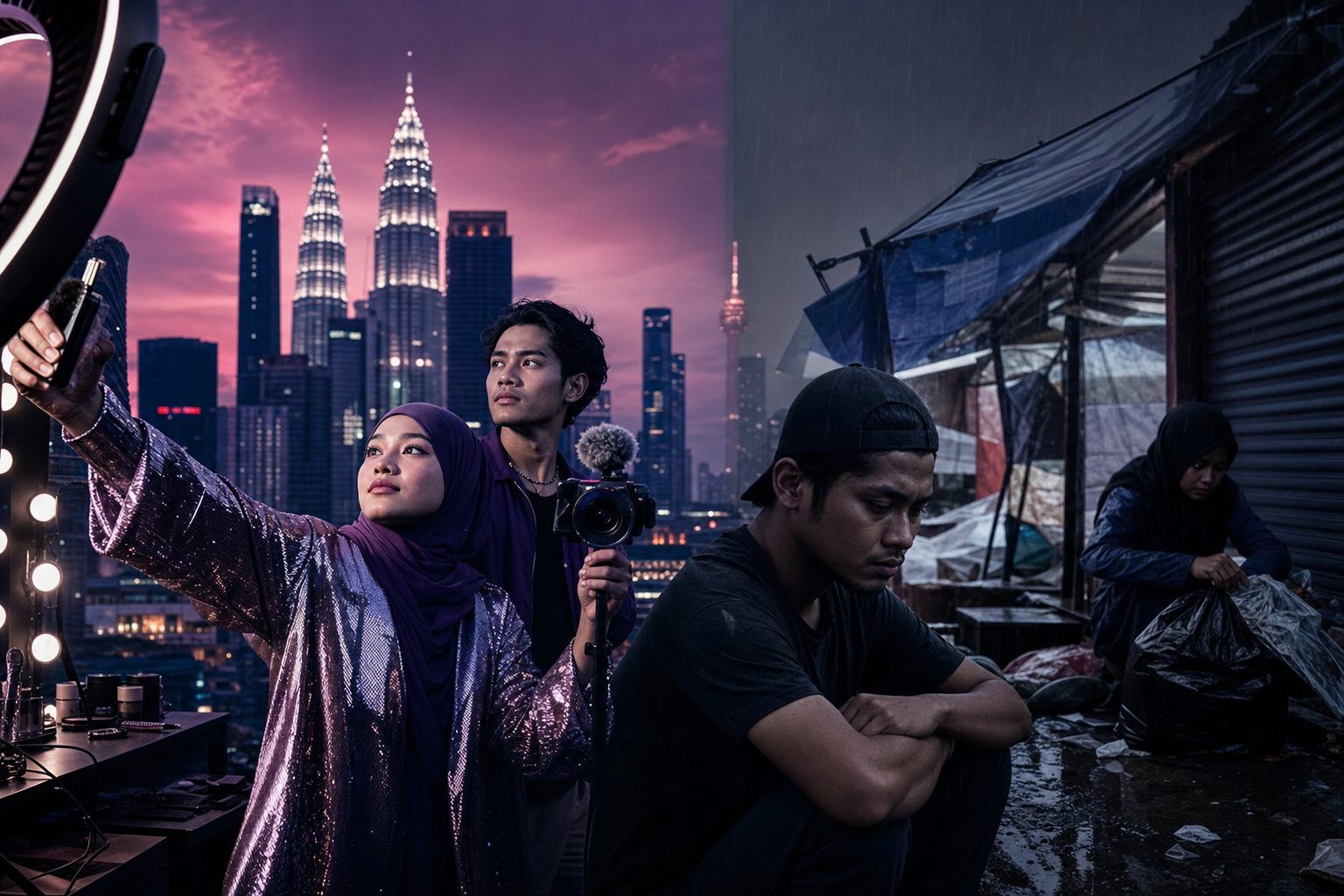
Malaysia's creator economy is simultaneously maturing and fracturing — with new tax frameworks, platform protests, and high-profile scandals reshaping the industry in real time. Based on Verbrol's analysis of 30+ signals, the creators who adapt to this new operating environment will define the next era of Malaysian digital commerce. Here's what the data is really telling us.
The Paradox Nobody in Malaysian Marketing Is Talking About
Here is the uncomfortable truth that most agency decks in Kuala Lumpur will not show you in 2026: Malaysia's creator economy is simultaneously the most professionalised and the most fragile it has ever been. Brands are pouring more ringgit into influencer partnerships than at any point in history, regulators are finally treating creators like real businesses, and yet — the platforms creators depend on are under siege, the public's trust in influencers is eroding, and the legal ground beneath the industry has shifted overnight.
Based on Verbrol's analysis of 30+ signals from news, YouTube, and social media over the past 48 hours, a single, underreported thesis is emerging: the formalisation of Malaysia's creator economy is not a growth catalyst — it is a stress test. And only the creators and brands who treat it as one will survive the next 12 months.
This is not a doom narrative. It is an opportunity map. Let me show you what the data actually says.
Three Crises Hitting at Once — And Why That Is Not a Coincidence
In the past 48 hours alone, three separate storylines have converged in Malaysian creator economy news, and the overlap is not accidental.
Crisis One: The Tax Reckoning. Malaysia's Inland Revenue Board (IRB) has rolled out new taxing guidelines for social media influencers that are more sweeping than most creators expected. We are not just talking about declared sponsorship fees — free gifts, digital tokens, and in-kind collaborations are now classified as taxable income under the new IRB framework. Many influencers have publicly called the guidelines impractical, but as CNA's reporting reveals, tax experts argue the rules simply bring creators in line with every other Malaysian professional. The era of operating in a fiscal grey zone is over.
Crisis Two: The Platform Power Struggle. Protesters gathered outside TikTok's office at Sunway Velocity in Kuala Lumpur this week — a rare, physical manifestation of creator frustration over what content creators describe as arbitrary restrictions on their reach and monetisation. According to reporting by Free Malaysia Today, demonstrators warned of larger rallies if platform policies do not change. This is significant: Malaysian creators are no longer quietly absorbing platform decisions. They are organising.
Crisis Three: The Trust Deficit. The high-profile death of Taiwanese influencer Iris Hsieh, now reclassified as murder and linked to Malaysian rapper Namewee, has dominated regional headlines. Separately, Indonesian media reports are circulating allegations connecting a Malaysian influencer to a scam operation. These are not industry-wide indictments — but in a market where parasocial trust is literally the product being sold, reputational shockwaves travel fast and wide.
Here is the pattern Verbrol's analysis surfaces: these three crises are not random. They are the natural consequence of an industry that scaled faster than its governance infrastructure. Malaysia's creator economy grew on vibes and virality. Now the bill has arrived — in the form of tax forms, protest signs, and police remand orders.
The Hidden Winners: Brands and Managed Platforms Built for Accountability
Here is the counter-narrative that almost no one in the Malaysian marketing press is publishing: the formalisation crisis is the best thing that has ever happened to professional, accountable players in this space.
When tax obligations are vague, any creator with a ring light and a phone can undercut a professional operation. When platform policies are opaque, charisma beats consistency every time. But when the IRB requires declared income, contracts, and paper trails — suddenly, the creators and agencies who already operate that way have a massive structural advantage.
This is exactly why managed creator content platforms like Creamatch are positioned to win in this environment. Malaysia's creator economy does not need fewer influencers — it needs better infrastructure. Brands need partners who can deliver compliance-ready creator relationships, documented deliverables, and measurable outcomes rather than vanity metrics. The shift from influencer marketing as an awareness tool to influencer marketing as an outcome driver — a trend AnyMind Group has documented across APAC — is accelerating precisely because accountability is now mandatory, not optional.
The Malaysian Reserve's analysis of how KOLs are shaping the future of advertising points to the same conclusion: the KOL ecosystem is maturing into a performance-driven channel, and brands that cling to follower counts as their primary metric are already behind.
Three actionable shifts for Malaysian brands and agencies right now:
- Audit your creator roster for tax compliance readiness. If your influencer partners cannot produce invoices or declare gifted product value, your brand is exposed in the new regulatory environment. Formalise every partnership — it protects both sides.
- Diversify platform dependency aggressively. The TikTok protests are a canary in the coal mine. No Malaysian brand should have more than 40% of its creator-led content budget locked into a single platform in 2026. RedNote's emergence as an alternative — particularly as South China Morning Post reports on its growing appeal to users navigating platform restrictions — is a trend worth watching.
- Invest in creator vetting as a core competency. The Namewee-Iris Hsieh case and the gambling promotion warnings from Malaysian authorities are reminders that brand association risk has never been higher. Malaysia has already set influencer ethical standards as digital speech rules take shape — enforcement will follow.
The Prediction: In 6 Months, Malaysia's Creator Tier Will Split in Two
Based on Verbrol's real-time market intelligence, here is what we are projecting with high confidence for Q4 2026:
Malaysia's creator landscape will bifurcate sharply into two distinct tiers. The first tier — call them Creator Professionals — will be registered businesses, tax-compliant, platform-diversified, and operating through managed content infrastructure like Creamatch. They will capture a disproportionate share of brand budgets as CMOs prioritise accountability over reach.
The second tier — Legacy Influencers — will struggle. Those who built audiences on a single platform, relied on gifted product without declared income, and operated without formal brand contracts will face compounding pressure from every direction: IRB audits, platform algorithm shifts, and advertiser risk aversion triggered by high-profile controversies.
The Padini body-shaming TikTok incident — which forced a public apology from one of Malaysia's most established fashion retailers — is a preview of the reputational math brands will increasingly refuse to accept. One wrong creator partnership can undo years of brand equity in a 15-second clip.
The creators and brands who understand this bifurcation now have a 6-month head start on everyone else. This is the early signal that Verbrol exists to surface — before it becomes obvious to the whole market.
What This Means for You Right Now
Malaysia's creator economy is not dying. It is growing up. And in my view, that is genuinely exciting — even if the transition is painful for those who thrived in the unregulated era.
The opportunity in 2026 is not chasing the biggest follower counts or the trendiest platform. It is building creator partnerships that are defensible: legally compliant, outcome-linked, and resilient to the platform volatility that is now a permanent feature of this market.
For Malaysian marketers, brand managers, and agency professionals reading this — the question is not whether to invest in creator marketing. The data is unambiguous: KOL-driven content is the dominant force in Malaysian digital advertising. The question is whether you are investing in the infrastructure to do it right.
The stress test is underway. Who are you betting on?
Based on Verbrol's analysis of 30+ signals from news, YouTube, and social media across the Malaysian creator economy landscape, June 2026.
Track Creator Economy trends in real-time at verbrol.com
Read more on Verbrol Intelligence: