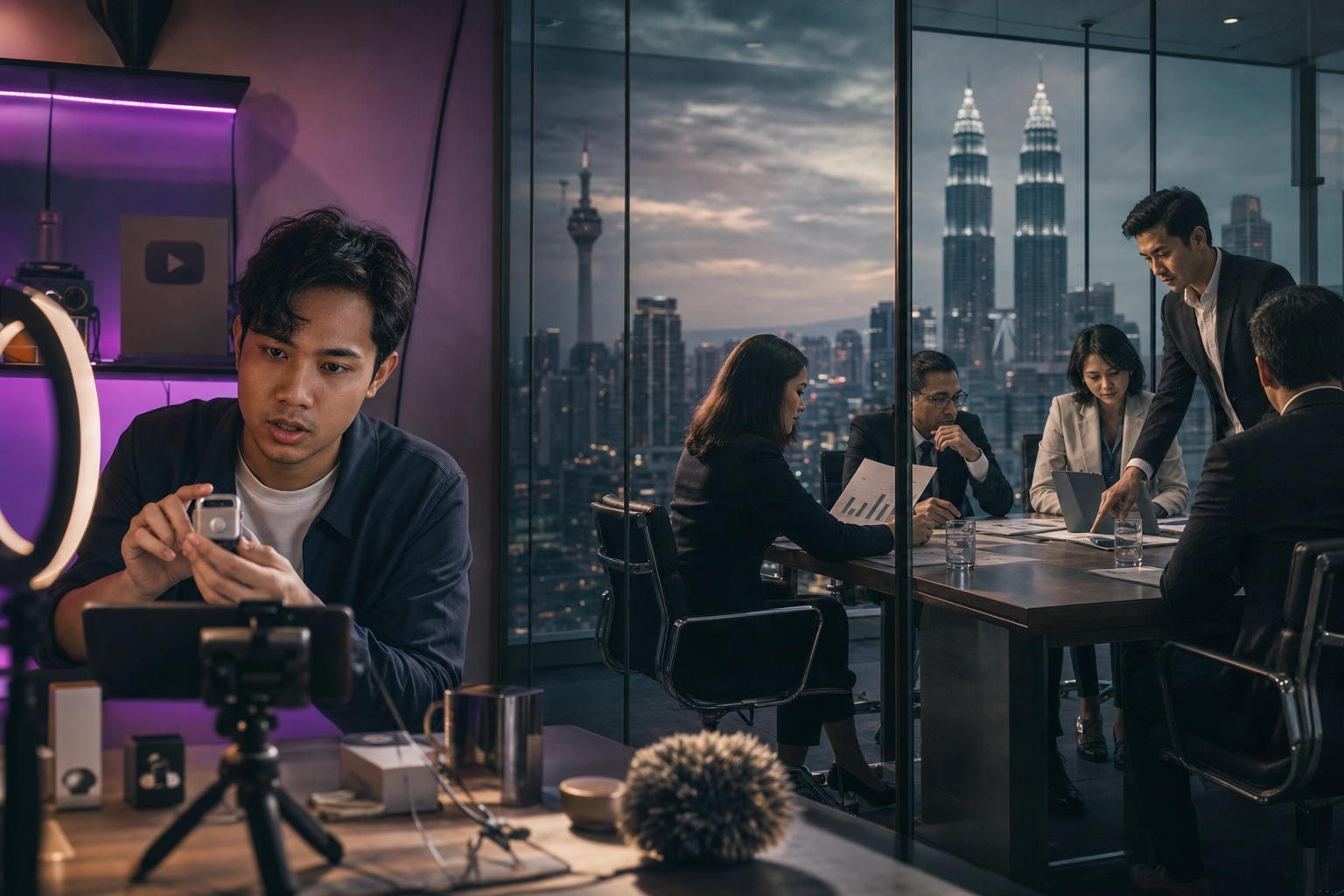
Big money is moving through Malaysia's creator economy — but a rash of legal storms, regulatory overhauls, and AI-generated influencers are forcing brands to play a much smarter game.
A weekday afternoon at Sunway Velocity in Kuala Lumpur — normally the kind of high-gloss mall backdrop you'd pick for a lifestyle unboxing video. Last week, it was something else entirely: a crowd of content creators and supporters gathered outside TikTok Malaysia's office, waving placards and warning of larger demonstrations if the platform didn't address what they described as unfair algorithmic restrictions throttling local creator reach. The protest didn't go viral in the traditional sense. But it said something loud about the state of Malaysia's creator economy in mid-2026: the industry has grown big enough to take to the streets.
And it has grown spectacularly. Malaysia's creator economy is no longer a side hustle ecosystem — it's a legitimate commercial infrastructure, one that brands, agencies, and platform operators are betting serious ringgit on. But the same week that protest unfolded, a Taiwanese influencer's death linked to Malaysian rapper Namewee was reclassified as murder, the government announced plans to criminalise cyberbullying following an influencer suicide, and a Singaporean consumer went public about needing corrective surgery after a KL liposuction procedure she booked through an influencer promotion. The boom and the breaking are happening simultaneously. Brands and marketers operating in this space need to understand both.
The Numbers Are Real — And They're Getting Bigger
Let's start with the upside, because it's genuinely staggering. Khairul Aming — Malaysia's most commercially dominant food content creator — broke the country's TikTok Shop livestream record earlier this year, moving RM2.3 million in a single day. That's not a typo. One creator, one stream, one day. According to Malay Mail, the record underscores how TikTok Shop has transformed live commerce from a novelty into a primary sales channel for Malaysian consumers.
TikTok's own data reinforces the structural shift. The platform's #JomLokal initiative — a multi-million-ringgit campaign supporting Malaysian MSMEs — reportedly grew sales of homegrown products by over 130%, according to TikTok's official newsroom. For brands like those in the Shopee and Lazada seller ecosystem, this signals where the attention economy is concentrating: short-form video, live commerce, and creator-led product discovery.
The institutional money is following. Tourism Malaysia and Guardian have both activated influencer marketing campaigns for domestic tourism and retail respectively, signalling that government-linked agencies and established retail chains now treat creator partnerships as standard media — not experimental spend. For marketers tracking where the budget is going, the answer in 2026 is increasingly: KOLs.
Platforms built specifically for this shift are gaining traction. Creamatch, Malaysia's managed creator content platform, sits at the intersection of brand demand and creator supply — structured specifically to reduce the friction that still plagues informal influencer deals in this market. As brand spend professionalises, managed platforms like Creamatch become less of a nice-to-have and more of an operational necessity.
The Regulatory Reckoning Is Here
Here's where it gets complicated for anyone running creator campaigns at scale. Malaysia's regulatory environment around content creators just got materially more demanding — and the trajectory is toward more rules, not fewer.
The Inland Revenue Board (IRB) released new tax guidelines that directly impact creators: free gifts, digital tokens, and brand collaborations are now classified as taxable income. According to The Edge Malaysia, the guidelines have been deemed impractical by many influencers — but tax experts quoted by CNA argue they ensure fairness relative to salaried workers. Regardless of where you land on the fairness debate, the operational reality for brands is this: creator fees and compensation structures need to account for a more complex tax environment, or you'll find your talent relationships strained at contract renewal.
Simultaneously, the government is moving toward criminalising cyberbullying following high-profile influencer suicides — a direct policy response to the mental health crisis playing out inside creator culture. The Malaysian Reserve has reported on Malaysia's push to set formal ethical standards for influencers — a framework that, once codified, will affect how brands brief creators and what disclosures they require.
The liability exposure is real too. The case of a Singaporean consumer requiring corrective surgery after booking a KL liposuction procedure promoted by a local influencer is the kind of story that accelerates regulatory timelines. Brands co-signing creator-promoted medical or health services are not insulated from that reputational blast radius.
AI Influencers, Platform Tension, and the RedNote Wildcard
Beyond regulation, two emerging dynamics deserve immediate attention from Malaysian marketers.
First: AI-generated influencers are no longer a future scenario. SAYS.com reported on Liz and Adam — two fully AI-generated Malaysian influencers already in market. These aren't deepfakes or digital avatars used for one campaign. They're persistent, brand-safe, and infinitely scalable personas. For brands drawn to influencer marketing primarily for content volume and brand safety, AI creators represent a genuine strategic option — even if the authenticity trade-off isn't yet fully priced in.
Second: the RedNote migration is quietly reshaping the creator map. South China Morning Post has documented how Chinese users fleeing platform pressure are landing on RedNote — and Malaysia is emerging as a content destination within those communities. For brands targeting Chinese-Malaysian consumers or regional audiences, this cross-platform migration is an early signal worth watching through tools like Verbrol Pulse.
The protest outside TikTok's Sunway Velocity office also points to a platform dependency risk that marketers have been slow to price in. When your creator strategy is 90% one-platform, a single policy change — algorithmic or regulatory — can crater your campaign performance overnight.
What Marketers Should Actually Do With This
The Malaysian creator economy in 2026 is not a space you can manage with a spreadsheet of follower counts and a handshake agreement. Here's where smart brand managers are placing their attention:
- Diversify platform exposure. TikTok Shop's live commerce numbers are real, but a single-platform creator strategy is operationally fragile. Build capacity across TikTok, Instagram, and YouTube simultaneously.
- Audit creator compliance posture. With new IRB guidelines in place, your creator contracts need to reflect proper compensation structures. Tax uncertainty on the creator's side creates deal friction and reputational risk for the brand.
- Treat brand safety as a primary brief item. The liposuction case and the Namewee-linked investigation are reminders that creator association carries real liability. Vetting needs to go beyond engagement rate — Bernama has covered multiple enforcement actions involving influencers that brands had active partnerships with.
- Get structured about creator sourcing. The days of DM-based influencer deals at scale are numbered. Managed platforms purpose-built for the Malaysian market are where professional brand-creator relationships now operate — and Creamatch is worth serious evaluation if you're running recurring creator programs.
- Watch the AI creator space closely. Not to deploy immediately, but to understand what "authenticity" means to your specific audience segments before AI creators become a default option in agency decks.
The creator economy here isn't slowing down. Khairul Aming's RM2.3M day and the crowds outside TikTok's office are two faces of the same truth: this industry has arrived at a scale where the rules, the risks, and the rewards are all getting bigger at the same time. The brands that navigate 2026 well will be the ones that take the complexity seriously — not just the reach numbers.
Track Creator Economy trends in real-time at verbrol.com
Read more on Verbrol Intelligence: