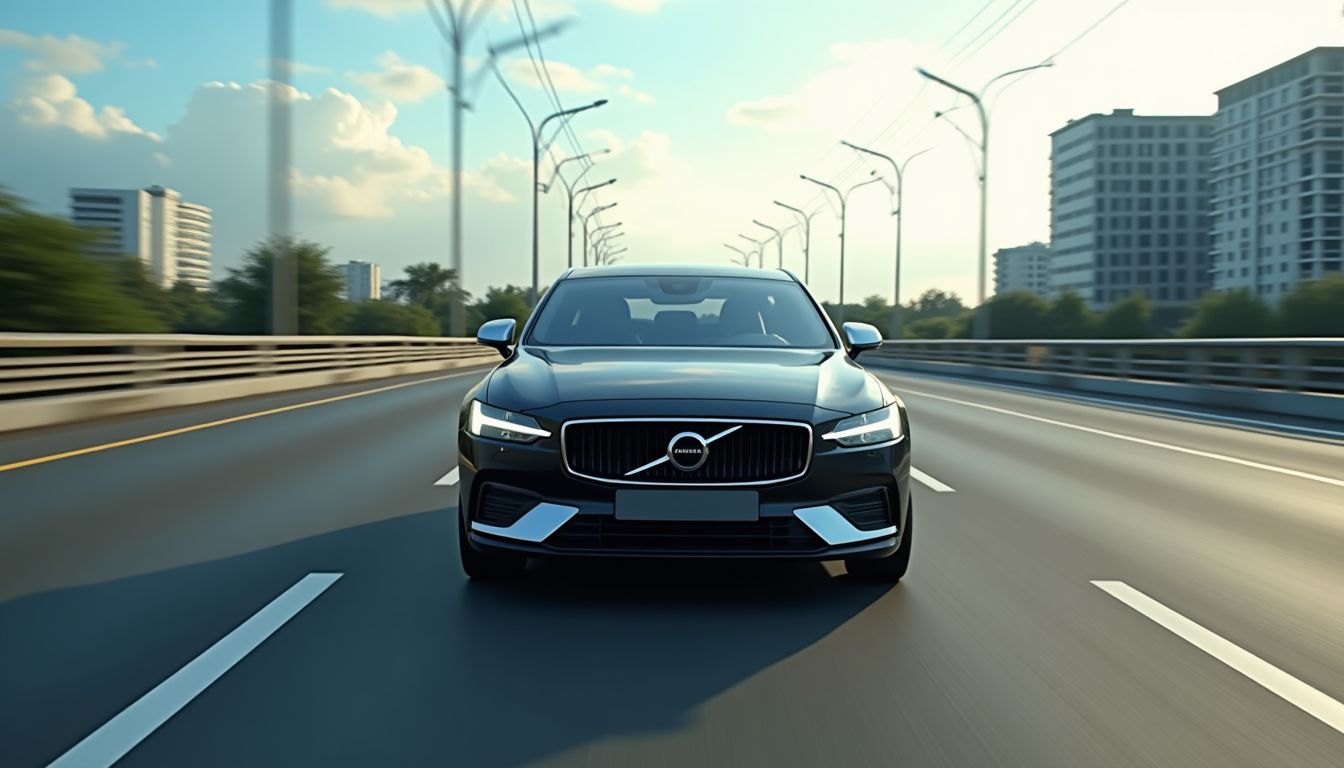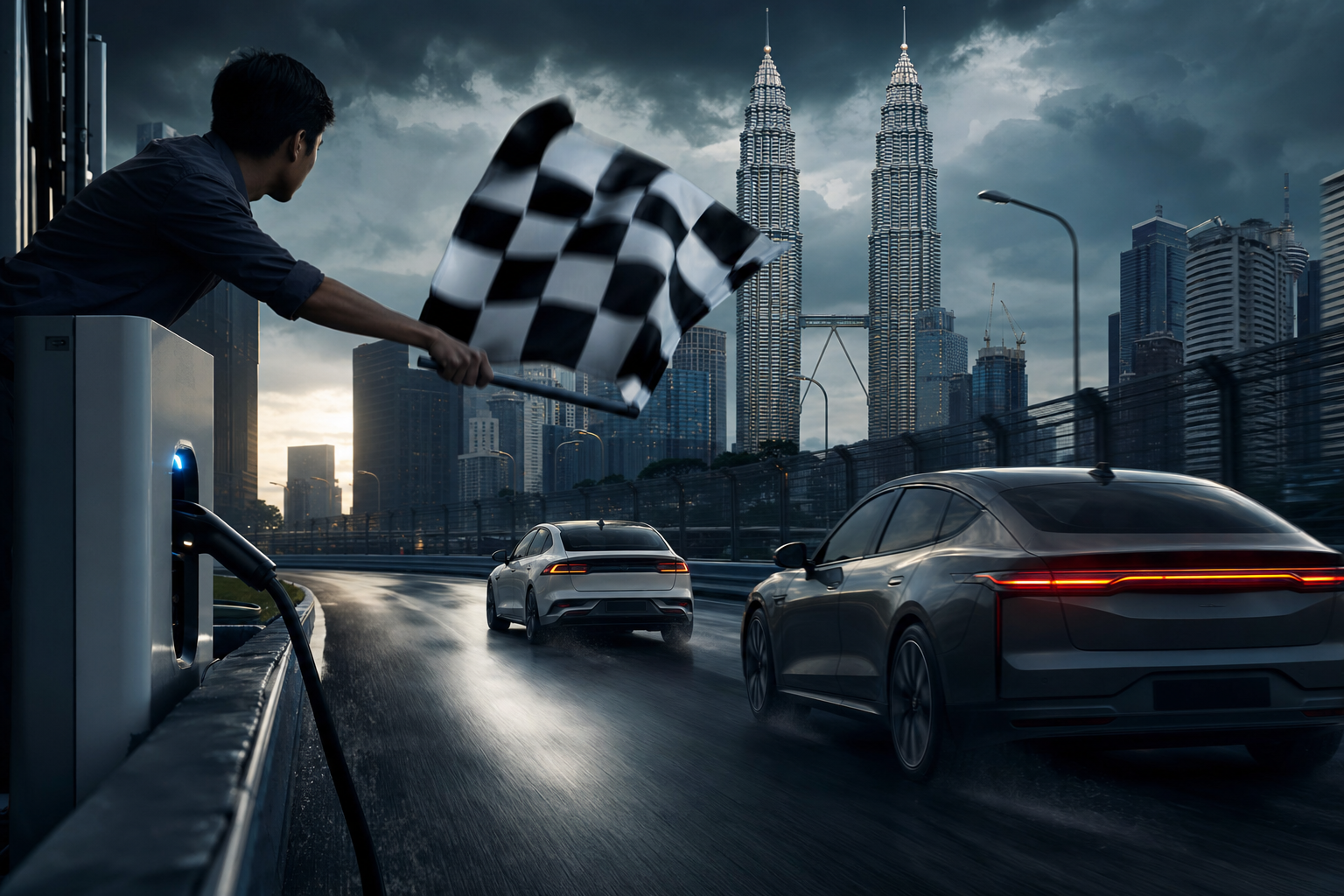
Malaysia's electric vehicle rollout is accelerating — but the real contest is over who controls the infrastructure, the pricing, and the consumer relationship underneath the car itself.
The Question Underneath the Sales Figures
Who actually owns a Malaysian EV? The buyer who signs the hire-purchase agreement, the brand that builds it, or the company managing the battery that powers it?
That question is no longer hypothetical. As of February 2026, Proton leads Malaysia's EV segment with 1,802 units sold, with BYD a distant second at 469 units, and iCaur, MG, and Zeekr rounding out the top five. The numbers confirm that the national marque has established a meaningful early-mover position. But the more significant structural development is happening one rung below the sales chart — in how the next wave of EVs will be financed, maintained, and ultimately controlled.
Perodua's forthcoming electric vehicle, confirmed for 2025 and now advancing through final development, is expected to arrive at approximately RM80,000 — competitive for a mass-market entry point. The pricing strategy, however, carries a structural condition: battery leasing. Under this model, the customer purchases the vehicle body while paying a recurring fee for battery access. Miss a payment, and the car can be remotely locked out. That detail, first reported by NST Online, reframes what "owning" an EV means in practice.
Battery Leasing: A Logical Solution With Real Trade-Offs
The battery-as-a-service model is not without industrial merit. Batteries represent roughly 30–40% of an EV's total cost. By separating the battery from the vehicle price, Perodua can lower the headline RM figure, address residual value anxiety, and offload degradation risk from the consumer — three obstacles that have historically suppressed EV adoption in price-sensitive segments.
Perodua's collaboration with an international partner to develop these affordable EVs, reported by Focus Malaysia, suggests the battery management infrastructure will likely be co-developed with — and partly controlled by — that overseas entity. This is where the trade-off sharpens: the convenience of a lower purchase price comes with a contractual dependency that extends well beyond the dealership floor.
For brand managers and fleet procurement teams, this matters operationally. Total cost of ownership calculations must now factor in lease duration, battery replacement cycles, and the contractual terms governing remote vehicle access. A locked car is not just a consumer inconvenience — for a corporate fleet, it is a logistics failure.
The Malaysian CBU EV policy adjustment from MITI, which frames import restrictions as a measure to strengthen the broader local automotive ecosystem rather than purely protect national brands, adds another layer to this. Policy is being used to shape the playing field — directing volume toward locally assembled or locally developed models — which gives Perodua's battery-lease architecture a degree of structural protection it would not otherwise have.
The Value Chain Pressure Is Real and Documented
The sales leadership Proton currently holds in the EV segment is commercially significant, but industry observers are pointing to a more durable challenge. Malaysia's auto sector must shift gears beyond assembly, as NST Online reported citing the Deputy Minister's position — a statement that reflects growing institutional pressure on both national carmakers and their supplier networks to move from volume-based assembly toward higher-margin engineering, software, and component manufacturing.
This is not a new concern, but it is acquiring urgency. Malaysia's automotive sector has been urged to move up the value chain as the mobility landscape restructures around electrification, connectivity, and software-defined vehicles. The risk for a market that built its industrial base on ICE assembly is straightforward: the components that matter most in an EV — battery cells, power electronics, motor controllers — are not yet manufactured domestically at scale.
EP Manufacturing's recently announced RM200 million vehicle paint facility expansion is a signal that tier-one suppliers are committing capital to the local ecosystem. Paint and body facilities are not glamorous, but they represent committed fixed investment and downstream integration — exactly the kind of upstream commitment the value chain argument requires. According to Bernama, such manufacturing investments are increasingly being framed within the National Automotive Policy's electrification targets.
For brands operating in Malaysia — whether Toyota Malaysia managing hybrid volumes, Honda Malaysia navigating the transition from ICE dominance, or BMW Malaysia protecting its premium EV positioning against Chinese entrants — the supply chain question is as strategic as the product question. The Star has tracked how Chinese EV brands are using Malaysia as a regional beachhead, with BYD's 469-unit February figure representing early-stage volume that will compound as localisation increases.
What Brand and Marketing Teams Should Be Tracking
For marketers working in or around Malaysia's automotive sector, the structural shifts above have direct content and positioning implications.
Battery leasing changes the purchase narrative. The consumer conversation is no longer purely about range, design, or total cost of ownership. It now includes questions of contractual risk, data ownership, and what happens when a payment lapses. Brands that address this directly — with transparent communication rather than footnoted terms — will earn disproportionate trust in a market still forming its EV opinions.
Policy-driven volume creates market distortions worth monitoring. CBU restrictions that favour locally assembled models will compress the competitive window for pure-import brands. Marketing spend calibration should account for this — short-term volume gains for imported models may not be sustainable if policy tightens further.
The EV buyer profile in Malaysia is still narrow. February's top-five EV brands are collectively still moving modest units by global standards. The mass-market inflection point — likely triggered when Perodua's RM80,000 model lands and battery leasing becomes normalised — has not yet arrived. Campaigns built for early adopters will need to be re-engineered for mainstream buyers who have different risk tolerances and different information needs.
For automotive brands investing in content to reach these buyer segments, Creamatch, Malaysia's managed creator content platform, offers structured access to automotive-adjacent creators who build trust with exactly the value-conscious, research-heavy audience now evaluating first-time EV purchases.
Industry intelligence aggregated through Verbrol Pulse confirms that automotive conversations in Malaysia are increasingly clustering around ownership structure and policy risk — not just product specifications. Monitoring those signals at the category level, rather than waiting for quarterly sales reports, gives brand teams a material timing advantage.
The Transition Is Underway — The Architecture Is Still Being Negotiated
Malaysia's EV market in mid-2026 is not a finished story. Proton's sales leadership is real but fragile. Perodua's battery-lease model is structurally innovative but contractually untested at consumer scale. MITI's CBU policy is directionally clear but operationally complex. And the value chain gap — between where Malaysian automotive manufacturing currently sits and where a software-defined EV industry requires it to go — remains the central industrial challenge of the decade.
For brand managers, fleet operators, and automotive marketers, the actionable posture is neither panic nor complacency. It is precision: understanding which structural shifts are policy-driven (and therefore durable), which are commercially driven (and therefore contestable), and where the consumer relationship is genuinely up for grabs.
The car is still the product. But increasingly, the subscription underneath it is the business.
Track Auto trends in real-time at verbrol.com
Read more on Verbrol Intelligence: