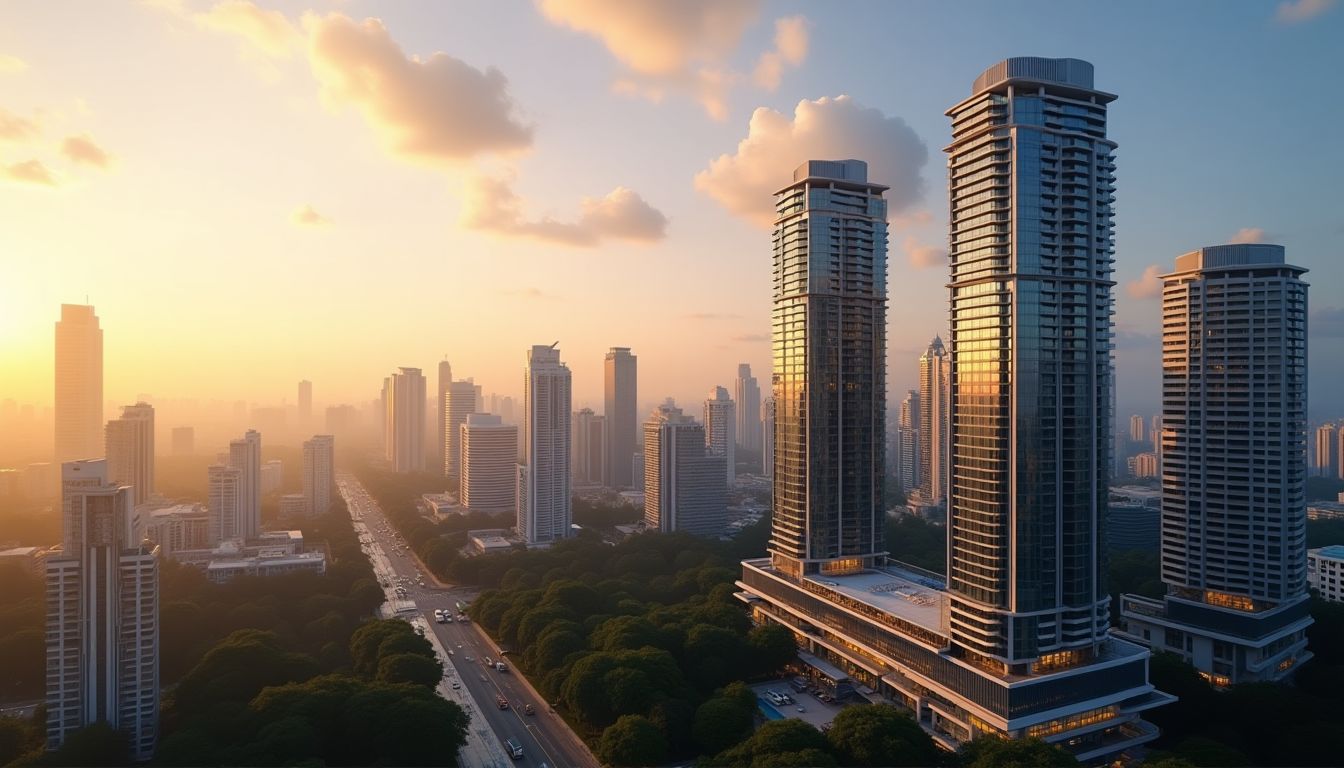
Transaction volumes are down, launches are delayed, and costs are rising — yet certain developers and asset classes are pulling firmly in the opposite direction. Malaysia's property market in 2026 is not in retreat; it is sorting itself out.
Where exactly are you standing in Malaysia's property market right now — on solid ground, or on a floor that is quietly shifting beneath you?
That question is more precise than it sounds. The aggregate picture for mid-2026 is cautious: Malaysia's property sector faces rising costs and delayed launches amid softer demand, with overall transaction volume falling 8.0 percent year-on-year in Q1 2026 according to NST Online. Construction input costs remain elevated, and several mid-tier developers have pushed new launches into the second half of the year.
And yet Mah Sing recorded its highest property sales since 2015 — RM2.51 billion for financial year 2025. Pesona Metro posted a 162 percent profit jump in FY2025 and is targeting RM500 million in new contracts. The Johor-Singapore Special Economic Zone is attracting sustained institutional attention. Industrial assets in the Klang Valley are being repriced upward.
This is not a uniform slowdown. It is a divergence — and divergences reward those who read the structure, not just the headline number.
The Aggregate Slowdown Is Real, But Selective
The Q1 2026 volume decline deserves to be taken seriously. Rising material costs, tighter household finances, and a cautious financing environment are compressing demand in the mass-market residential segment. Developers who built land banks around the RM400,000–RM600,000 mid-range residential category are feeling the most immediate pressure.
How Malaysia's property financing policy in 2026 shapes buyer decisions is a question now directly influencing launch timing, unit sizing, and pricing strategy. Developers are not simply delaying; many are reconfiguring products to align with what banks will actually approve and what buyers can realistically service.
Data from NAPIC has consistently shown that affordability gaps are most acute in Kuala Lumpur and Selangor, where median house prices remain significantly above what the median household income can support at standard loan-to-value ratios. That structural tension has not resolved — it has merely been deferred by government intervention schemes that are now themselves under budget pressure.
For brand managers and marketing professionals tracking the sector: the residential slowdown is not a temporary dip to wait out. It is a structural recalibration that will take multiple quarters to stabilise.
Industrial and Commercial Assets Are Moving in a Different Direction
The headline residential data obscures a more dynamic picture in commercial and industrial property. According to CBRE | WTW's Industrial Property Monitor for Q1 2026, higher-value assets are actively driving growth in the Klang Valley property market. Purpose-built warehousing, data centre-adjacent logistics facilities, and semiconductor-linked industrial parks are seeing both occupancy gains and capital value appreciation.
This is structurally connected to Malaysia's positioning within ASEAN's supply chain reconfiguration. As manufacturers diversify away from single-country dependencies, Malaysia — with its relatively stable regulatory environment and developed port infrastructure — continues to attract industrial tenants who require long-term, high-specification facilities.
Gamemuda's infrastructure pipeline and IJM's commercial development arm are both positioned to benefit from this cycle. The industrial segment does not generate the same consumer-facing visibility as a new township launch, but from an investment-grade perspective, it is currently the more reliable asset class.
The Johor-Singapore SEZ Is Not Hype — It Is a Structural Demand Driver
Of all the geographical narratives circulating in Malaysian property in 2026, the Johor-Singapore Special Economic Zone carries the most durable fundamentals. The Johor-Singapore SEZ as a bright spot for real estate is now a mainstream observation, but the mechanism behind it is worth spelling out: cross-border capital flows, Singapore-based buyers seeking ringgit-denominated assets at a discount, and multinational corporations requiring physical operational space in a lower-cost jurisdiction directly adjacent to Singapore's financial infrastructure.
UEM Sunrise and EcoWorld both hold significant landbanks in southern Johor that are directly in the demand corridor. The risk is timing — SEZ-linked demand is real but uneven in its geographic distribution, and not every Iskandar-adjacent project will benefit equally. Developers with pre-existing infrastructure and transit connectivity to the Rapid Transit System Link will be structurally advantaged over greenfield sites that require buyers to absorb additional commute uncertainty.
For investors monitoring entry points, iProperty's market data for Johor currently reflects rising search intent in the RM500,000–RM900,000 segment from Singapore-registered users — a leading indicator that typically precedes transaction volume by one to two quarters.
East Malaysia: The Under-Monitored Opportunity
Beyond the Peninsula, emerging opportunities in Sabah and Sarawak are attracting a different class of investor attention in 2026. Sarawak's digital economy ambitions — anchored by government-linked infrastructure investment — are creating demand for commercial and mixed-use development in Kuching and Miri that has no direct equivalent in the Peninsula's current cycle.
Sabah's hospitality-linked residential market, meanwhile, continues to appeal to buyers seeking lower entry prices with lifestyle upside. These are not primary markets for institutional capital, but for mid-sized developers and individual investors looking for asymmetric return profiles relative to Klang Valley pricing, East Malaysia merits serious analytical attention rather than dismissal as a secondary consideration.
The IHH Healthcare-Pelaburan Hartanah partnership for a new 260-bed medical block further illustrates how healthcare infrastructure investment is becoming a parallel driver of surrounding property value — a pattern that Verbrol market tracking has flagged as increasingly consistent across secondary Malaysian cities.
What This Means for Brands and Market Participants
For marketing and brand professionals operating within or adjacent to the property sector, three operational conclusions follow from the current structure.
First, segment-level messaging has become mandatory. A single campaign positioning a developer as broadly accessible in a market where affordability anxiety is acute and industrial asset values are rising will fail to resonate with either audience. Sunway's ability to maintain brand coherence across township, healthcare, and commercial segments works because each sub-brand carries its own positioning logic.
Second, the financing environment is now part of the product story. Buyers at the iProperty research stage are arriving with specific questions about loan eligibility, not just unit specifications. Developers whose digital content infrastructure answers financing questions directly — rather than directing users to call a sales agent — will convert at a measurably higher rate.
Third, place-based content is underutilised. The Johor SEZ, East Malaysia's emergence, and the Klang Valley industrial repricing are all stories that reward location-specific content strategies. Platforms tracking creator content performance — such as Creamatch, Malaysia's managed creator content platform — are well-positioned to help property brands build hyper-local narratives that aggregate search intent before competitors recognise the window.
The Structure Beneath the Slowdown
Malaysia's property market in mid-2026 is not in crisis. It is in the early stages of a structural differentiation that will separate developers, asset classes, and geographies that have genuine demand fundamentals from those that were riding a broader cycle.
The 8 percent volume decline is a real number. So is Mah Sing's record RM2.51 billion in sales. Both are true simultaneously — which means the only analytical error available is treating the aggregate as the whole story.
For brands, investors, and market professionals, the actionable posture is precision: know which segment, which geography, and which buyer profile you are addressing. The market is not moving uniformly in any direction. It is sorting.
Track Property trends in real-time at verbrol.com.
Read more on Verbrol Intelligence: