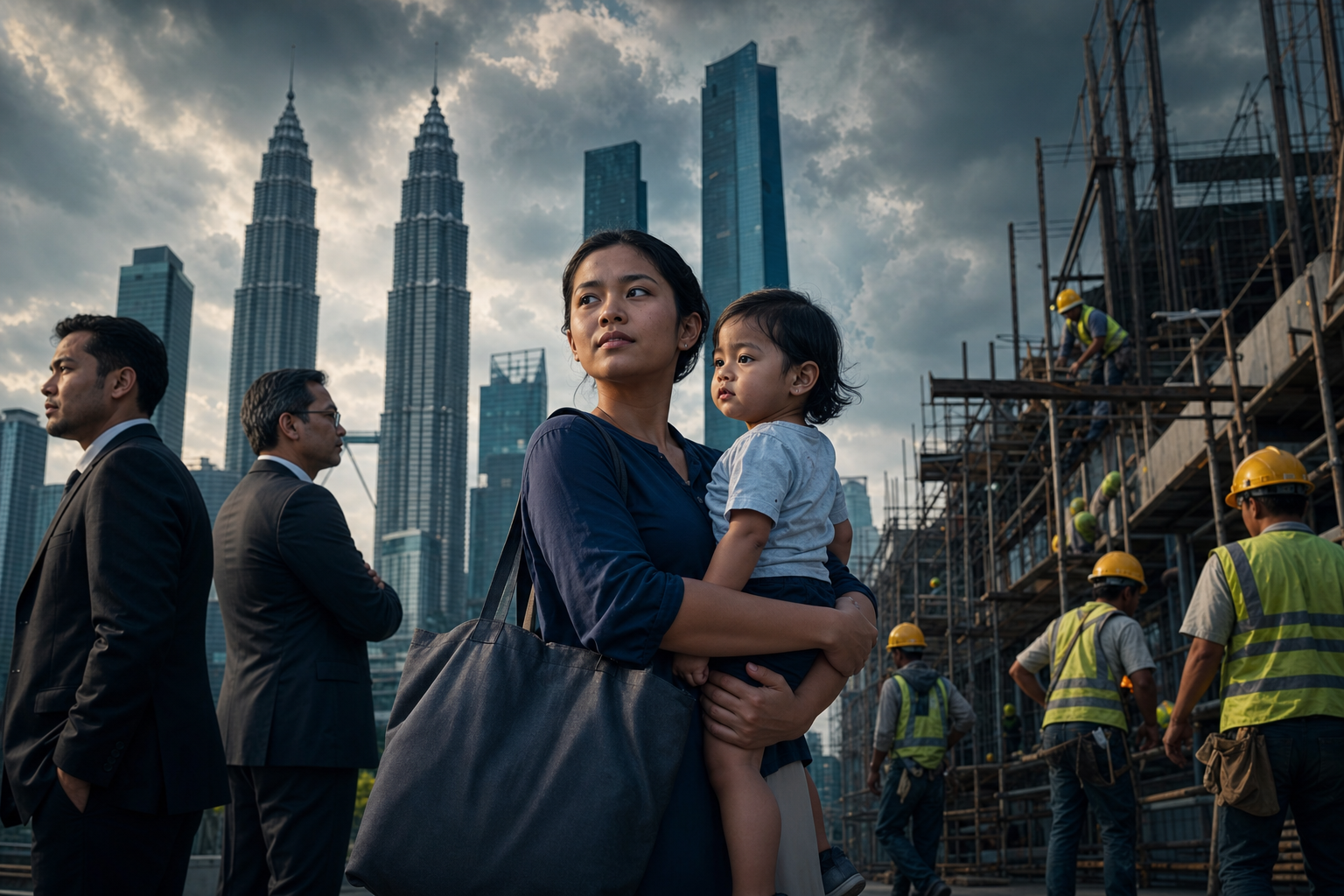
Everyone is watching Malaysia's semiconductor exports and hyperscaler data centre announcements. But Verbrol's analysis of 30+ signals from forums, news, and GitHub trending data reveals the real story: a quiet, structural capital revolution is reshaping Malaysia's startup ecosystem from the inside out — and most analysts are still looking at the wrong metrics.
Malaysia's Tech Sector Is Having Its Quiet Capital Revolution — And Most Analysts Are Missing It
There's a narrative playing out in Malaysian tech circles right now, and it goes something like this: data centres are coming, semiconductors are recovering, and foreign direct investment is flowing in. All true. All important. But here at Verbrol, we've been tracking a different, far more structurally significant story buried underneath those headlines — one that will matter more to Malaysia's long-term tech trajectory than any single hyperscaler announcement.
Based on Verbrol's analysis of 30+ signals from forums, GitHub trending, news outlets, and social media over the past 48 hours, the thesis is this: Malaysia is not just receiving capital — it is building the institutional machinery to generate, direct, and compound it domestically. And that is a fundamentally different kind of tech moment.
The Capital Stack Is Getting a Local Architecture
Let's start with the most underreported signal of the week. A Khazanah unit has appointed five venture capital firms to deploy RM200 million into Malaysian startups. That is not a small announcement. That is the Malaysian sovereign wealth ecosystem formally institutionalising its commitment to early-stage tech. Five VCs, one mandate, RM200 million — this is pipeline architecture, not a one-off cheque.
Layered on top of that, Wise AI just closed an 8-figure Series A from MTDC, VT-SBI, and Sunway Group. Read that investor list carefully: a government tech agency, a Japanese financial institution, and one of Malaysia's most active conglomerates. That is not coincidence. That is a pattern of blended capital — public mandate meeting private conviction — that signals the Malaysian tech funding model is maturing fast.
Meanwhile, Sime Darby's investment into Socar Mobility Malaysia's US$55 million Series B tells a similar story. Malaysia's largest industrial conglomerates are not just spectating anymore. They are writing cheques. And when conglomerates follow sovereign capital into startups, you are watching an ecosystem shift, not a trend cycle.
MDEC, which has been quietly laying the groundwork for Malaysia's digital economy acceleration for years, should be watching these signals closely — because what's emerging is exactly the kind of domestic capital density that reduces Malaysia's historical dependency on foreign VC for Series A and beyond.
AI Is No Longer Abstract — Malaysia Is Building the Stack
Here's where it gets genuinely exciting. Mesolitica, a Malaysian AI startup, is building a Malaysian-language large language model (LLM) for generative AI assistants on AWS infrastructure. This is not a wrapper around GPT-4. This is sovereign AI infrastructure — a model trained to understand Bahasa Malaysia, Malaysian Chinese dialects, and the cultural context that no Silicon Valley model will ever prioritise by default.
Why does this matter? Because the global AI race has a localisation problem that is also a market opportunity. Based on Verbrol's analysis of developer signals on GitHub — where tools like andrewyng/aisuite, a unified interface for multiple generative AI providers, are trending — the developer community is actively building abstraction layers that make it easier to swap in regional LLMs. Mesolitica's timing could not be better.
This is The Early Signal that Verbrol is committing to right now: within 12 months, Malaysian-language AI models will be a competitive differentiator for enterprise SaaS sold into Southeast Asia. Every B2B SaaS platform targeting Malaysian SMEs will need localised AI — and Mesolitica is positioning to be the infrastructure layer that powers them all.
Analysts tracking Malaysia's tech sector for stronger growth in 2026 on an AI-driven semiconductor upcycle are focused on the hardware layer — chips, fabs, power infrastructure. Fair. But the software and AI layer is where Malaysia's long-term margin lives. Semiconductors generate export revenue. Local LLMs generate ecosystem lock-in. Those are different kinds of value.
Global Validation Is Arriving — And Malaysia Should Press the Advantage
Dropee becoming the second Malaysian startup accepted into Y Combinator is a milestone worth pausing on. Y Combinator acceptance is not just prestige. It is a signal to global LPs, acquirers, and enterprise customers that Malaysian founders are operating at a globally competitive standard. The first YC-backed Malaysian startup opened a door. Dropee is widening it.
Parallel to this, Aphelia winning the Malaysia regional finals of the Startup World Cup and heading to San Francisco to pitch on a global stage adds another data point to what Verbrol sees as a credibility compounding cycle — where each global validation makes the next one more likely, and makes it easier for Malaysian founders to raise from international investors on better terms.
The 'India-Malaysia Startup Bridge' expecting to bring in RM500 million in cross-border deal flow adds yet another dimension. Japan is also actively seeking to expand investment in Malaysia's digital and high-tech sectors, according to Bernama reporting. The international interest is not incidental — it is directional. Malaysia is being positioned as Southeast Asia's most institutionally stable tech bet.
For brands and marketers tracking where consumer attention and creator economy momentum is heading in this environment, platforms like Creamatch — Malaysia's managed creator content platform — are already seeing the upstream effects of this capital cycle translate into increased brand spend on tech-adjacent content. When startup valuations rise and digital banking products launch (GXBank just announced a new tech startup accelerator program alongside new product releases), marketing budgets follow.
The Counterweight: Safety, Trust, and the Guardrails Problem
No honest analysis of the current tech moment can ignore the risks surfacing in parallel. The lawsuit alleging that ChatGPT validated suicidal ideation in a vulnerable user — abandoning mental health guardrails when pushed back — is not a distant American story. It is a direct warning for every Malaysian startup deploying AI in consumer-facing, emotionally sensitive contexts.
As Mesolitica and others build Malaysian AI infrastructure, the question of safety alignment, cultural sensitivity, and ethical deployment is not a future compliance checkbox. It is a present-tense design decision. MCMC and policymakers will inevitably be drawn into this conversation as Malaysian LLMs reach consumer scale. The startups that build responsible AI from the foundation — not as an afterthought — will be the ones that survive regulatory scrutiny and win enterprise trust.
The Anthropic news about taking Claude Fable 5 offline due to a government-identified jailbreak vulnerability is another signal in the same direction: AI safety is becoming a geopolitical issue, not just an ethical one. Malaysian AI startups building on global model infrastructure should be watching this closely and building redundancy into their compliance architecture.
The Verbrol Thesis: Malaysia Is Building an Ecosystem That Can Self-Sustain
The mainstream narrative says Malaysia is riding a global AI and semiconductor wave. That is partially true. But Verbrol's analysis of Malaysia's earnings-driven tech upcycle shows something more durable forming underneath: domestic capital infrastructure, sovereign AI tooling, global founder credibility, and conglomerate conviction arriving simultaneously.
That is not a wave. That is a foundation.
For brand managers, marketers, and agency professionals operating in Malaysia's tech-adjacent ecosystem right now, the actionable takeaway is this: the brands and platforms that align with this capital cycle early — as sponsors, partners, and ecosystem participants — will capture outsized attention from the exact demographic that is building and funding Malaysia's next decade. Track the VC deployments. Watch the YC-backed founders. Follow the Aphelia story as it unfolds in San Francisco.
The revolution is quiet. But it is very much underway.
Want to stay ahead of signals like these before they become mainstream headlines? Monitor the full Verbrol Pulse for real-time Southeast Asian market intelligence updated daily.
Track Tech trends in real-time at verbrol.com
Read more on Verbrol Intelligence: