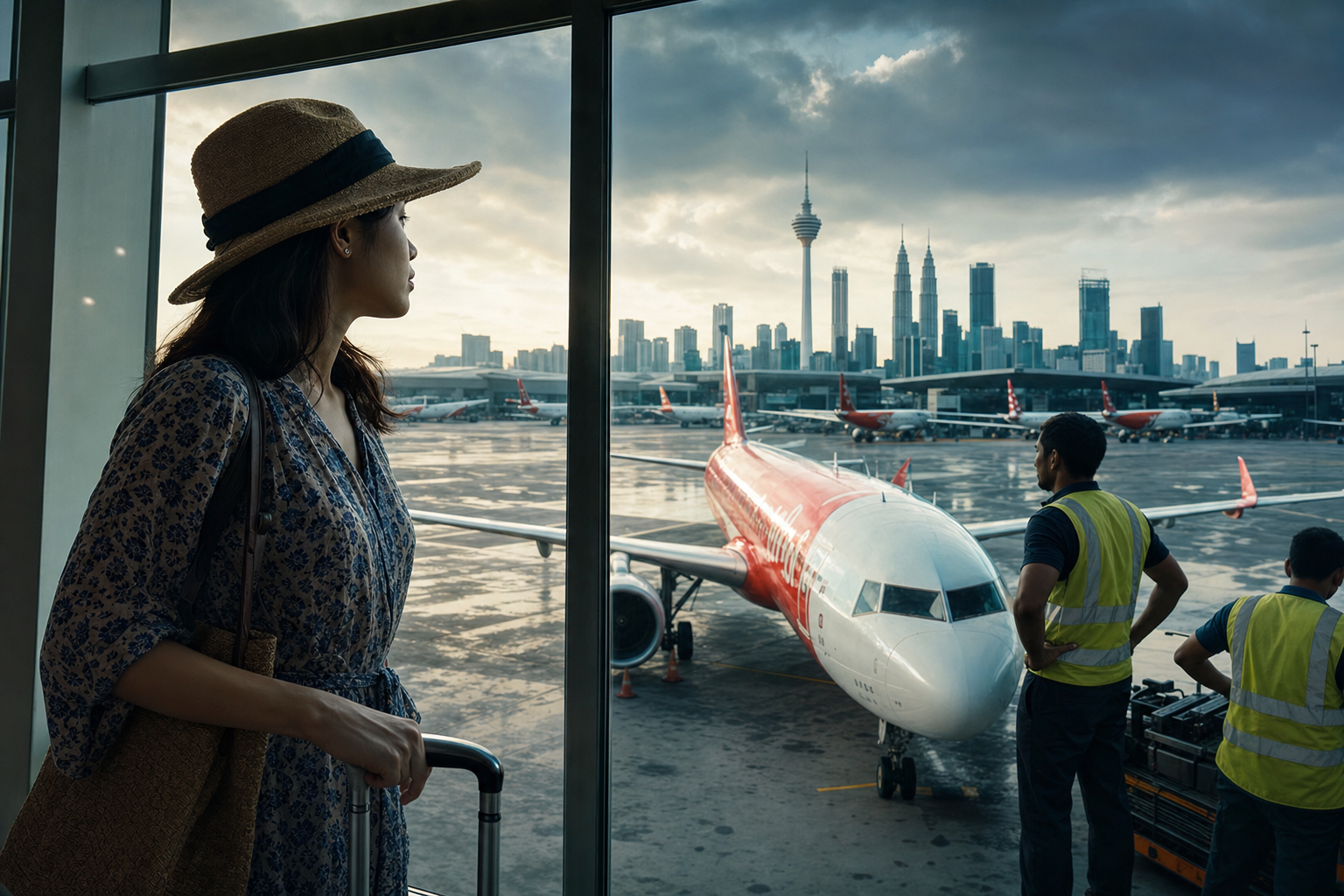
AirAsia shed RM2.35 billion in market value in a single week while simultaneously completing the most ambitious aviation consolidation in Southeast Asian history. Based on Verbrol's analysis of 30+ signals from news, YouTube, and regional media, the real story of Malaysia's travel market in June 2026 is not about turbulence — it is about who quietly benefits when the dominant carrier consumes itself in structural transformation.
The Carrier That Lost Billions and Won Everything at the Same Time
Let me put a number on the table before anything else: RM2.35 billion. That is what AirAsia X shed in market capitalisation during a single week of turbulence, a figure so dramatic it overshadowed every other travel story in Malaysia this June. Financial desks ran the numbers. Aviation analysts raised eyebrows. Social media did what social media does — it amplified the alarm.
But here is the thesis I want to commit to, one that no Malaysian portal has yet articulated clearly: AirAsia's short-term market destruction is, paradoxically, the most structurally bullish event for Malaysia's travel ecosystem in half a decade. The chaos is not the story. The consolidation underneath the chaos is.
Based on Verbrol's analysis of 30+ signals from news, YouTube, and regional media over the past 48 hours, the signals point overwhelmingly in one direction — while everyone is watching the carrier bleed, a leaner, more globally ambitious AirAsia is being quietly assembled in plain sight.
The Consolidation Nobody Fully Priced In
The sequence of events this week reads like a corporate thriller. AirAsia X completed its acquisition of AirAsia Berhad and AirAsia Aviation Group Limited from Capital A. Capital A confirmed the disposal of its aviation business. A key Thai regulatory condition waiver was secured. AirAsia X will formally be renamed simply "AirAsia" from next week — collapsing two distinct brand identities into one unified carrier.
Simultaneously, the group fully secured a RM1 billion private placement at RM1.65 per share and is now targeting RM5 billion in earnings by FY2026 for the enlarged group, off a base where fourth-quarter profit had already tripled year-on-year.
This is not a struggling airline. This is a carrier executing a multi-year restructuring at speed, absorbing short-term valuation pain to unlock long-term scale. The RM2.35 billion weekly loss in market cap is the price of structural surgery, not the symptom of a deteriorating business.
For Malaysian travel marketers and brand managers, this distinction matters enormously. The partner ecosystem — hotels, destination boards, experience operators, travel tech platforms — must recalibrate around a single, consolidated AirAsia entity that now controls a significantly larger slice of regional seat capacity and holds a genuinely global expansion agenda.
As The Star reports, AirAsia X has already launched inaugural flights to Istanbul, is positioning Bahrain as a strategic hub connecting Asia, the Middle East, Europe and Australia, and is doubling down on domestic recovery through its Unlimited Pass product. The geographic ambition here is real, not aspirational.
The Domestic Tourism Signal Everyone Is Underreading
While the consolidation story dominated business headlines, a subtler but equally important signal emerged in parallel: Malaysia's domestic travel demand is holding firm, and festive travel patterns are revealing a nation increasingly confident about movement.
BusinessToday Malaysia's recent analysis of what Malaysia's festive travel reveals about a nation on the move paints a picture of a middle-class travel segment that has normalised frequent short-haul trips as a lifestyle expectation rather than an occasional luxury. Cross-border travel into southern Thailand continues despite official safety advisories, as Travel And Tour World documents — demand resilience that suggests Malaysian travellers are making sovereign risk assessments independently of government guidance.
The new AirAsia Unlimited Pass, designed explicitly to accelerate domestic tourism recovery, is the product manifestation of this trend. If priced accessibly and marketed aggressively, it could become the single most powerful domestic travel stimulus tool Malaysia has seen outside of government intervention.
For brands in the travel-adjacent space — hospitality, F&B, lifestyle retail — the Unlimited Pass model represents a distribution channel worth taking seriously. It creates a captive, high-intent travel audience that needs accommodation, experiences, and spending categories filled. This is exactly the kind of audience-brand alignment opportunity that platforms like Creamatch, Malaysia's managed creator content platform, are built to activate — connecting destination brands and travel-lifestyle advertisers with creators who move this audience.
The Peripheral Risk Signals Brands Must Not Ignore
Not every signal in this week's data set is bullish. Two deserve serious attention from travel marketers.
First, the AirAsia boarding dispute. A viral incident involving a family and a medical child restraint escalated to the point where AirAsia issued a public apology and submitted revised procedures to regulators. The engagement on this type of customer service story — even at low direct social numbers — has a long tail. Based on Verbrol Pulse monitoring patterns, service recovery stories in Malaysian aviation tend to resurface every three to four weeks in community forums and parenting groups long after the initial news cycle. Brands co-marketing with AirAsia should build response protocols around reputational adjacency.
Second, the Philippines regulatory demand. An AirAsia affiliate faces a US$14 million unpaid dues claim from the Philippine regulator. This is a regional signal, not a Malaysia-specific one, but it confirms that the consolidation process carries cross-border regulatory friction. For brands considering regional travel campaigns anchored to AirAsia routes, the Philippines corridor warrants a watch flag.
Third, and this is the one I would push hardest on: a YouTube video calling for a boycott of Indonesian food establishments and urging Malaysians to avoid travelling to Indonesia surfaced in this monitoring window. Engagement was minimal — two interactions — but the sentiment category it represents (economic nationalism intersecting with travel decisions) is one Verbrol has tracked as a slow-building undercurrent in Malaysian consumer discourse since late 2024. It has not broken into mainstream media. It may not. But destination marketers targeting the Indonesia-Malaysia corridor should be aware it exists.
According to Bernama, regional travel advisories and ASEAN cross-border dynamics remain active variables in the second half of 2026, particularly following the cautionary guidance around Myanmar visits. The regional safety perception landscape is more fragmented than headline tourism numbers suggest.
What Malaysia's Travel Marketers Should Do Right Now
The actionable layer of this analysis is straightforward:
- Rebase your AirAsia partnership strategies around the consolidated entity. The rebrand from AirAsia X to AirAsia is not cosmetic. It changes co-marketing structures, audience access, and campaign geography.
- Build domestic tourism content now, before the Unlimited Pass marketing machine reaches full speed. First-mover content on popular domestic routes will capture search traffic that the Pass will generate in Q3 2026.
- Invest in creator-led travel content for the mid-tier domestic and short-haul segments. As the future of mobility in Malaysia analysis from The Star confirms, mobility patterns in Malaysia are shifting structurally. Creator content that maps to how Malaysians actually move — not how planners assume they move — will outperform. Creamatch is worth evaluating here for brands that need scale without the overhead of managing creators in-house.
- Monitor the Indonesia sentiment corridor via Free Malaysia Today and community-level listening tools. It is at 2% resonance now. In six months, under the right geopolitical conditions, it could be a campaign risk.
The Verdict: Controlled Chaos Is Still a Strategy
Malaysia's travel market in June 2026 is not in crisis. It is in transition — which is a harder state to communicate, and therefore the one most misread by analysts looking for simple narratives.
AirAsia losing RM2.35 billion in a week while targeting RM5 billion in FY2026 earnings is not a contradiction. It is the cost of becoming the carrier that the Southeast Asian market actually needs: consolidated, globally routed, domestically incentivised, and operationally unified under a single brand.
For marketers, the opportunity is in reading the transition correctly — and positioning now, before the structural clarity arrives and every competitor pivots simultaneously.
Based on Verbrol's analysis of 30+ signals from news, YouTube, and regional media, the brands that act on the consolidation thesis in Q3 2026 will find significantly less competition for AirAsia's expanded audience than those who wait for the turbulence to pass.
The sky is not falling. It is being reorganised.
Track Travel trends in real-time at verbrol.com
Read more on Verbrol Intelligence: