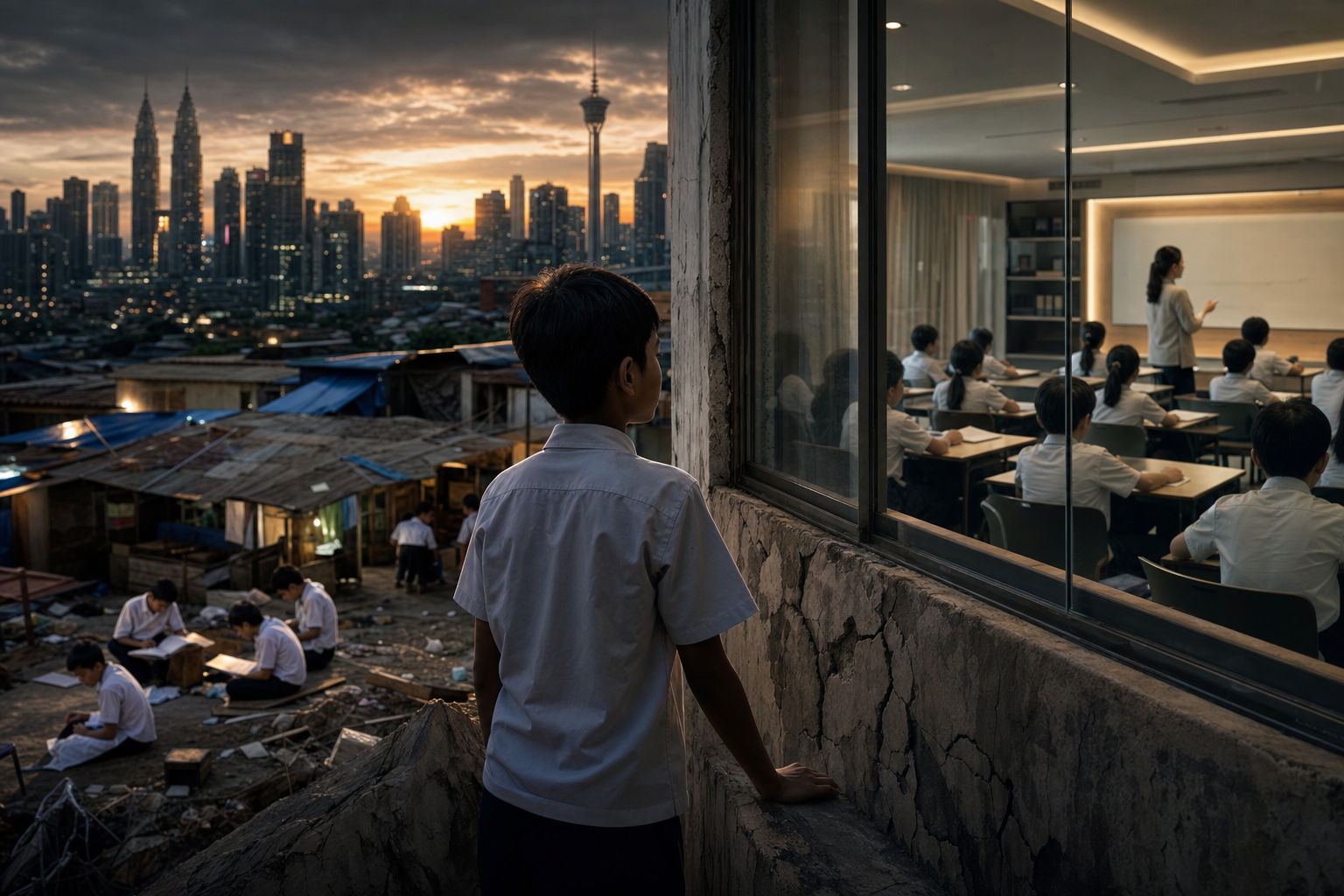
Scandals go viral, ministers respond, money gets allocated — but the structural cracks in Malaysian education keep widening. The loudest conversations aren't the most important ones.
Ada benda yang aku perasan lately. Every time a scandal breaks about Malaysian education — a viral clip, a politician's allegation, a student's exposé — the ministry responds within 48 hours. Statements issued. Investigations promised. Press conferences held.
Tapi bila isu structural yang lebih dalam? Silence that stretches for years.
That's the uncomfortable truth about Malaysian education in June 2026. We've gotten very good at reacting to what trends. We haven't gotten better at fixing what actually matters.
Viral Accountability Has a Shelf Life
Last week, the Education Ministry denied it only acts on misconduct after cases go viral. The defence itself is revealing — because it acknowledges the framing is already in the public's mind. The rakyat believes the system only moves when embarrassed into moving. That belief didn't come from nowhere.
Around the same time, Jitra assemblyman Haim Hilman Abdullah raised allegations of 'backdoor' entry into public universities. The higher education ministry is now mulling legal action over the claims — treating it as a defamation issue rather than, perhaps, an opportunity to demonstrate real transparency.
Legal threats in response to whistleblowing. That's a particular kind of signal.
This is the viral accountability trap: the system responds to heat, not light. A TikTok blows up, a minister holds a press conference, the news cycle moves on. Nothing systemic changes. Repeat next month.
The Vernacular School Distraction (And Why RM50m Doesn't Settle It)
On the vernacular schools front, the deputy education minister confirmed no SJKT will be closed, with RM50 million allocated for Tamil school upgrades. Good. Infrastructure matters. But this announcement — which plays well in the news cycle — doesn't address the teacher shortage in SJKTs, the curriculum integration question, or whether Tamil school graduates have equitable pathways into tertiary education.
Allocation without a structural plan is political comfort food. It fills the news cycle but not the real gap.
The Malaysian education debate keeps getting pulled into vernacular school territory because it's emotionally charged and politically legible. Meanwhile, the deeper question — are all Malaysian children, regardless of school stream, leaving secondary education with the skills the economy actually needs — stays on the backburner.
According to Bernama, graduate employability and skills mismatch have been flagged consistently over the last decade. The conversation we're having publicly and the problems that show up in employment data are two different conversations.
The Higher Education Quality Claim vs. Ground Reality
The Malaysian Qualifications Agency recently asserted that Malaysian higher education meets international standards. The MQA's job is to make that case, so the statement itself isn't surprising. But the framing deserves scrutiny.
"Meets international standards" is a floor, not a ceiling. It means we're accredited. It doesn't mean we're producing graduates who compete at the level we need them to, or that the learning experience inside lecture halls is actually preparing students for a world where AI can now grade their essays.
Speak to lecturers at any of the private universities — Taylor's University, Sunway University, UCSI — off the record, and you'll hear a consistent story: student engagement is down, the hybrid learning hangover from COVID is still real, and nobody has a settled answer for what to do about AI-assisted work. One recent piece from industry observers noted that AI grading tools are creating situations where students thank teachers for feedback that the teacher never actually wrote — the human relationship at the core of education, quietly being hollowed out.
Monash Malaysia and INTI have both piloted AI-assisted learning modules in recent semesters. The results are mixed — not because the tools are bad, but because passive content delivery, whether via a video or an AI chatbot, doesn't produce deep learning. Simulation-based and experiential learning remains stubbornly difficult to scale. That's not a Malaysian problem exclusively, but Malaysia has fewer resources to experiment with than our benchmarks.
HELP University's recent curriculum reviews point toward competency-based learning frameworks — a step in the right direction, but still early-stage when measured against what the job market is already demanding.
What Actually Needs to Change
Let's be direct. Three things:
-
Accountability architecture, not just accountability reactions. The ministry doesn't need to respond faster to viral scandals. It needs systems that surface problems before they go viral — independent audit mechanisms, protected internal reporting, and consequences that aren't contingent on public pressure.
-
Skills alignment that talks to industry, not just rankings. QS rankings matter for institutional branding. They don't map cleanly to whether a UITM or UPM graduate can walk into a 2026 workplace and be immediately productive. The The Star's coverage of graduate employability over the years tells a consistent story: the gap between what universities produce and what employers want has been persistent and stubbornly resistant to policy tweaks.
-
Honest conversation about EdTech's limitations. The education sector globally is learning that passive digital content — "text and next" modules, auto-graded quizzes — creates the appearance of learning without the substance. Malaysian institutions investing in EdTech infrastructure need to pair that with genuine pedagogical redesign, not just digitise old lectures.
For brands and marketers working in the education space, this environment has real implications. Students and parents are more sceptical than ever. Institutional reputation built on press releases and rankings brochures is fragile. Authentic content — student testimonials, outcome data, honest employer partnerships — carries more weight. Platforms like Creamatch are seeing this shift play out in how education brands approach creator-led content: it's less about glossy campus tours and more about real graduate stories, delivered through voices the audience actually trusts.
The Verbrol Pulse tracking of education-sector sentiment across social and news channels through June 2026 shows one consistent pattern: the loudest conversations (viral scandals, political allegations, funding announcements) generate short-term engagement spikes, then flatline. The slower-burning conversations — about AI in classrooms, about graduate employability, about what learning actually means now — accumulate quietly but consistently.
That second category is where the real story is. It's also where the real solutions need to come from.
Kita boleh terus react pada apa yang trending. Atau kita boleh mula fix apa yang broken. Malaysia's education sector in 2026 is, frankly, doing more of the former than the latter. The data supports that. The rakyat — students, parents, employers — already know it.
The question is whether the institutions do.
Track Education trends in real-time at verbrol.com
Read more on Verbrol Intelligence: