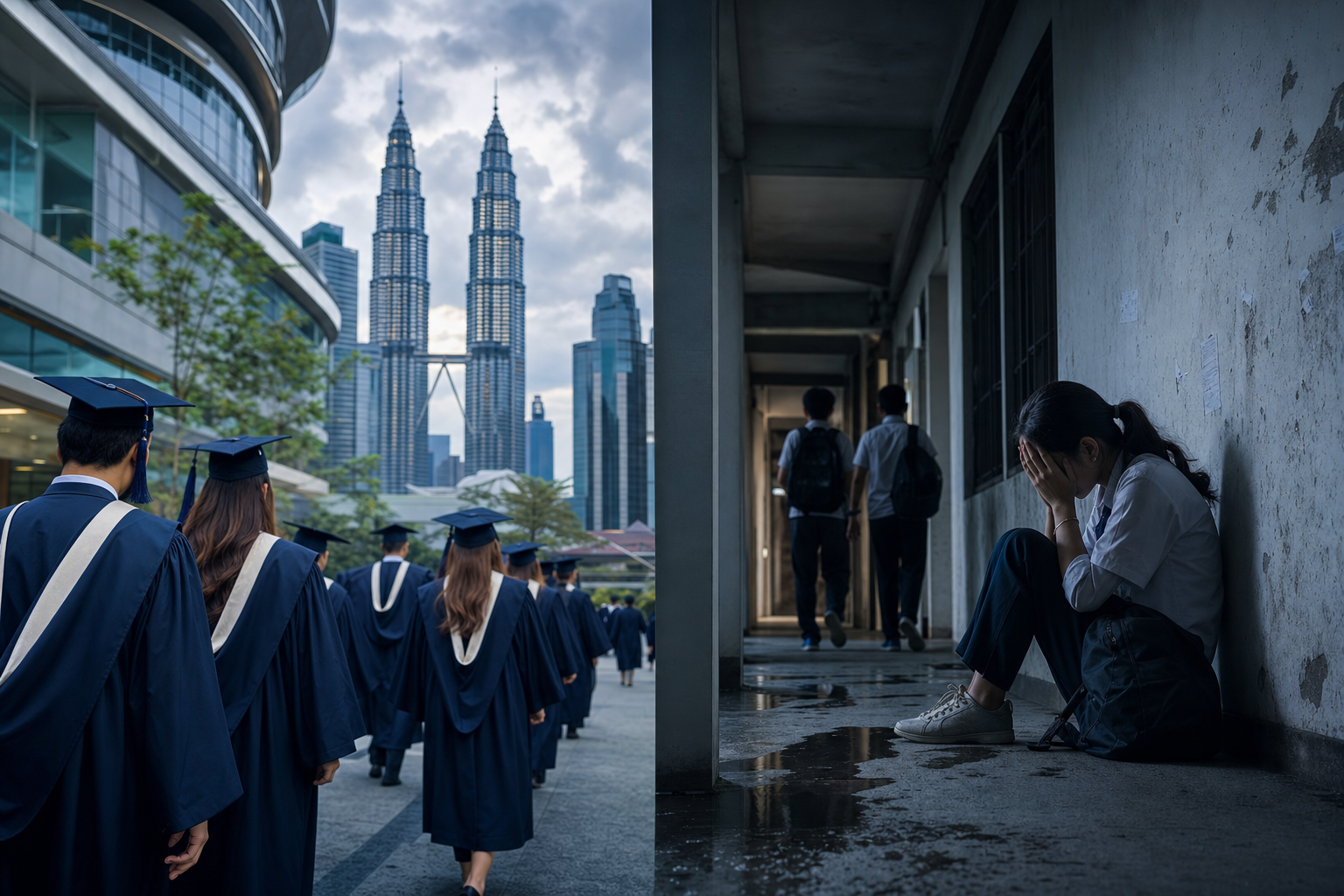
Malaysia's universities are chasing international benchmarks while the ministry scrambles to respond to viral misconduct scandals — the gap between the brochure and the reality has never been wider.
Ada benda yang aku perasan belakangan ni. Setiap kali kita bercakap pasal pendidikan Malaysia, ada dua cerita yang selalu berjalan serentak — cerita atas pentas, dengan sijil akreditasi dan digital transformation, dan cerita belakang tabir, di mana refugees tak dapat sekolah, skandal misconduct kena viral dulu baru tindakan diambil, dan rakyat biasa tertanya-tanya sama ada sistem ini langsung peduli dengan mereka.
Both stories are real. Both are Malaysia in 2026.
The Accreditation Story Is Real — But Incomplete
Let's give credit where it's due. Malaysian higher education has genuinely met international standards under MQA oversight, and that is not a small thing. Private institutions like Taylor's University, Sunway University, and UCSI have spent years building programmes that pass increasingly rigorous benchmarks. Malaysia Qualifications Agency (MQA) enforcement means our degrees carry weight internationally — yang mana penting bila graduan kita nak compete di pasaran global.
But here is what the press release will not tell you: accreditation measures input, not outcome. A university can tick every MQA box and still produce graduates who cannot write a coherent email in English or Bahasa Malaysia, graduates who have never worked on a real cross-functional project, graduates who paid RM120,000 for a piece of paper that says they are ready when they are not.
The credential exists. The competency is another conversation.
Private universities are not the only players feeling this pressure. HELP University and INTI have both pushed harder on industry-linkage programmes precisely because employers have been vocal — publicly and privately — about the gap between what universities produce and what the market needs. Yang soal bukan sama ada kita ada akreditasi. Yang soal ialah: akreditasi kepada siapa, dan untuk siapa?
When Misconduct Goes Viral, Then Gets Acted On
This one stings more, because it is about trust.
The Education Ministry recently denied that it only acts on misconduct after cases go viral — which is, honestly, exactly what you would expect a ministry to say. The problem is the pattern.
Parents and students have been documenting education-related misconduct on TikTok and X for years now. Teacher bullying. Discriminatory remarks in classrooms. Administrative corruption at the institutional level. And the cycle is consistent: incident happens, silence, clip goes viral, statement issued, "action being taken."
This is not a Malaysian problem exclusively — social media as accountability infrastructure is a global phenomenon. Tapi di sini, the institutional reflex is still reactive, bukan proactive. When the Free Malaysia Today report landed, the comments section was predictable: ramai yang skeptikal. Not because Malaysians do not want to trust the system — but because the data trail keeps contradicting the press statement.
For brands and institutions in the education space, this is a signal worth taking seriously. The era of controlling the narrative through official channels is over. Dalam dunia di mana seorang pelajar boleh post video dan dapat 2 juta views sebelum pejabat kau buka esok pagi — your reputation is now a live feed, not an annual report.
The Digital Education Shift Is Real, But Uneven
Everybody is talking about eLearning. The transformation of digital education is real — flexible, personalised, increasingly mobile-first. Monash Malaysia has been one of the more visible movers here, integrating hybrid models that take student location and schedule constraints seriously. Corporate training vendors are building multilingual modules. There is serious investment happening.
But zoom out from the KLCC-level view and the picture shifts. Rural schools are still fighting for stable internet. Refugee children — and Malaysia has roughly 180,000 registered refugees, many of school age — remain largely outside any formal system. Experts have been calling for a structured framework to manage the refugee education issue, but structural progress has been slow.
Digital education solves real problems for students who are already inside the system. It does not, by itself, solve the access problem for those who are not.
This is also where content strategy for education brands needs to mature. Most education marketing in Malaysia is still aspirational — the smiling student, the modern campus, the global partnership. Tapi the conversations happening on TikTok and in WhatsApp groups are messier: cost of tuition, job placement rates, whether a particular degree actually gets you hired. The audience has moved. The messaging has not.
For institutions wanting to meet students where they actually are, creator-led content is increasingly the bridge. Platforms like Creamatch, which connects brands with managed creator talent in Malaysia, are already fielding education sector clients who understand that a 90-second authentic video from a current student lands harder than any brochure. Authenticity is the new accreditation, at least in the court of public opinion.
What the Ground Is Actually Saying
Ada beberapa takeaways yang datang dari monitoring sentiment across platforms, termasuk dari tracking di Verbrol Pulse:
- Institutional trust is fragile. Every viral misconduct case costs the whole sector, not just the institution involved. Brand equity in education is collective.
- Access conversations are growing louder. State government commitments to education access are visible at the state level — which means communities are holding local leaders to the promise.
- eLearning adoption is real but class-stratified. Institutions serving mid-to-upper income brackets are moving fastest. The students who need flexible digital access most are still the last to get it.
- The NUS student handbag business story — where students turned a classroom idea into a S$400K business that broke even in three months — is the kind of content going viral in the education space right now. Not lecture halls. Entrepreneurship outcomes. Malaysian institutions, take note: people are no longer just asking what you teach. They are asking what your graduates do.
According to Bernama, education sector investment remains a national priority heading into the second half of 2026, with multiple ministry-level initiatives in the pipeline. The infrastructure spend is real. The question is always: does the rakyat feel it?
Dan pada akhirnya, itulah yang menentukan — bukan dalam laporan tahunan, tapi dalam perbualan ibu bapa di school gate, dalam WhatsApp group graduan yang tengah struggle cari kerja, dalam TikTok comment section yang lebih jujur daripada mana-mana public relations statement.
The education sector in Malaysia is genuinely changing. But change at the top does not automatically mean change at the bottom. The brands, institutions, and policymakers who understand this — yang faham bahawa trust is earned in the comment section, not the press release — are the ones who will still be standing in the next decade.
Semua yang lain sedang beli masa.
Track Education trends in real-time at verbrol.com
Read more on Verbrol Intelligence: