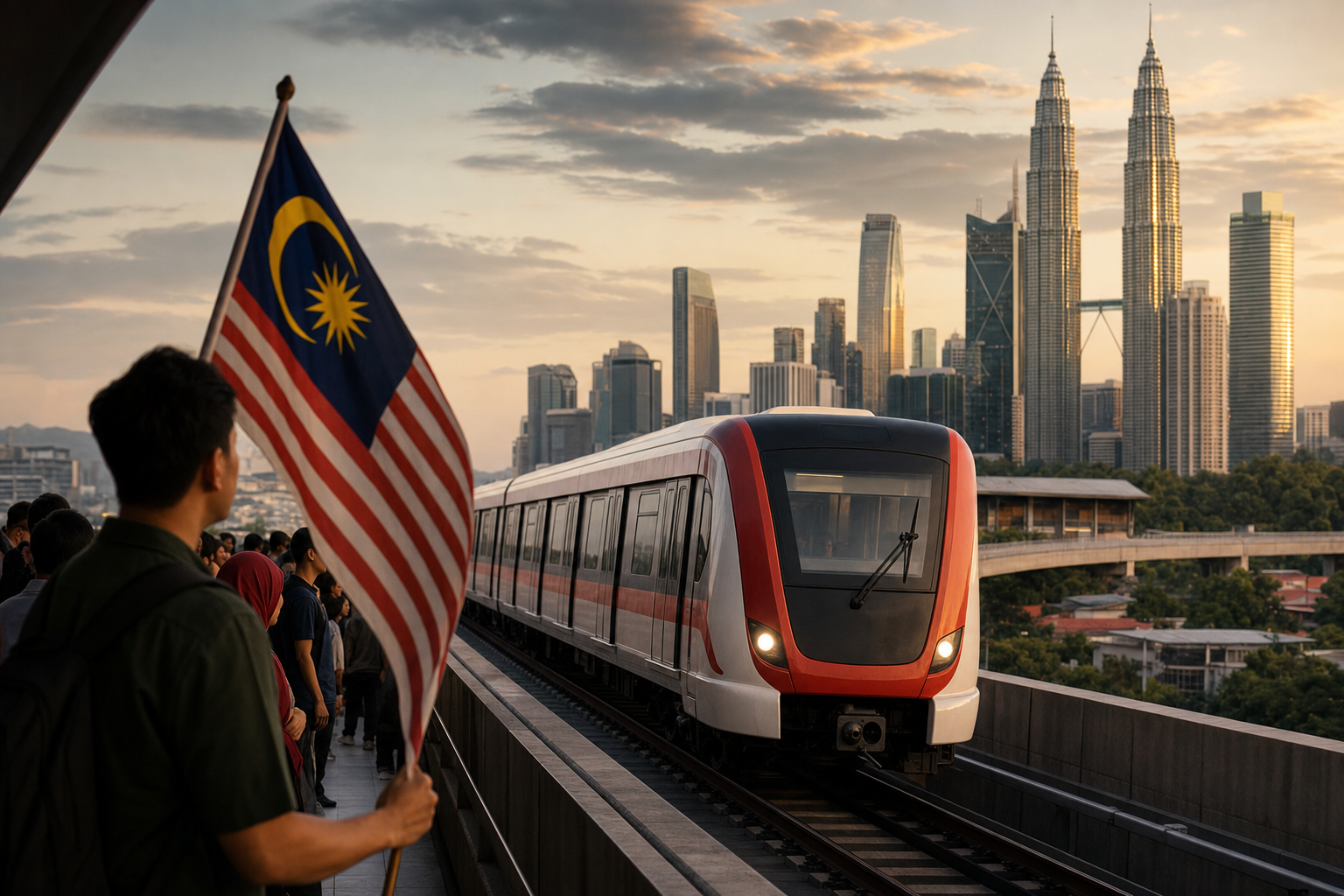
The LRT Shah Alam Line opened to up to 10,000 day-one riders. But Prasarana is already reviewing frequency — and that tells the real story.
When the doors of the LRT Shah Alam Line slid open at 6am on June 29, commuters were already waiting. Between 5,000 and 10,000 passengers rode the line on its first day of operations — a figure that, by Prasarana's own admission, is just the beginning of what the company expects to become a structurally transformative corridor for Klang Valley transit.
The number itself is notable. First-day ridership for new rail lines in Malaysia has historically been driven by curiosity as much as commuter need. But what makes the Shah Alam Line's opening signal different is the conversation that followed almost immediately: Prasarana is already talking about reviewing train frequency. That is not the language of a launch. That is the language of a system under pressure to scale.
The Frequency Problem Is Actually a Demand Signal
Prasarana confirmed it would monitor passenger flow on the Shah Alam Line, including the cascading effects on the Kelana Jaya Line where interchange points connect the two networks. Seven additional trains are due for delivery by 2028, and the operator has signalled it will adjust scheduling as ridership grows.
This sequencing tells a more interesting story than the headline ridership figure. Rail operators typically build frequency buffers into launch schedules — they run lighter timetables early and expand capacity as patterns stabilise. For Prasarana to surface frequency review discussions within the first operational week suggests demand is already testing those buffers earlier than projected.
The target of 67,000 daily riders — Prasarana's own benchmark for the Shah Alam Line at maturity — would make it one of the busier spokes in the Klang Valley network. Getting there from a 5,000 to 10,000 day-one baseline requires compounding growth, and the speed at which frequency conversations are happening suggests the ramp may be steeper than the standard adoption curve.
Shah Alam's Transit Gap Was Always Structural
Shah Alam is not a new city with an emerging commuter base. It is a long-established urban centre — home to federal government offices, a major public university, a significant industrial belt, and a residential population that has for years relied disproportionately on private vehicle usage for the final kilometre problem.
The absence of direct rail access was a known gap. What the LRT Shah Alam Line changes is not just the physical connectivity — it is the modal calculus for a commuter segment that previously had no credible reason to leave the car. When viable rail becomes available to an underserved but already dense population, ridership does not grow linearly. It tends to jump.
This is the context that gives Prasarana's early operational data its real weight. The riders who showed up on day one were not randomly distributed curious members of the public. Many were likely testing a journey they have been planning since the line's delays pushed the opening past multiple earlier target dates. Latent demand, deferred, tends to arrive concentrated.
What the Network Effect Looks Like
The Shah Alam Line does not operate in isolation. Its interchange with the Kelana Jaya Line is not just a physical connection — it is a load redistribution event for the entire western corridor of the Klang Valley rail map. Prasarana's monitoring of the Kelana Jaya Line in parallel reflects an awareness that the Shah Alam Line's success creates knock-on capacity questions elsewhere.
This is a sophisticated operational challenge, and it is also an opportunity. Network effects in urban transit tend to be self-reinforcing. More riders on the Shah Alam Line mean more interchange activity at connection points, which in turn increases the utility of the broader network for journeys that do not originate or terminate on the new line at all.
For Prasarana, which operates multiple lines across Kuala Lumpur and the valley, the Shah Alam Line is both a standalone service and a node that changes the value proposition of assets it already owns. The commercial and ridership upside is therefore not confined to one line's P&L — it spreads.
The 2028 Train Delivery Window Is the Real Constraint
Seven additional trains by 2028 is a two-year supply horizon in a demand environment that appears to be accelerating now. If frequency pressure is visible in week one, Prasarana's operational challenge through 2026 and 2027 is managing the gap between current rolling stock capacity and the moment those additional units arrive.
How the operator manages that window — through timetable optimisation, platform management, and interchange load balancing — will determine whether the Shah Alam Line consolidates its early ridership or loses commuters back to the car because the experience degraded under crowding.
The line is open. The early numbers are strong. But Prasarana's real test is not the launch — it is whether the system can hold demand long enough for supply to catch up.
Related Reading
- UTAR's Quiet Strength: Why Malaysia's Largest Chinese-Founded University Is Built for Economic Uncertainty
- EdgeProp's Listing Breadth Tells a Story the Headlines Don't: Malaysia's Property Market Is Moving in Every Direction at Once
- Stadium, Saman, dan Soal Reputasi: MRCB Berhadapan Ujian Lebih Besar Daripada Sekadar Mahkamah
- Gas Malaysia Cipta Sejarah Asia Pasifik, Tapi App Sendiri Pun Tak Boleh Log Masuk
Frequently Asked Questions
When did the LRT Shah Alam Line open to the public? The LRT Shah Alam Line officially opened on June 29, with doors sliding open at 6am for its first commuters. Between 5,000 and 10,000 passengers rode the line on its inaugural day of operations.
How many passengers rode the Shah Alam Line on its first day? Prasarana recorded between 5,000 and 10,000 passengers on the Shah Alam Line's first day of service. The operator has indicated this is expected to grow significantly as the line becomes a key transit corridor in the Klang Valley.
Will Prasarana increase train frequency on the Shah Alam Line? Yes, Prasarana has confirmed it will monitor passenger flow and review train frequency on the Shah Alam Line in response to growing demand. Seven additional trains are scheduled for delivery by 2028 to help expand capacity as ridership increases.
Does the Shah Alam Line connect to other LRT lines in Kuala Lumpur? The Shah Alam Line connects to the existing Kelana Jaya Line through interchange points, linking the two networks for commuters. Prasarana has stated it is monitoring the impact of Shah Alam Line ridership on passenger flow at these shared interchange stations.
Why is Prasarana already talking about adjusting the Shah Alam Line schedule so soon after launch? Prasarana raised frequency review discussions within the first operational week, which signals that demand is already outpacing the lighter timetable typically used during a new line's launch phase. Rail operators normally build in frequency buffers early on, so early scheduling discussions suggest stronger-than-expected passenger uptake.