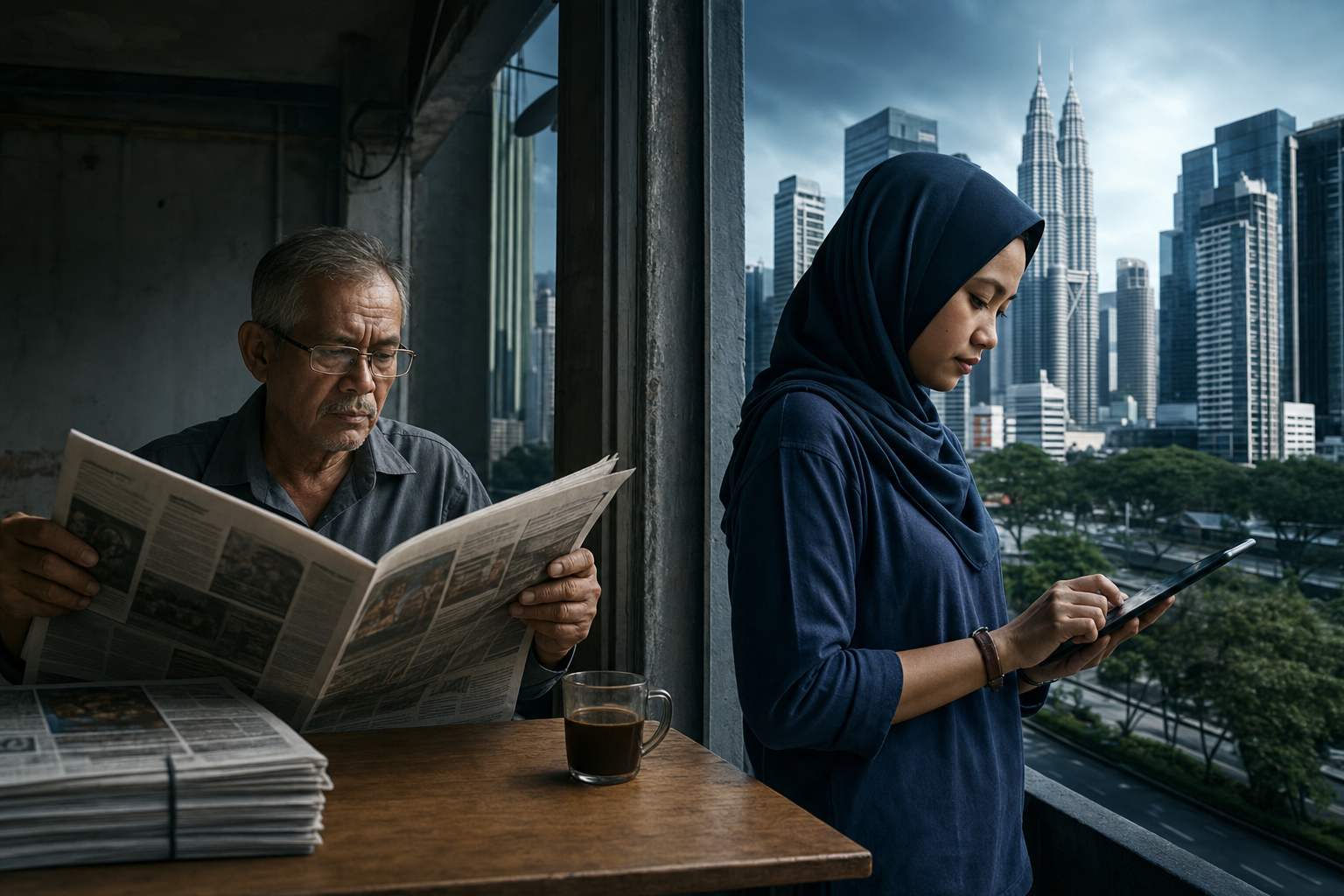
Harian Metro is quietly running print and e-Paper tracks in parallel — and the week's signals reveal a bundling strategy worth watching closely.
Harian Metro's Dual-Track Survival: How Malaysia's Tabloid Giant Is Playing Both Sides of the Print-Digital Divide
By Priya Menon
When a legacy newspaper reminds its followers to grab a physical copy at the kedai and offers a subscription link in the same breath, that is not confusion — that is strategy.
Harian Metro, the NSTP-owned Malay-language tabloid that has dominated street-level readership for decades, is doing something quietly interesting right now. Rather than abandoning print in the breathless rush toward digital-first that has consumed much of the regional media industry, it is running both tracks simultaneously — and the market signals from the past week suggest the approach is holding its own, at least in terms of audience engagement.
The Dual-Format Play
Every morning this week, Harian Metro pushed out near-identical messaging: get the print edition at your local store, or subscribe to the e-Paper at subscription.nstp.com.my. The phrasing is deliberate. It does not treat the e-Paper as a consolation prize for those who missed the physical copy. It presents both as valid, coequal choices — a subtle but telling signal about how the brand is positioning itself internally.
This dual-track publishing model is increasingly rare. Most legacy media players in Southeast Asia have collapsed their print operations or dramatically reduced frequency, betting entirely on digital revenue streams. NSTP's decision to keep Harian Metro's physical edition front and centre — while simultaneously building out an e-Paper subscription pipeline — reflects a calculated read on their core readership demographics, many of whom still associate the brand with the tactile experience of a tabloid in hand.
The e-Paper push, funnelled through a centralised NSTP subscription portal, also points toward something strategically significant: bundling. A single subscription infrastructure for multiple NSTP titles — including Berita Harian and New Straits Times — means Harian Metro is not just selling itself; it is an anchor tenant in a broader media bundle play.
Content as Brand Signal: The Hockey Captain Story
Among the week's editorial output, one story cut through: the profile of a former national hockey captain turned successful entrepreneur. On the surface, it reads as a human-interest feature. But editorially, it represents a content direction that Harian Metro has been leaning into with increasing confidence — aspirational Malay narratives that celebrate local success stories without the political baggage that dominates competitors' front pages.
This is not accidental. In a media environment where trust in news institutions has been eroded by perceived political alignment, stories about a hockey-player-turned-businessman are low-controversy, high-shareability content. They travel well on social platforms, generate warm sentiment, and keep the brand associated with community pride rather than partisan conflict. For a title carrying mixed sentiment signals this week — 30 mentions, mood uneven — this kind of content acts as an emotional stabiliser.
The MetroTV Dimension
Every social post this week was tagged with both #HMETRO and #METROTV — a consistent cross-branding exercise that underscores the video extension of the Harian Metro franchise. MetroTV represents the brand's attempt to capture the audience segment that has migrated from print to video content consumption, particularly on mobile.
The consistent dual-tagging is not just administrative housekeeping. It is brand architecture in action, training audiences to associate the Harian Metro identity with a broadcast persona, not merely a newspaper. In tech terms, it is the media equivalent of a platform expanding its surface area — the same core brand, multiple consumption interfaces.
This matters for the advertising equation. Brands buying Harian Metro's audience are, in theory, not buying a newspaper readership. They are buying access to a cross-platform community that spans print, e-Paper, web (hmetro.com.my), and video. Whether NSTP is successfully monetising this bundled reach is a separate question — but the infrastructure for the pitch is clearly being built.
What the Mixed Sentiment Actually Means
Thirty mentions in a week with mixed sentiment is neither alarming nor celebratory — it is the murmur of a brand that remains part of the daily conversation without dominating it. For a tabloid of Harian Metro's age and reach, relevance without virality might actually be the sustainable play. Viral moments burn bright and fade. Consistent daily cadence — show up, deliver the summary, remind people where to subscribe — compounds quietly over time.
The real test for Harian Metro is not whether it can trend. It is whether the e-Paper subscription base is growing fast enough to offset the structural decline in physical circulation that every print title in the world is experiencing. NSTP has not disclosed granular subscription figures publicly, but the frequency and consistency of subscription call-to-actions this week suggests the funnel is being worked hard.
For a 40-year-old tabloid navigating a fractured attention economy, that kind of unglamorous, methodical digital conversion work may prove to be its most important editorial decision yet — one made not in the newsroom, but in the product team.
Priya Menon covers media, technology and digital economy for this publication.
Related Reading
- The Edge Malaysia Is Quietly Becoming the Intelligence Layer Malaysia's Capital Markets Can't Ignore
- Unifi Di Persimpangan: Antara Ambisi Perniagaan dan Kepercayaan Pelanggan
- The Malaysian Reserve dan Pertaruhan Liputan Teknologi: Bila Media Tradisional Memeluk Masa Depan
- Utusan Malaysia dan Permainan Baru Media Digital: Bila Berita Bola Sepak, Politik, dan Jenama Berkumpul di Satu Platform
Frequently Asked Questions
What is Harian Metro and who owns it? Harian Metro is a Malay-language tabloid newspaper based in Malaysia that has long dominated street-level readership in the country. It is owned by the New Straits Times Press (NSTP), one of Malaysia's oldest and most established media companies.
Is Harian Metro still printing a physical newspaper? Yes, Harian Metro continues to publish a physical print edition available at local stores, while also offering a digital e-Paper subscription through subscription.nstp.com.my. Unlike many regional media outlets that have shifted entirely to digital, Harian Metro is actively maintaining both formats simultaneously.
How is Harian Metro adapting to the digital age? Harian Metro is running a dual-track publishing strategy, promoting both its print edition and its digital e-Paper subscription as equal, coexistent choices for readers. This approach contrasts with most Southeast Asian legacy media outlets, which have largely reduced or eliminated their print operations in favor of digital-only models.
What language is Harian Metro published in? Harian Metro is published in the Malay language, making it one of the leading Malay-language tabloids in Malaysia. Its wide street-level readership reflects its strong connection to everyday Malaysian audiences.
What makes Harian Metro's publishing strategy different from other newspapers in Southeast Asia? While most legacy media players in Southeast Asia have dramatically scaled back or abandoned print in favor of digital revenue streams, Harian Metro continues to treat its physical and digital editions as equally valid offerings. This dual-format approach is described as increasingly rare in the regional media landscape, positioning NSTP's tabloid as something of an outlier in the industry's broader shift away from print.