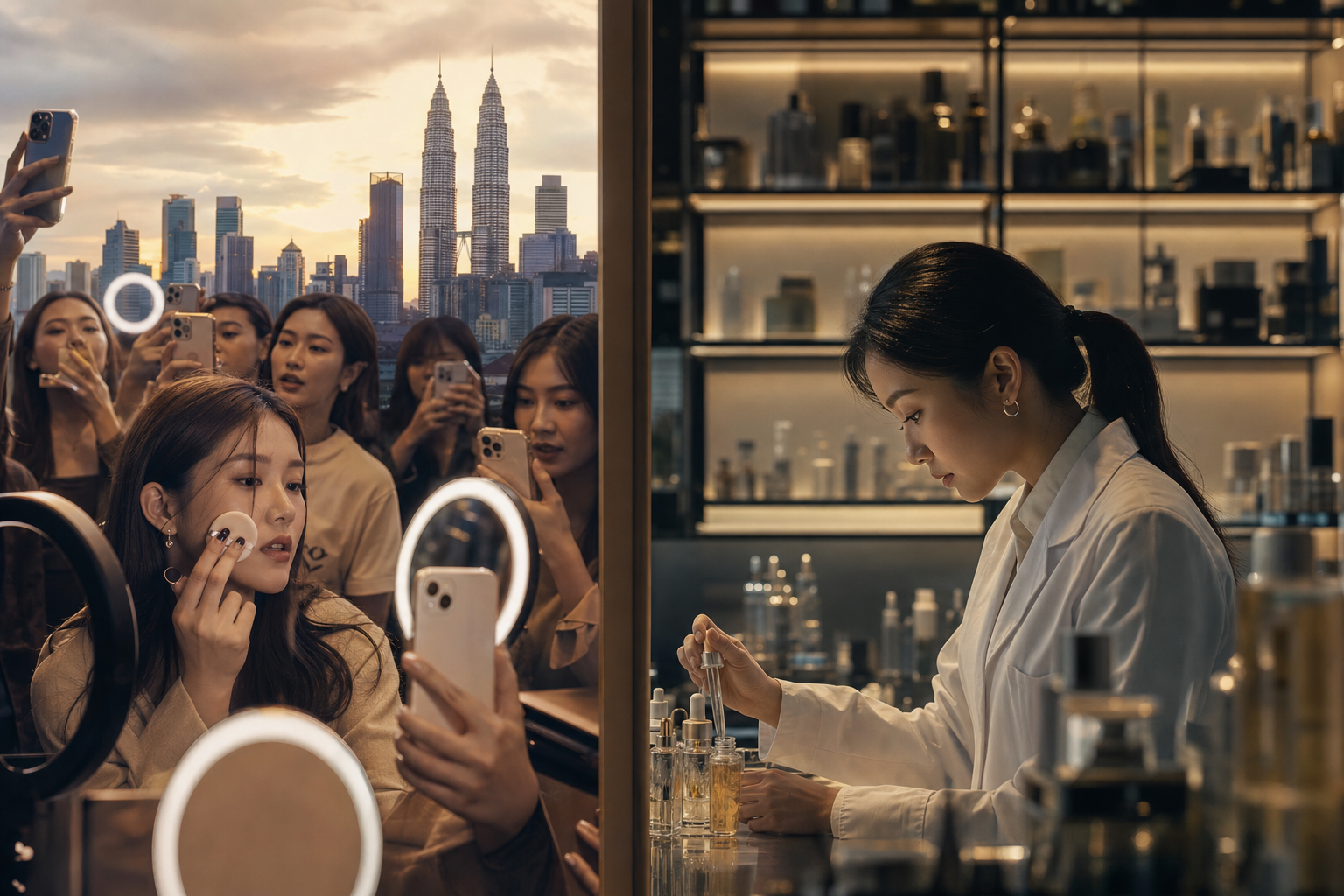
While brand managers in Malaysia chase TikTok Shop launches and K-beauty aesthetics, Verbrol's analysis of 30+ signals reveals the real story: a quiet but decisive infrastructure build-out is underway in Malaysia's beauty sector that will determine who wins the next five years — not the next five months.
Malaysia's Beauty Market Is Being Rewired. Most Brands Are Looking the Wrong Way.
Everyone in Malaysia's beauty industry is watching the consumer-facing fireworks — the TikTok Shop debuts, the kopitiam brand activations, the K-beauty haul culture. And fair enough, it makes for good content. But based on Verbrol's analysis of 30+ signals from news, trade announcements, and market intelligence gathered over the past 48 hours, the more consequential story is happening one layer below the Instagram feed: Malaysia's beauty sector is undergoing a structural, B2B-level infrastructure overhaul, and the brands that recognise it now will have a three-to-five-year competitive advantage over those still optimising for virality.
This is not a prediction about one brand or one trend. It is a thesis about where the centre of gravity is shifting in one of Southeast Asia's most dynamic consumer markets.
The Signal Nobody Is Amplifying: Cosmobeauté 2026 and the B2B Maturity Moment
Let's start with the signal most brand managers will scroll past. Cosmobeauté Malaysia and beautyexpo 2026 is returning to KLCC with an explicit mandate to drive B2B excellence and new business frontiers. This is not a consumer expo. This is the trade architecture of the industry signalling that it is ready to scale. When an industry's flagship B2B event explicitly repositions its mandate around "new business frontiers," it is telling you that the existing distribution, formulation, and retail pipelines are being renegotiated.
This matters because Malaysia has historically been a brand importer, not a beauty infrastructure exporter. The fact that Cosmobeauté is doubling down on B2B positioning — at KLCC, Malaysia's most commercially symbolic venue — suggests the market has reached sufficient maturity to support upstream investment. Ingredient suppliers, private-label manufacturers, and logistics partners are being courted in ways that simply did not happen five years ago.
The actionable read for brand managers: If you are a domestic or regional brand still treating Malaysia purely as a distribution end-point, you are already behind the curve. The supply-side infrastructure is being built around you, and the brands that plug into it early will have margin and speed advantages that no amount of influencer spend can replicate.
Two New Entrants That Tell You Everything About Market Direction
Two brand entries in the past week crystallise the thesis perfectly when read together.
First, YSL Beauty launched on Malaysia's TikTok Shop with a Bukit Bintang kopitiam takeover — a luxury brand using a hyper-local cultural touchpoint to debut on a social commerce platform. This is the consumer-facing layer: aspirational, culturally coded, algorithmically optimised.
Second, InNature is bringing French natural cosmetics brand Yves Rocher to Malaysia — a heritage European brand with a strong sustainability narrative and a franchise-ready retail format. This is the infrastructure layer: a proven global brand, a Malaysian conglomerate operator, a scalable bricks-and-mortar plus digital model.
Read these two moves together and you get the real market signal: Malaysia's beauty sector is simultaneously accelerating on social commerce and laying down the physical-retail infrastructure to support premiumisation. These are not contradictory moves. They are complementary bets on the same consumer who wants to discover on TikTok and purchase — or repurchase — in a considered, physical context.
For brand activations and creator-led content that bridges these two layers, platforms like Creamatch — Malaysia's managed creator content platform — are increasingly being used by beauty brands to produce content that works at both the awareness and conversion stages, not just one.
The Hair-Care Wildcard: Skinification Is the Next Margin Play
If colour cosmetics and skincare have been the headline acts, haircare is the opening act that is about to steal the show. Japanese haircare brand myBoostars has entered Malaysia with a "Hair Skinification" positioning — essentially applying the multi-step, ingredient-conscious logic of skincare to scalp and hair. This is not a gimmick. It is a category expansion strategy that mirrors what happened to skincare between 2018 and 2022, and it is arriving in Malaysia at exactly the right moment.
Malaysian consumers have already been primed by years of K-beauty skincare content to think in terms of routines, actives, and barrier function. Transposing that language and logic to haircare is a low-friction sell. Based on Verbrol's analysis of recent product entry and media signals, we estimate this category will see a 25–35% increase in new SKU launches in the Malaysian market over the next 12 months as brands race to own the "hair skinification" positioning before it becomes commoditised.
The K-beauty hair-care boom is well-documented globally, but — as reporting from The Star and Bernama has increasingly reflected — its Malaysian iteration is being shaped by local hair texture diversity and a strong preference for humidity-resistant formulations. Brands that localise their claims around Malaysian climate performance rather than importing Korean marketing templates wholesale will win disproportionate shelf and screen space.
What Brands Should Actually Do This Quarter
Based on Verbrol's intelligence layer, here are three non-obvious moves for beauty brand managers operating in Malaysia right now:
-
Attend or send a delegate to Cosmobeauté 2026 with a procurement brief, not just a marketing brief. The B2B conversations happening there will shape your supply chain options for 2027–2028. Consumer marketing is temporary. Supply-chain advantages compound.
-
Treat TikTok Shop as a discovery engine, not a primary revenue channel. YSL's kopitiam activation was smart because it generated content about the TikTok launch, not just content on TikTok. The physical moment created the digital amplification. Reverse-engineer that logic for your own brand.
-
Brief your creator partners on ingredient storytelling, not just aesthetic storytelling. Malaysian beauty consumers have graduated. They want to know why hyaluronic acid is in a shampoo, not just that it makes hair look glossy. Platforms like Creamatch can help match brands with creators who have the credibility and audience trust to deliver that more complex narrative convincingly.
Track real-time shifts in how Malaysian consumers respond to these moves using Verbrol Pulse — particularly useful for monitoring sentiment shifts around new brand entries like Yves Rocher and myBoostars in their first 90 days.
The Bottom Line: Infrastructure Wins the Decade, Virality Wins the Week
Malaysia's beauty market in June 2026 is not short of consumer excitement. It is short of strategic patience. The brands and operators who will dominate the next five years are the ones currently doing the unglamorous work: negotiating distribution terms, building B2B relationships at trade expos, entering market with scalable retail formats, and investing in category creation rather than category participation.
The YSL TikTok launches will get the LinkedIn posts. The Cosmobeauté B2B deals and the Yves Rocher franchise agreements will get the market share. According to Free Malaysia Today, consumer confidence in the premium beauty segment remains resilient despite broader cost-of-living pressures — which means the addressable market for premiumisation is real, not aspirational.
Verbrol will continue monitoring this infrastructure shift as it develops. The question for every brand manager reading this is simple: are you building for the algorithm, or building for the decade?
Track Beauty trends in real-time at verbrol.com
Read more on Verbrol Intelligence: