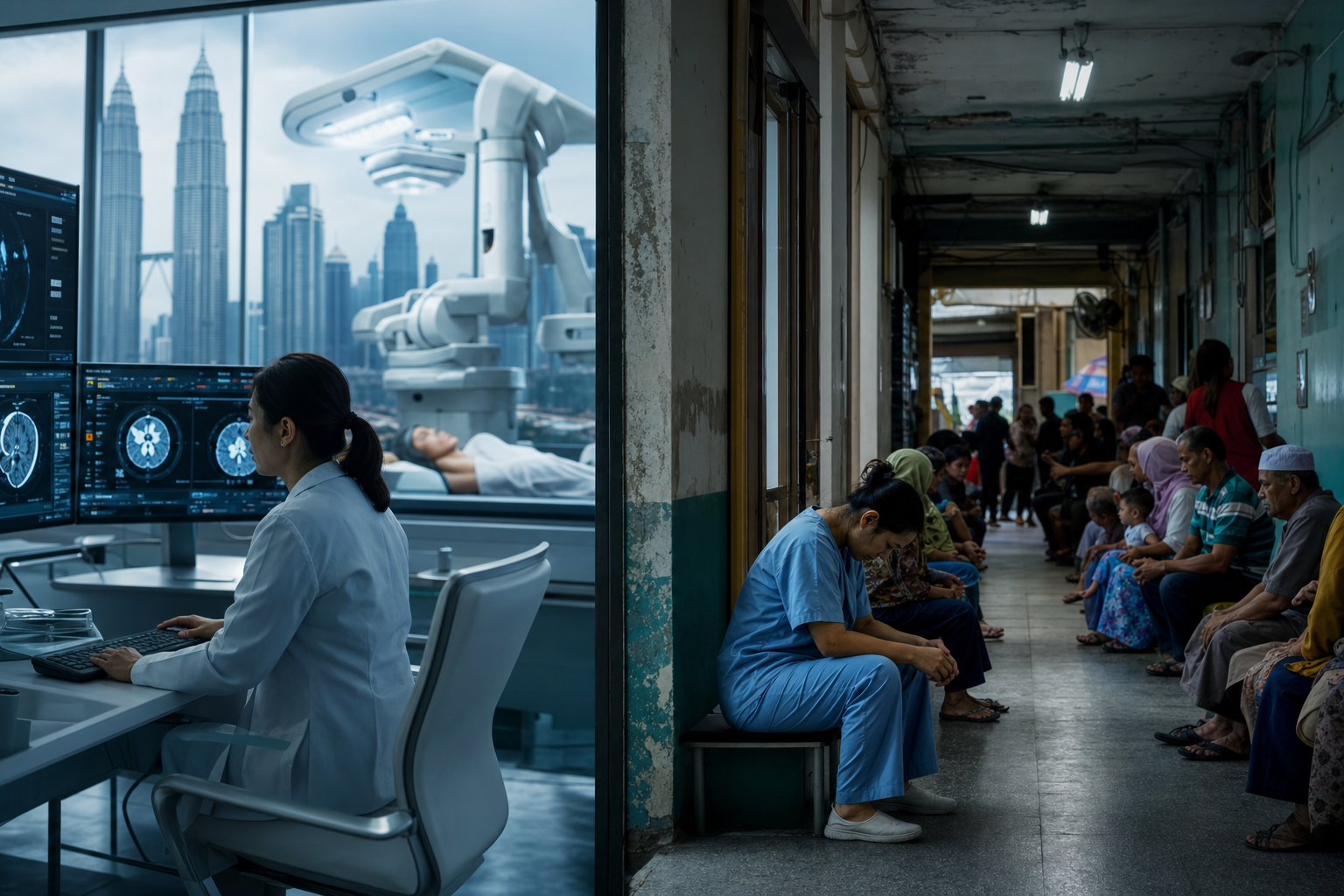
Malaysia is simultaneously launching AI-powered cancer care systems and hemorrhaging healthcare workers due to budget austerity. Based on Verbrol's analysis of 16+ signals, this is not a transition story — it is a two-speed collapse dressed up as progress.
Malaysia's Health Sector Is Being Upgraded at the Top and Hollowed Out at the Bottom
There is a version of Malaysia's healthcare story being told right now that is genuinely impressive. Pantai Hospital Kuala Lumpur just launched an AI-powered adaptive radiotherapy system for personalised cancer care — a genuinely world-class deployment. The medical takaful base plan pilot is on track for July launch, promising to extend insurance access to underserved Malaysians. And AirAsia has inked a partnership with HYROX to position fitness travel as a mainstream lifestyle category across Asia Pacific.
That is the headline version. Now here is what Verbrol's analysis of 16+ signals from news, YouTube, and event data actually shows: beneath this glossy surface, Malaysia's health system is being systematically defunded, its frontline workforce is migrating overseas, dengue is surging to near-record levels, and the incoming El Niño cycle is about to make all of it worse. This is not a transformation story. This is a two-speed collapse dressed up as progress.
The Budget Cut Nobody Is Talking About Loudly Enough
Let's start with the signal that should be dominating every boardroom conversation in the Malaysian health and insurance sector, but isn't. CodeBlue's analysis of Malaysia's healthcare budget reductions describes the situation plainly: these cuts are sounding a "death knell" for the public health system. That is not hyperbole from a fringe publication. CodeBlue is Malaysia's most credible health journalism outlet, and the language they are using is categorical.
The ground-level confirmation is already visible in social media. A YouTube comment picked up in Verbrol's monitoring — "Jururawat Malaysia ramai yang menerima tawaran kerja di negara yang lebih besar gajinya" — with 4 engagements is a small but telling signal. Nurses are being recruited away to higher-paying systems in Singapore, the Gulf, and Australia. When you reduce healthcare budgets while neighbouring countries are actively poaching your trained workforce, you are not trimming fat. You are removing structural muscle.
According to the Ministry of Health Malaysia, the public system is already stretched across primary, secondary, and tertiary care. Budget compression at this juncture does not just slow growth — it accelerates the private-public divide. High-net-worth Malaysians access AI radiotherapy at Pantai. Everyone else joins a longer queue in an understaffed clinic.
The actionable read for brand managers and health sector strategists: the private healthcare and insurance market is about to absorb demand that the public system cannot serve. This is a structural demand shift, not a cyclical one.
Dengue Is Not a Background Risk — It Is a Foreground Crisis
Dengue deserves more airtime than it is currently receiving from Malaysia's marketing and brand intelligence community. Malaysia now records the third-highest dengue caseload in ASEAN, according to Health Minister Dzulkefly Ahmad. Cases are up over 20% nationwide in recent weeks, and the Minister has confirmed this is consistent with a four-to-five year cyclical surge pattern. It is not an anomaly. It is a predictable event that arrived on schedule.
More pressingly, a stronger El Niño is forecast to bring drier weather and compounding health risks to Malaysia toward year-end. That combination — a dengue surge underway now, plus an El Niño-driven dry spell increasing stagnant water zones in urban areas — creates a compounding public health risk window from Q3 through Q4 2026.
For health brands, insurers, wellness platforms, and consumer goods companies: the demand signal for vector-borne disease prevention, diagnostics, and related insurance products is not speculative. It is evidence-based and time-bound. Campaigns built around dengue awareness and prevention between July and November 2026 will land in a context of acute public concern. The World Health Organization's guidance on dengue prevention remains the authoritative benchmark for any brand messaging in this space — precision and accuracy matter when consumers are genuinely anxious.
The Wellness Economy Is Real — But It Is Serving the Wrong Segment
Based on Verbrol's analysis of 16+ signals from news, YouTube, and Eventbrite Malaysia data, there is a parallel health economy running on an entirely different track from the public crisis described above. The APHM International Healthcare Conference and Exhibition 2026 is on the radar for industry professionals. AirAsia's HYROX partnership is mainstreaming fitness as a travel identity marker. Social media is generating its own micro-health economy — from "spermmaxxing" content monetising male fertility anxiety, to the "Hollywood dose" Accutane microdosing trend going viral, to a YouTube commenter on a price-comparison video earning 3 engagements by wishing a seller good health and prosperity.
That last signal is small but culturally significant. Malaysian social media users are associating economic value — a good price — with health and blessed prosperity in the same sentence. Health is not being discussed purely clinically. It is becoming a social currency.
The wellness economy is growing. But it is largely serving urban, digitally active, middle-to-upper-income Malaysians. Health advocates cited in recent news are pushing for the government to reward Malaysians who practise healthy lifestyles — suggesting grocery subsidies and transport discounts tied to fitness targets like 10,000 daily steps. That proposal, whether it advances policy or not, signals that there is now serious mainstream appetite for incentivised preventive health.
For brands operating in the wellness, fitness, nutrition, or health tech space, the strategic window is in bridging mass-market access with premium positioning. Creator-led content is the mechanism that closes that gap most efficiently. Platforms like Creamatch, Malaysia's managed creator content platform, are positioned to connect health brands with authentic, audience-matched creators who can translate complex health messaging into culturally resonant content — particularly important in a market where health anxiety is high but institutional trust is under pressure.
The Thesis: Malaysia's Health System Has a Two-Speed Problem That Is About to Become a Brand Liability
Verbrol's original read of this data landscape is this: Malaysia is building a premium health layer on top of a deteriorating public foundation, and in 2026, the gap between the two is going to become impossible to ignore.
For marketers, this creates a specific risk. Brands in the health, wellness, and insurance categories that position exclusively around premium innovation — AI diagnostics, personalised medicine, fitness travel — will face credibility pressure as the public health crisis becomes more visible through dengue headlines, nurse emigration stories, and budget cut coverage. The two narratives will collide in consumer perception.
The brands that win this cycle are those that acknowledge both realities: that innovation is happening and that the baseline system is under stress. Medical takaful expansion, preventive health incentives, and accessible wellness content are the product and messaging territories that sit credibly across both tracks.
Monitor the Verbrol Pulse for real-time health sector sentiment shifts — particularly around dengue case trajectory, budget debate coverage, and medical takaful uptake signals as the July pilot launches. The next 90 days in Malaysian health are not a quiet period. They are a decision window.
What Marketers Should Do Right Now
- Dengue is a campaign opportunity with a hard time window. Brands in diagnostics, insurance, home hygiene, and public health education should be activating between July and October 2026, not after the peak.
- Takaful expansion is the biggest underreported growth signal in Malaysian health insurance. The July pilot launch is not a trial — it is the start of a structural market expansion. Brands that build trust now will own the segment later.
- Nurse brain drain is a reputation risk for the public system and a demand driver for private care. If you are a private hospital or health platform, the data supports aggressive positioning on service quality and workforce investment.
- Wellness content needs mass-market credibility, not just premium aesthetics. Use managed creator ecosystems like Creamatch to ensure your health messaging reaches the right segments with the right voice.
- Track compounding climate-health risks. El Niño plus dengue plus budget austerity is not three separate stories. It is one converging risk narrative that will shape public health sentiment in Malaysia through Q4 2026.
For deeper cross-sector signal tracking and Southeast Asian market intelligence, explore what Verbrol monitors across news, social, and event data in real time.
Track Health trends in real-time at verbrol.com
Read more on Verbrol Intelligence: