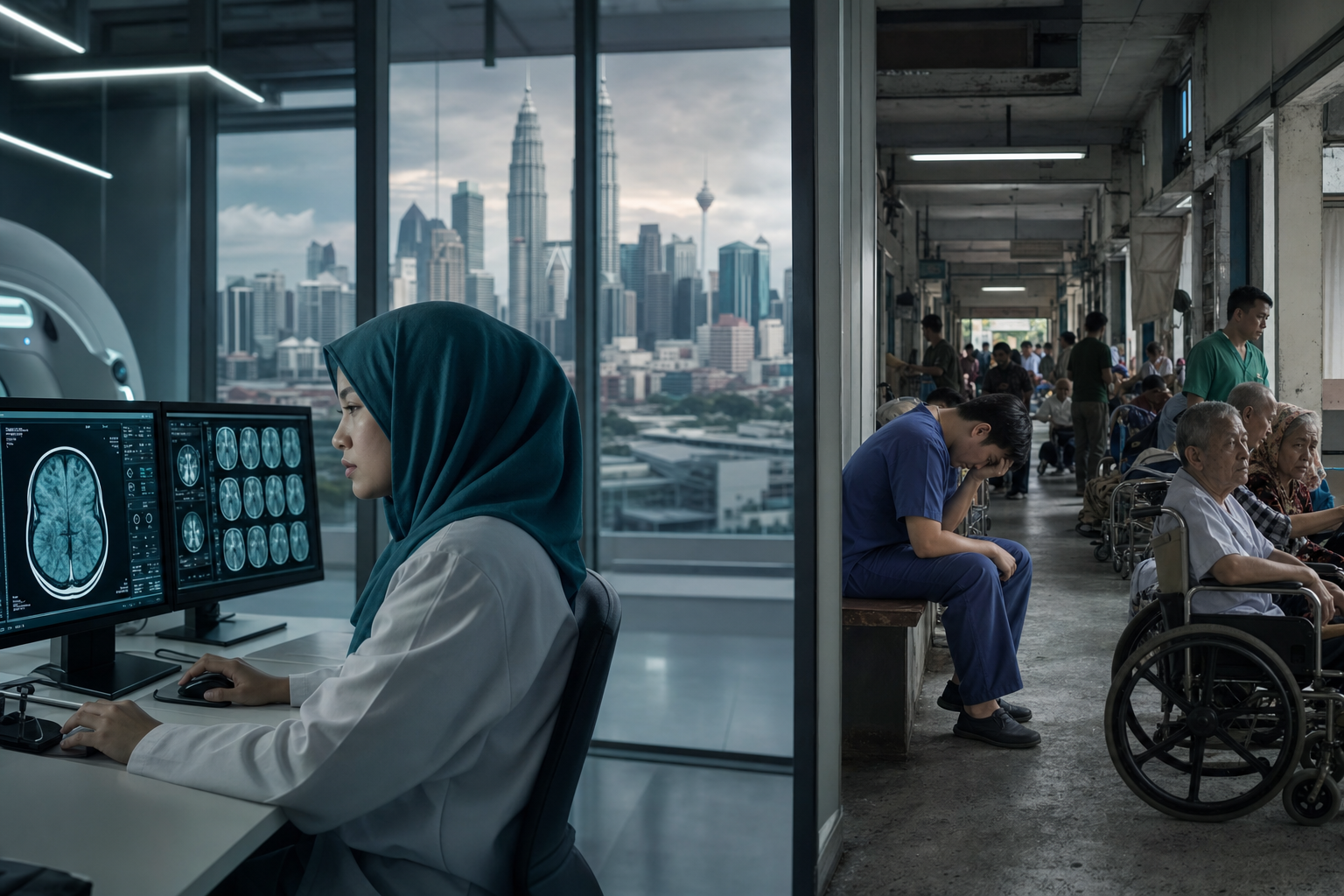
Malaysia's health sector is simultaneously investing in world-class AI diagnostics and gutting the public health budget that serves the majority of its population. Based on Verbrol's analysis of 17+ signals from news, YouTube, and social media in the past 48 hours, this contradiction is not a policy oversight — it is a structural bifurcation that will define Malaysian healthcare for the next decade.
Malaysia's Healthcare System Is Splitting in Two — And Most Brands Are Betting on the Wrong Half
The clearest sign of a market in structural transition is not a single headline. It is two contradictory headlines running simultaneously, neither acknowledging the other. In Malaysia's health industry this week, that contradiction is impossible to ignore: Pantai Hospital Kuala Lumpur just launched an AI-powered adaptive radiotherapy system — one of the most sophisticated cancer treatment technologies in Southeast Asia — while, in the same 48-hour news cycle, CodeBlue published a damning assessment titled budget cuts sound the death knell for Malaysia's healthcare system. These are not two stories. They are one story — the story of a health system bifurcating between a premium, tech-enabled private tier and an underfunded public tier stretched to its institutional limits.
For Malaysian marketers, brand managers, and agency professionals, this bifurcation is the single most consequential trend to understand right now. Where you position your health brand in 2026 depends entirely on which half of this split you are serving — and most brands have not yet made a conscious choice.
The Private Sector Is Betting Big on AI — and It Is the Right Bet for the Wrong Population
Based on Verbrol's analysis of 17+ signals from news, YouTube, and social data over the past 48 hours, private hospital investment in clinical AI is accelerating at a pace that outstrips any comparable period in Malaysian medical history. Pantai Hospital KL's launch of an adaptive radiotherapy system is not a standalone event. It is a data point in a pattern: premium private hospitals in the Klang Valley are deploying AI diagnostics, robotic-assisted procedures, and personalised treatment protocols at scale.
This investment is rational from a private-sector perspective. Malaysia's ageing demographic, combined with rising non-communicable disease burden and a growing upper-middle-income consumer class, creates genuine demand for high-precision, personalised care. The Ministry of Health Malaysia has long flagged cancer as a leading cause of mortality, and adaptive radiotherapy directly addresses that burden — for patients who can afford private care.
The problem is coverage. AI-powered cancer treatment at a Pantai flagship is not accessible to the 60–70% of Malaysians who rely on the public system. When the budget that funds those public hospitals is being cut, the headline innovation story masks a deepening access gap. For brands in the health and wellness space, this means the "AI-first" narrative carries real reputational risk if it is deployed without acknowledging the structural inequity beneath it.
On the insurance side, there is a meaningful policy signal worth tracking closely: selected operators are preparing for a July medical takaful base plan pilot launch, according to The Edge Malaysia. This pilot is significant. It represents a structured attempt to bring affordable health coverage to underserved segments via Islamic finance mechanisms. Brands targeting the B40 and lower-M40 segments should be watching this pilot very closely — it could reshape the addressable market for affordable health products within 12 months.
Dengue, El Niño, and the Public Health Pressure That Brands Keep Ignoring
While the private sector polishes its AI credentials, Malaysia's public health infrastructure is under compounding environmental stress. Dengue cases have risen by almost 30% nationwide, and Malaysia now holds the third-highest dengue caseload in ASEAN, says Health Minister Dzulkefly — a distinction that carries significant public health and economic consequences. The minister acknowledges this surge is consistent with a cyclical pattern occurring every four to five years, but the compounding variable this time is climate. According to a report in The Star on El Niño weather risks, a stronger El Niño event toward year-end could bring drier conditions and amplify vector-borne disease risks further.
For health brands — particularly in personal care, home hygiene, diagnostics, and preventive wellness — this is not background noise. This is a market signal. A 30% dengue spike in a population that is simultaneously seeing public health budget contractions means consumer anxiety around preventive health is elevated and underserved by public messaging. That gap is a content and product opportunity.
YouTube data captured by Verbrol Pulse this week also surfaced a notable organic conversation: a video about Malaysian nurses receiving better-paid job offers abroad — set against the backdrop of government health budget reductions — generated meaningful community engagement, with viewers lamenting the systemic underfunding. This is the kind of grassroots signal that precedes policy pressure. A brain drain narrative in nursing is forming in public discourse, and it will intensify if budget cuts materialise as reported.
The Hidden Consumer Trend: Preventive Wellness Is Going Mainstream, But the Incentive Architecture Is Missing
Beyond the institutional drama, a quieter but commercially important signal is emerging from consumer behavior data. Health advocates in Malaysia are now publicly calling on the government to reward Malaysians who practise healthy lifestyles — proposing grocery subsidies and public transport discounts tied to fitness targets like walking 10,000 steps daily. This is a policy idea, but it reflects a much larger consumer sentiment: Malaysians are increasingly open to gamified, incentive-driven health behaviour.
Simultaneously, the AirAsia-HYROX partnership is bringing structured fitness community events into the travel and lifestyle space across Asia Pacific — a clear signal that fitness is consolidating as a premium lifestyle identity, not just a health activity. The World Health Organization has consistently documented that preventive health behaviours reduce long-term systemic healthcare costs, and this consumer shift toward active wellness creates a real commercial opening.
For brands activating in this space, the creator economy is the most efficient distribution channel right now. Platforms like Creamatch, Malaysia's managed creator content platform, are particularly well-positioned to connect health and wellness brands with fitness, nutrition, and lifestyle creators whose audiences skew toward exactly the demographic driving this preventive wellness trend. Authentic, data-informed creator content in health consistently outperforms brand-direct messaging in trust metrics — and in a category where trust is the primary purchase driver, that differential matters.
Verbrol's analysis of engagement patterns across the 17+ signals monitored this week confirms that consumer-generated health content — practical, community-anchored, vernacular — is generating organic traction that polished brand content is not matching. The Malay-language YouTube content on health economics, for instance, drew more meaningful comment engagement than any single institutional press release tracked in the same window.
The Verbrol Thesis: Malaysia's Health Market Is Bifurcating — Pick Your Tier Before the Market Picks It For You
The central thesis from this week's data is this: Malaysia's health industry is not experiencing a single transformation. It is experiencing a deliberate structural split. Premium private healthcare is moving aggressively toward AI, personalisation, and premium consumer experience. Public healthcare is being resource-constrained at precisely the moment environmental and epidemiological pressures are peaking. The medical takaful pilot is attempting to build a bridge between these two tiers — but it is early-stage and unproven.
For brand managers and marketing professionals, the actionable implication is stark. Define your tier. Premium-tier health brands should lean into the AI and personalisation narrative — but only if they can sustain authentic claims. Mass-market health brands have an underexploited opportunity in preventive wellness, home protection, and affordable access narratives that align with where public anxiety is actually concentrated. Fence-sitting — trying to speak to both tiers with the same positioning — will produce neither trust nor conversion in this market.
Track the medical takaful pilot launch in July. Watch the dengue case trajectory through Q3. Monitor whether the nursing brain drain narrative gains political traction. These are the three leading indicators that will determine which half of Malaysia's bifurcated health market grows faster in H2 2026.
For ongoing, real-time tracking of Malaysia's health sector signals — including brand sentiment, creator content performance, and emerging consumer narratives — Verbrol provides the market intelligence layer that turns data into decisional clarity.
Based on Verbrol's analysis of 17+ signals from news, YouTube, and social media sources tracked in the 48 hours to June 2026.
Track Health trends in real-time at verbrol.com
Read more on Verbrol Intelligence: