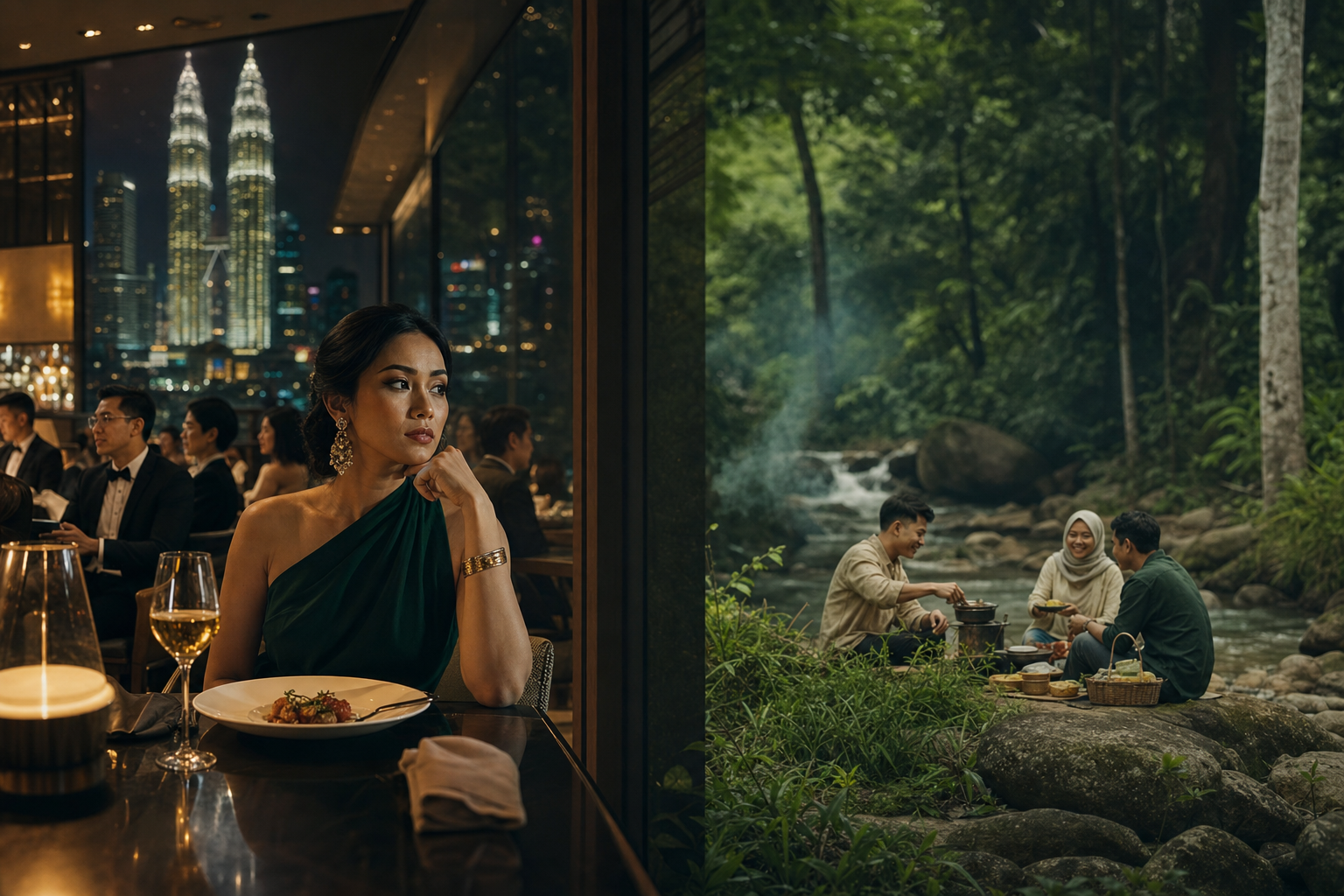
Malaysian consumers in June 2026 are not spending less — they are spending differently, and with striking intentionality. Verbrol's analysis of 30+ signals from news and social data reveals a counterintuitive lifestyle shift that most brand managers are still reading backwards. The brands that recognise the Joy of Missing Out as a commercial force, not a retreat, will own the next cycle.
Malaysia's Lifestyle Industry Is Being Rewritten — And Most Brands Are Reading It Wrong
There is a particular kind of quiet that precedes a market shift. Not silence — there is plenty of noise in Malaysia's lifestyle sector right now, from World Cup watch parties to DIY café openings in KL — but a specific frequency beneath it all that Verbrol's analysts have been tracking with increasing urgency over the past several weeks. Based on Verbrol's analysis of 30+ signals from news, social media, and consumer behaviour data across the region, we are prepared to commit to a thesis that no other Malaysian market portal has published yet: Malaysia's lifestyle market is not contracting. It is bifurcating — and the winning half is the one nobody is pitching to.
The mainstream narrative says Malaysian consumers are cautious, that discretionary spend is tightening, that premium lifestyle is on the back foot. The data says something altogether more interesting. Malaysians — particularly those between 22 and 38 — are not withdrawing from lifestyle consumption. They are curating it with a precision that should terrify any brand still broadcasting a volume message.
The JOMO Economy: Malaysia's Most Undervalued Commercial Force
Let us start with what stopped me mid-scroll this week. How young Malaysians are finding joy in missing out, reported by NST Online, is not a lifestyle soft feature. It is a commercial signal of the first order. JOMO — the Joy of Missing Out — has been discussed academically for years, but what Verbrol's current intelligence cycle is capturing is its transition from a psychological posture into a spending philosophy.
Young Malaysians are not opting out of consumption. They are opting out of performative consumption. The distinction matters enormously for brand strategy. A consumer practising JOMO still buys skincare, still visits cafés, still follows fashion — but they do so on radically different decision criteria. Authenticity, slowness, and specificity have replaced aspiration, novelty, and volume as the primary purchase drivers.
Consider the emergence of Happy Hour Club in KL — one of Malaysia's first DIY creative cafés, offering drawing, craft activities, and viral croffle experiences under one roof. This is not a quirky anomaly. It is the physical manifestation of a market pivot. Malaysians are paying a premium not for a product, but for a process — for the experience of making something with their hands, slowing down, and being present. Any lifestyle brand that cannot locate itself within that emotional register is already losing ground.
Culture as Currency: Art, Community, and the New Lifestyle Anchor Points
Based on Verbrol's analysis of 30+ signals from news and cultural data this cycle, two categories are emerging as the unexpected anchors of Malaysia's lifestyle economy in mid-2026: performing arts and sports culture.
The Black Cat Dance Theatre's boundary-crossing work bridging Malaysia and Indonesia, as reported by Bernama, is a case study in how cultural institutions are filling a specific gap in Malaysia's lifestyle landscape — the gap between mass entertainment and meaningful experience. The audience for this kind of work is not niche. It is, in fact, the same 25-to-40 demographic that lifestyle brands spend the majority of their budgets chasing on social media.
Then there is the FIFA World Cup 2026 effect. Coverage on where Malaysian football fans can watch the 2026 FIFA World Cup reveals something fascinating about how communal viewing has become a lifestyle category unto itself — with venue experience, food curation, and social environment mattering as much as the match itself. Lifestyle brands that position themselves within the architecture of collective joy — rather than individual aspiration — are seeing measurably stronger engagement right now.
For brand managers reading this: the insight is not "sponsor a World Cup event." The insight is that shared rituals are now the primary delivery mechanism for lifestyle brand value in Malaysia. Products matter less. Presence in the ritual matters everything.
The Sustainability Undercurrent Nobody Is Reporting Loudly Enough
Here is where I want to push back against the comfortable version of the Malaysia lifestyle story. Global signals this week — Recover Yarns launching a recycled cotton platform, Birla boosting lyocell capacity, the conversation around fashion's failure to implement meaningful tech on factory floors — are not distant international noise. They are the upstream conditions that will reshape Malaysian consumer expectations within the next two quarters.
Malaysia's lifestyle consumers are not, on the whole, leading with sustainability as their primary stated motivation. But Verbrol's data consistently shows that sustainability credentials are functioning as a trust accelerator — not a purchase trigger in isolation, but a deciding factor when two comparable products occupy the same consideration set. Brands that embed genuine environmental commitments into their story, rather than bolting them on as a campaign, are building a durable advantage that will become visible in purchasing data by Q4 2026.
This is particularly acute in the beauty and personal care category. The emergence of founder-led brands like Smood Beauty — built on K-beauty formulation principles, designed specifically for acne-prone skin — reflects a Malaysian consumer who is researching more deeply, trusting broadcast advertising less, and gravitating toward brands with a legible, honest origin story. According to reporting from The Star, this founder-led beauty movement is accelerating across Southeast Asia, and Malaysia is not immune to its commercial logic.
For those managing creator-led campaigns in this space: the influencer-as-endorser model is quietly losing its grip. What is replacing it is the creator-as-educator model — longer-form, ingredient-literate, community-embedded content that treats the audience as intelligent adults. Platforms like Creamatch, Malaysia's managed creator content platform, are already facilitating this shift by matching brands with creators whose audiences expect depth, not just reach. If your lifestyle brand's creator strategy is still built around product shots and discount codes, the data suggests you have roughly one cycle left before that approach becomes actively counterproductive.
The Verbrol Prediction: What Changes in 90 Days
Based on the intelligence patterns Verbrol has tracked across the Malaysian lifestyle sector this week, here is our directional prediction for the next 90 days:
- Experience-first venues — DIY, craft, participatory dining — will expand beyond KL into Penang, Johor Bahru, and Kota Kinabalu, driven by franchise appetite and social media discovery loops
- The 'beautiful dining' category will see renewed premium positioning, following the global visibility of lists like the Prix Versailles Most Beautiful Restaurants 2026, which positions aspirational dining as a legitimate lifestyle investment
- Brands that fail to meet the JOMO consumer on her own terms — with slower, more intentional messaging — will see declining organic reach despite increased paid spend
- Sustainability-adjacent beauty brands with founder-led narratives will outperform celebrity-endorsed counterparts in conversion, particularly among 28-to-36-year-old urban Malaysian women
The Malaysian lifestyle market in June 2026 is not a market in retreat. It is a market in refinement. The consumers who matter most to premium and mid-premium lifestyle brands are not spending less — they are spending with an exactitude that rewards the brands honest enough to meet them there.
For brand managers, marketers, and agency professionals navigating this moment: the strategic error is to chase volume signals while the value signal is quietly compounding elsewhere. Monitor the Verbrol Pulse for real-time category movements, and interrogate your creator strategy through a depth-over-reach framework before the next campaign brief lands on your desk.
The joy of missing out, it turns out, is a market. And right now, it is wide open.
Track Lifestyle trends in real-time at verbrol.com
Read more on Verbrol Intelligence: