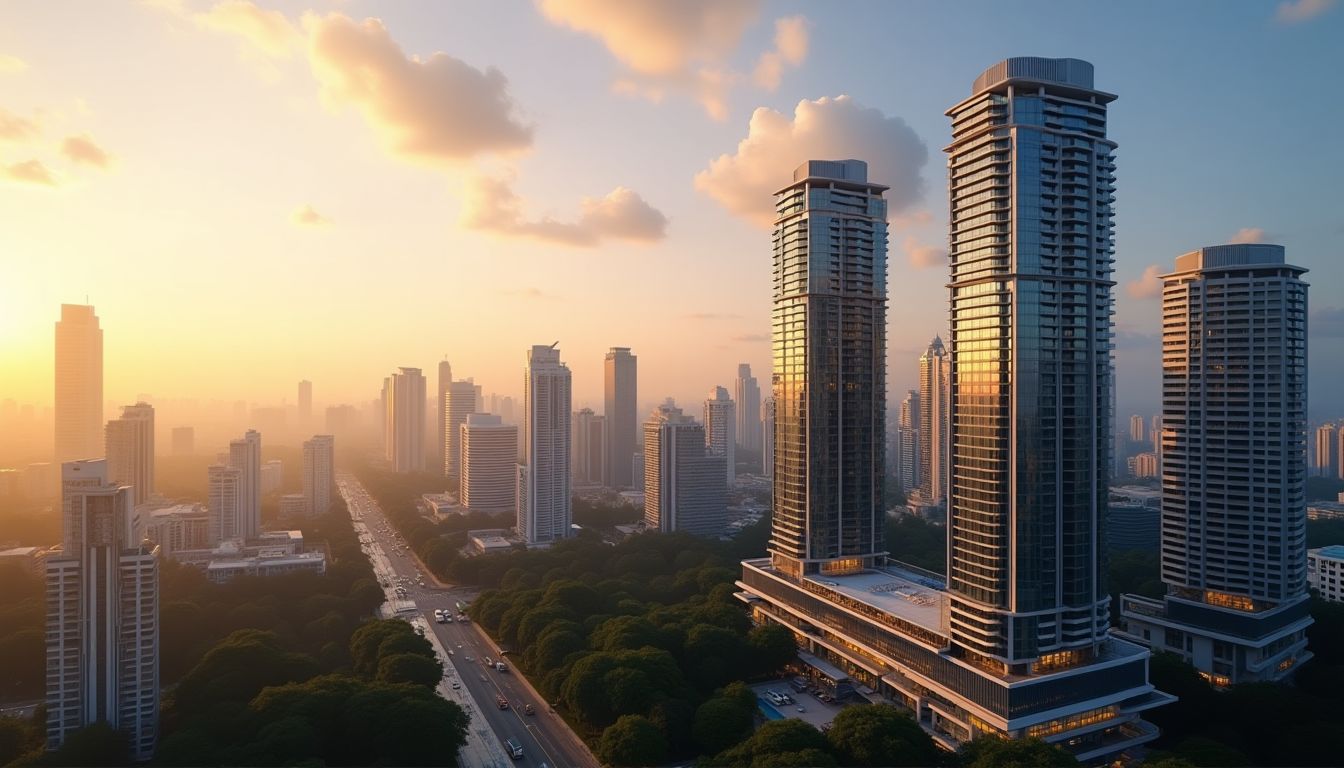
Malaysia's property market is generating headlines for luxury demand and rising transaction volumes — but based on Verbrol's analysis of 30+ signals, the real structural shift is happening in industrial and logistics assets. EVs, data centres, and sovereign capital are quietly rewriting who wins in Malaysian real estate.
Malaysia's Property Market Is Surging — But You're Looking at the Wrong Segment
Every property analyst in Kuala Lumpur right now is talking about the same things: Chinese ultra-high-net-worth buyers circling Mont Kiara, luxury launch prices crossing RM2,000 psf in KLCC, and how the luxury property market in Malaysia will move in 2026. The narrative is seductive. The data, however, points somewhere else entirely.
Based on Verbrol's analysis of 30+ signals from news, developer announcements, and transaction data tracked via Verbrol Pulse, the most consequential property story in Malaysia right now is not residential — luxury or otherwise. It is industrial. And it is accelerating faster than the market's pricing mechanisms have caught up with.
This is the paradox of Malaysian property in mid-2026: transaction volumes and values are rising across the board — Savills' Klang Valley Residential Property Monitor for Q4 2024 confirmed growth in both — yet oversupply and high household debt continue to weigh heavily on the residential sector. The smart capital has already moved on.
The Hidden Winner: Industrial Property Is Where the Structural Bets Are Being Placed
The signal most analysts are underweighting: EVs are powering Malaysia's industrial property boom, according to EdgeProp's June 2026 coverage. Malaysia's positioning as a regional EV supply chain hub — driven by government incentives, proximity to regional OEMs, and competitive land costs versus Singapore or Thailand — is generating sustained demand for purpose-built industrial facilities across Selangor, Johor, and Penang.
This is not speculative. The developer-side capital allocation tells the story clearly. Sime Darby Property has launched a RM1.25 billion fund specifically targeting data centres and industrial assets — a company that just took the top spot at The Edge Malaysia Top Property Developers Awards 2024. When Malaysia's most decorated developer is allocating RM1.25 billion away from residential and toward industrial and digital infrastructure, that is not a portfolio footnote. That is a strategic declaration.
Based on Verbrol's analysis of 30+ signals, three converging forces are compressing industrial vacancy rates in key corridors:
- EV supply chain localisation: Component manufacturers, battery assembly, and logistics providers requiring large-format, high-specification warehousing and factory space
- Data centre demand: Hyperscaler and regional cloud provider expansion, particularly in the Klang Valley, requiring power-dense industrial land with grid connectivity
- China+1 capital flows: Chinese manufacturers — some of the same ultra-wealthy individuals Tatler Asia notes are buying Malaysian luxury residential — are simultaneously acquiring industrial landbanks for manufacturing relocation
According to transaction data tracked by NAPIC, industrial property in Malaysia has demonstrated consistently tighter vacancy dynamics compared to the persistently oversupplied office and retail segments. The divergence is widening.
The Paradox the Headlines Miss: Oversupply and Boom, Simultaneously
Here is the contradiction sitting in plain sight. The Malaysian Reserve is reporting that oversupply and high debt weigh heavily on Malaysia's property sector. The Asia Property Awards and PropertyGuru's Q1 2024 Market Report are simultaneously reporting that Malaysia's property market is surging. Both are correct — because they are describing entirely different markets wearing the same label.
Residential overhang — particularly in the RM500,000–RM800,000 price band in secondary locations — remains structurally unresolved. iProperty's listing data continues to reflect extended days-on-market for high-rise condominiums outside established corridors. Household debt-to-GDP remains among the highest in ASEAN, which constrains end-financing approval rates for first-time buyers at the precise price points where developer inventory is most concentrated.
Meanwhile, the industrial segment operates with fundamentally different demand drivers — institutional tenants, long-lease structures, and capital from sources entirely insulated from Bank Negara's household lending constraints. This is why Malaysia's recent wins at the FIABCI World Prix d'Excellence Awards are meaningful beyond awards-night optics — they signal that Malaysian developers are building product that global institutional capital recognises as credible.
The financing ecosystem is also evolving. Funding Societies and Boost Bank have partnered to expand property-backed business financing for SMEs in Malaysia — a structural development that broadens the capital stack for commercial and industrial property transactions beyond traditional bank mortgage channels.
What This Means for Brands, Investors, and Market Participants in 2026
For brand managers, marketers, and business decision-makers reading this: the property sector's transformation has direct downstream implications for where commercial activity — and commercial real estate demand — concentrates over the next 24 months.
If you are a brand or agency working in the property space, the developer marketing briefs are shifting. Industrial and mixed logistics-residential township projects require different content strategies than luxury condominium launches. At Verbrol, we track how developer messaging is evolving across segments in real time — and the creative gap between how industrial developers communicate versus how the market now expects them to communicate is significant. For property developers seeking to close that gap through authentic content, platforms like Creamatch, Malaysia's managed creator content platform, are increasingly being used to build credible, localised content at scale — particularly for township and industrial park positioning that requires genuine community storytelling rather than glossy renderings.
If you are an investor or analyst, the thesis is straightforward: track capital allocation by the top-tier developers, not their residential launch calendars. Sime Darby Property's RM1.25 billion industrial and data centre fund is the leading indicator. The lagging indicator — when this shows up in NAPIC transaction statistics and analyst consensus — will arrive 12 to 18 months later.
If you are in the EV or technology supply chain, Malaysia's industrial corridor positioning is a genuine window that will not remain this competitively priced once institutional recognition fully reprices the asset class. Based on Verbrol's analysis of 30+ signals from developer announcements, foreign direct investment flows, and sector news, that repricing likely begins in earnest before Q1 2027.
The Verbrol Thesis: Malaysia's Real Property Story Is Being Written in Logistics Corridors, Not Penthouse Floors
The mainstream property narrative in Malaysia in mid-2026 is gravitating toward luxury residential and foreign buyer demand — compelling stories, well-told, commercially important. But based on Verbrol's analysis of 30+ signals from news, developer strategy, financing innovation, and international capital flows, the structural shift that will define Malaysian property's next decade is industrial.
EVs brought the demand. Data centres brought the capital intensity. China+1 brought the urgency. And Malaysia's top developers — led by a Sime Darby Property now deploying RM1.25 billion into industrial and digital assets — are responding with conviction.
The market that is "surging" and the market that is "oversupplied" are not contradictions. They are two different markets. The investors, brands, and strategists who understand that distinction in June 2026 will be very well positioned when the consensus catches up.
Track Property trends in real-time at verbrol.com
Read more on Verbrol Intelligence: