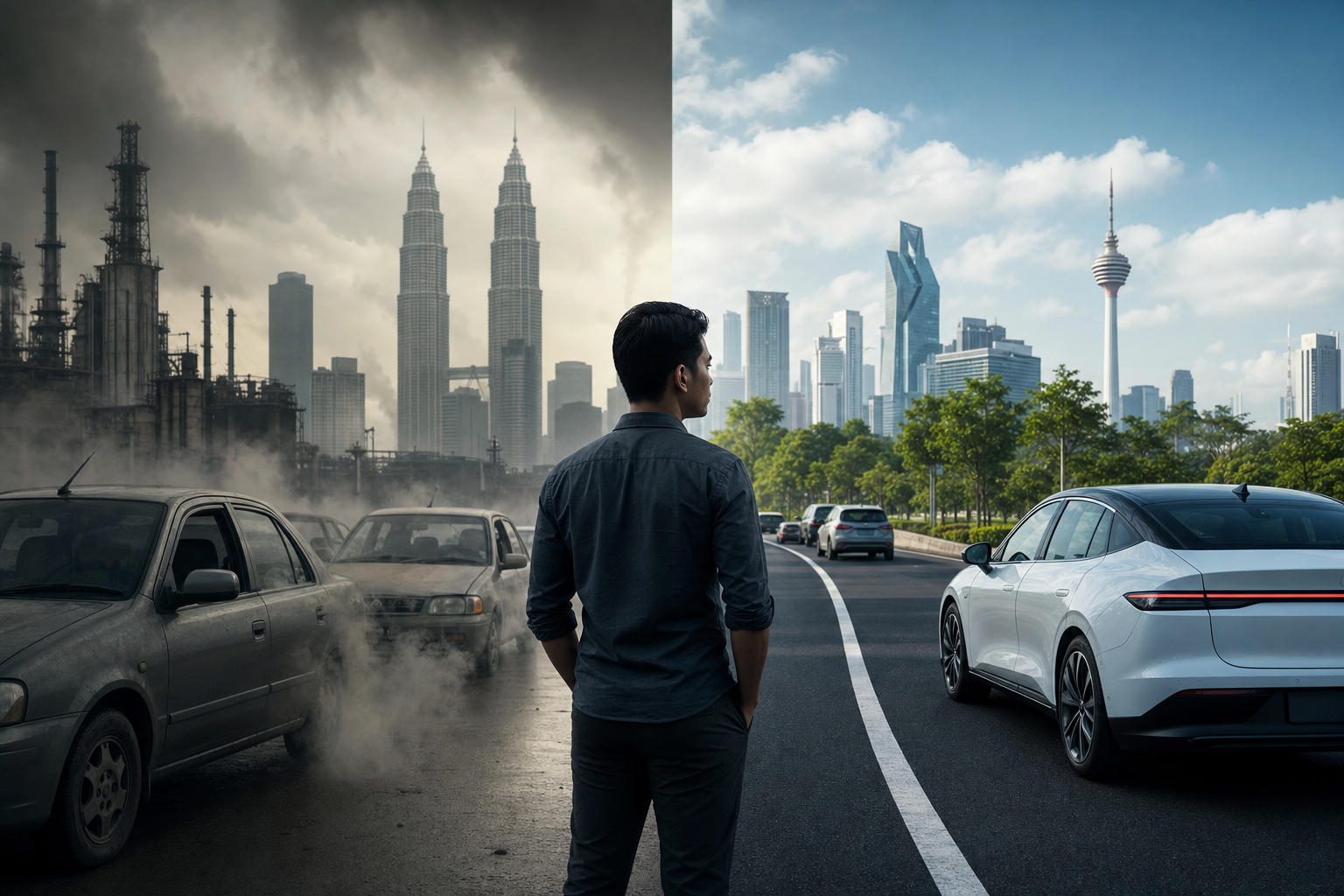
Two national carmakers racing toward EVs, Chinese brands claiming 7.6% of the market from near zero, and a battery-leasing model that could redefine how Malaysians own cars — this is the week Malaysia's auto industry moved faster than most brands are ready for.
Three years ago, Chinese-branded cars held 0.08% of the Malaysian passenger car market. Today that figure stands at 7.6% — a near-hundredfold expansion compressed into a single product cycle. That single data point frames everything else happening in Malaysia's automotive sector right now.
Proton's Momentum Is Real — and Measurable
The numbers coming out of Pro-Net and Proton Holdings this week are not marketing copy. The Proton Saga MC3 posted 8,207 units delivered in April alone — a 50.9% jump over March — bringing year-to-date deliveries to 29,977 units, up 42.8% year-on-year. These are volume figures that rival segments see across an entire quarter.
More strategically significant is the Proton e.MAS 5. It has become the first EV in Malaysia to break into the country's top five bestselling cars, capturing nearly 50% of Malaysia's total EV market in its segment window. For a product category that was considered aspirational and niche as recently as 2023, that penetration rate signals a genuine inflection point — not a promotional spike.
The Geely partnership, now several years in, has delivered measurable structural outcomes: 34 new models, a claimed tenfold quality improvement index, 146 additional showrooms, and sales more than doubled from the 2018 all-time low — a 144% climb to reach a 15-year high. According to Bernama, the industrial logic of the tie-up has now been validated at the retail level. Proton's next product offensive includes the AMA02 (an A-segment SUV to rival Perodua's Ativa, with production slated for Q4 2026), alongside the AMA05, AMA06, and a next-generation GMA EV platform. Facelifts for the S70 and X90 are also in the pipeline.
The supply chain is not entirely clean, however. A live legal dispute between Proton and a supplier over unpaid dues introduces an execution risk that brand managers and procurement teams tracking the national carmaker should not overlook. Rapid model expansion creates vendor stress — and stressed vendors create quality and delivery timeline risk.
Perodua's EV Bet: The Battery Lease Model Changes the Equation
Perodua's approach to electrification is structurally different from Proton's, and deliberately so. The confirmed first Perodua EV, targeting a launch in 2025 and now in final approach, is expected to be priced around RM80,000 — but with a battery leasing component rather than outright ownership.
This is not a compromise. It is a deliberate architecture decision that addresses two of the most persistent barriers to EV adoption among Malaysia's mass-market buyer base: residual value uncertainty and battery degradation anxiety. By separating the battery from the vehicle purchase, Perodua positions the RM80k entry point as genuinely competitive rather than aspirationally priced.
The trade-off is the lock-out clause. As reported by NST Online, Perodua's EV can be remotely locked out over unpaid battery fees — a feature that will generate consumer discomfort and almost certainly regulatory scrutiny. For brand managers advising clients in the automotive adjacent space, this is a crisis communications risk that needs pre-emptive scenario planning, not reactive damage control.
Perodua is also collaborating with an international partner on the EV development programme — a structural parallel to Proton's Geely alignment, though details on the partner remain limited in public disclosure.
Chinese Brands and the Restructuring of Market Share
The 7.6% market share figure for Chinese car brands in Malaysia is not the ceiling — it is likely a waypoint. The pace of expansion from 0.08% in three years reflects a combination of aggressive pricing, rapid dealer network build-out, and product specifications that over-deliver relative to price point in segments that Proton and Perodua do not fully cover.
The WASIC 2026 forum saw China and Malaysia agree to explore new automotive cooperation opportunities — a signal that the bilateral relationship in this sector is moving beyond pure import dynamics toward potential co-development or manufacturing arrangements on Malaysian soil. That shift, if it materialises, would have significant implications for Toyota Malaysia, Honda Malaysia, and other established non-national players currently anchored to CBU import or CKD assembly models.
For context on where the broader market sits structurally, the Malaysian Vehicles Market Facts & Data 2026 report from Focus2Move provides useful baseline volume data against which the current EV and Chinese brand disruption can be measured.
What the Industry Needs Beyond the Sales Floor
The structural question underneath all this week's news is one that Malaysia's Deputy Minister of Investment, Trade and Industry has already flagged publicly: Malaysia's auto sector must shift gears beyond assembly if it intends to participate in — rather than just consume — the EV transition. The semiconductor integration gap is particularly acute: as PwC notes in its analysis of automotive semiconductors in Malaysia, the country has the fabrication infrastructure but lacks the design and integration capability to move up the value chain. That gap is what determines whether Malaysia becomes a net beneficiary or a net assembler in the next decade of automotive electrification.
For marketers and brand managers operating in or around the automotive sector, the actionable read from this week's signals is threefold:
- EV is no longer a premium segment story. The Proton e.MAS 5 in the top five and Perodua's RM80k target price confirm that EV consideration is now a mass-market conversation. Content and campaign strategies that treat EV buyers as early adopters are already behind.
- Battery leasing will generate controversy before it generates loyalty. Brands adjacent to Perodua — insurers, fintech players, after-sales service networks — need to position now on the consumer trust dimension, not after the first lock-out incident goes viral. Influencer and creator content explaining the mechanics clearly will matter; platforms like Creamatch, Malaysia's managed creator content platform, are well-positioned to help automotive brands build that educational layer at scale.
- Chinese brand growth is a distribution story as much as a product story. The speed of the 0.08% to 7.6% move was enabled by dealer network expansion and financing accessibility, not just price. Competitors and adjacent brands should be studying that playbook at the channel level.
The Verbrol Pulse dashboard tracking Malaysian auto conversations this week shows the Proton e.MAS 5 and Perodua EV battery lease model as the two dominant narrative threads — not coincidentally, both revolve around the same consumer anxiety: what does EV ownership actually cost me, month by month, across the full vehicle life?
That question is the real market signal. Brands that answer it clearly — in product design, in financing architecture, and in content — will own the next phase of Malaysia's automotive transition.
Track Auto trends in real-time at verbrol.com
Read more on Verbrol Intelligence: