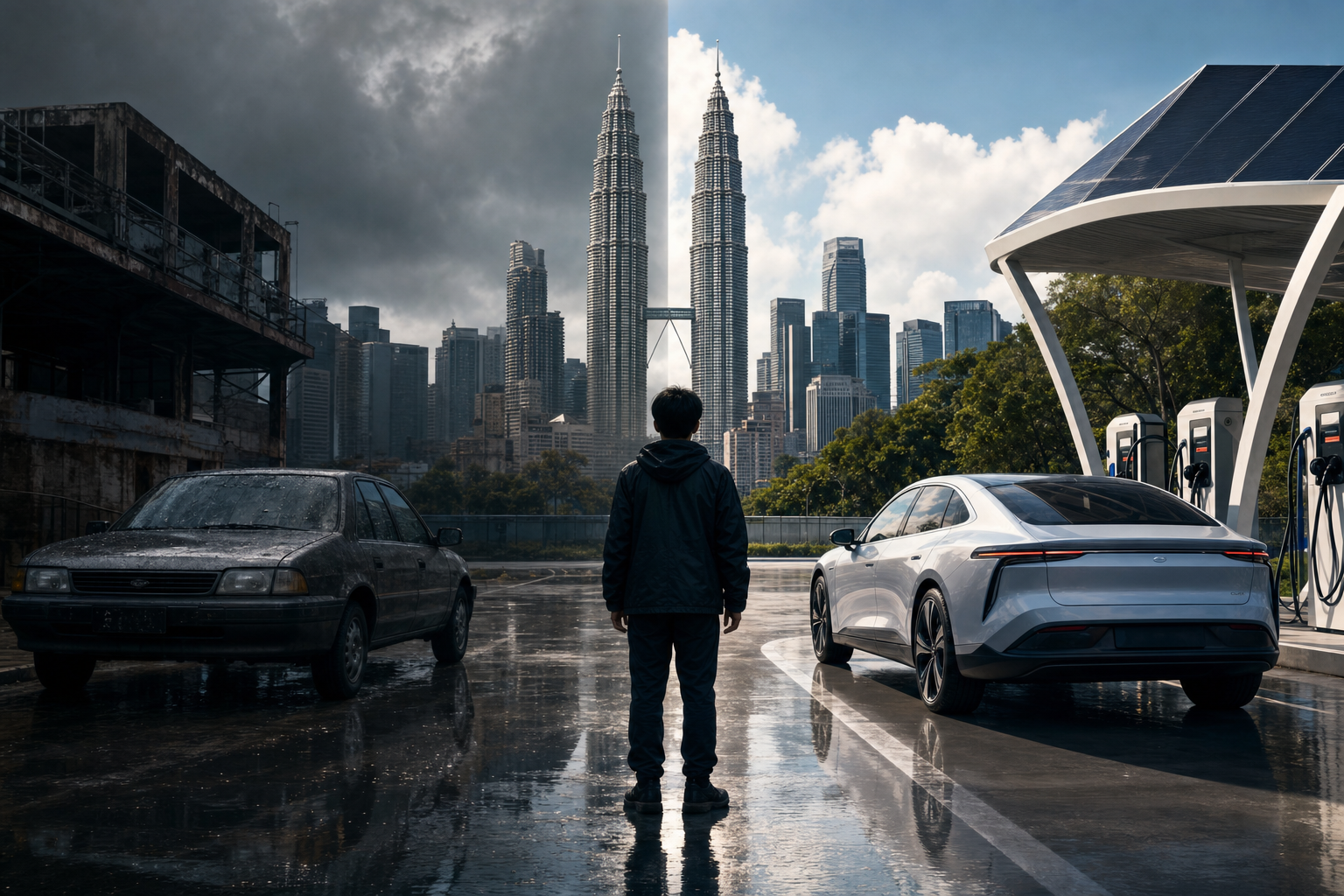
Malaysia's two national carmakers are no longer playing catch-up — they are actively reshaping the rules of the country's electric vehicle market, and the moves they make in 2026 will define the next decade.
Walk into any Proton showroom in Petaling Jaya today and you will notice something that would have been unimaginable five years ago: a queue. Not for the Saga, the nameplate that has anchored Proton's volume for two decades, but for the e.MAS 5 — the brand's first serious electric vehicle and, as of mid-2026, the first EV to break into Malaysia's top five bestselling cars.
That is not a marketing claim. It is a structural shift. And understanding why it happened — and what comes next — is essential reading for anyone tracking where Malaysian consumer spending is moving.
Proton's Geely Dividend Is Finally Paying Off on the Ground
The numbers behind Proton's resurgence are precise enough to be instructive. Since the Geely partnership formalised in 2018, Proton has launched 34 new models, recorded a 10x internal quality improvement score, added 146 new showrooms, and doubled overall sales. From its 2018 all-time low, cumulative sales have climbed 144% to reach a 15-year high — a trajectory that Paul Tan's Automotive News has tracked in granular detail.
The Saga MC3 alone delivered 8,207 units in April 2026, a 50.9% jump over March, with year-to-date volume at 29,977 units — up 42.8% year-on-year. For a nameplate that sceptics had written off as tired, those are not incremental gains. They signal that Proton has rebuilt enough dealership infrastructure and consumer trust to convert renewed curiosity into actual purchase decisions.
But the more consequential development is the e.MAS 5 capturing nearly 50% of Malaysia's EV market, according to Pro-Net, Proton's EV distribution arm, as reported by The Edge Malaysia. That level of EV market concentration in a single model — a domestically assembled one — tells you the purchase barrier was never purely about price. It was about familiarity, after-sales confidence, and financing accessibility. Proton's existing network resolved all three simultaneously.
The forward pipeline reinforces the ambition. Production of the AMA02 — positioned as a Saga Cross A-segment SUV targeting the Perodua Ativa — is confirmed to begin in Q4 2026, per supplier disclosures. Beyond that, Proton has flagged the AMA05, AMA06, a next-generation GMA EV, and mid-cycle updates for the S70 and X90. That is not a model refresh schedule. That is a platform war.
Perodua's Calculated Bet: RM80,000 and a Battery You Do Not Own
Perodua's EV strategy is structurally different, and deliberately so. Where Proton moved quickly with an assembled Geely-platform product, Perodua is engineering a market entry around affordability architecture rather than speed. The projected price point of approximately RM80,000 — reported by Paul Tan's Automotive News — is notable, but the battery leasing model attached to it is the actual innovation.
Under this structure, the customer purchases the vehicle body while leasing the battery separately, reducing the upfront capital commitment and transferring residual value risk away from the owner. NST Online's coverage of the battery lock-out mechanism for unpaid battery fees raised legitimate questions about consumer risk, and those questions are valid from a brand trust standpoint. Perodua will need to communicate the leasing terms with precision — any ambiguity will erode the very confidence the model is designed to build.
The collaboration with an unnamed international partner to co-develop these affordable EVs, as reported by Focus Malaysia, suggests Perodua is running a similar technology-transfer playbook to what Proton executed with Geely. The difference is timing and segment: Perodua is targeting the sub-RM100,000 bracket where volume lives, and where the mass-market EV transition will ultimately be decided.
For brand managers and marketers observing this from the outside, the implication is straightforward: the RM80,000 Perodua EV, if it launches in 2027 as trajectory suggests, will become the dominant conversation in the first-car and family-replacement segments. Campaigns built around range anxiety and charging infrastructure today will need to pivot toward ownership cost modelling and lease-versus-buy messaging tomorrow.
The Chinese Brand Pressure Nobody Fully Priced In
Both national carmakers are executing their EV pivots under competitive pressure that has escalated faster than most analysts projected. Chinese car brands held 0.08% of the Malaysian market four years ago. They now command 7.6% — a near-hundredfold expansion in market share within a single product generation cycle.
This is not an abstraction. It represents actual units, actual conquests, and actual consumers who evaluated national brands and chose an import. The deputy minister's call for Malaysia's auto sector to shift gears beyond assembly reflects exactly this anxiety at the policy level: the current assembly-and-badge model is insufficient insulation against Chinese OEMs that arrive with fully amortised R&D costs, vertically integrated battery supply chains, and aggressive pricing authority.
According to The Star, the industry is projecting record sales volume — but record volume in a market where Chinese brands are gaining 7+ percentage points can mask structural share loss for incumbents. The headline number flatters; the segment-by-segment decomposition does not.
PwC's analysis of semiconductor integration in Malaysia's automotive future adds another layer: the transition to software-defined vehicles requires chip-level competencies that neither Proton nor Perodua currently hold domestically. The supply chain dependency on foreign semiconductor partners is a medium-term vulnerability that the Geely and international-partner collaborations only partially address.
For agency professionals and brand managers working with automotive clients, Verbrol Pulse provides the real-time signal layer to track how these competitive narratives are landing with Malaysian consumers — which models are generating organic conversation, which concerns are surfacing in owner communities, and where sentiment is diverging from sales data.
What This Means for Marketers and Brand Strategists
The Malaysian auto market in the second half of 2026 is not a single story. It is three simultaneous structural transitions running in parallel: the EV adoption curve accelerating faster than infrastructure planning assumed; the national carmaker duopoly under genuine competitive pressure for the first time in a generation; and a pricing war in the EV segment that will compress margins before it builds volume.
For brand managers, the actionable read is this:
- Proton's e.MAS 5 success is a distribution story as much as a product story. The brand leveraged 146 new showrooms and an existing service network to remove the post-purchase anxiety that has stalled EV adoption elsewhere. Any brand entering the EV-adjacent accessory or finance space should map its distribution against Proton's dealer footprint first.
- Perodua's battery leasing model will create a new content category. Consumers will need education on what leasing means for ownership, resale, and long-term cost. Brands that build credible explainer content before Perodua's official launch will own that search intent window. Content marketing teams working with automotive clients should explore creator-led education formats now — platforms like Creamatch, Malaysia's managed creator content platform, offer structured ways to scale that kind of authentic, technically accurate content through verified local voices.
- Chinese brand incursion is a competitive intelligence problem, not just a sales problem. The 7.6% market share figure is a lagging indicator. The conversation volume, search intent, and test-drive conversion data for brands like Chery, BYD, and Changan have been moving ahead of official sales figures for 18 months. Monitoring those leading indicators through tools like Verbrol gives automotive marketers the forecast window that quarterly TIV data cannot.
There is also the supplier relationship issue worth noting. Proton's ongoing legal dispute with a supplier over unpaid dues, reported by The Edge Malaysia, is a supply chain signal that warrants attention from anyone in the automotive parts or tier-2 supplier ecosystem. Rapid model expansion strains working capital and payment cycles — that pressure does not stay contained at the OEM level.
Malaysia's auto sector is at an inflection point that rewards precision over optimism. The volume numbers look strong. The structural questions — who owns the EV supply chain, how battery leasing scales, whether the national carmakers can outpace Chinese OEM momentum — are unresolved. Watch the product pipeline, not the press releases.
Track Auto trends in real-time at verbrol.com
Read more on Verbrol Intelligence: