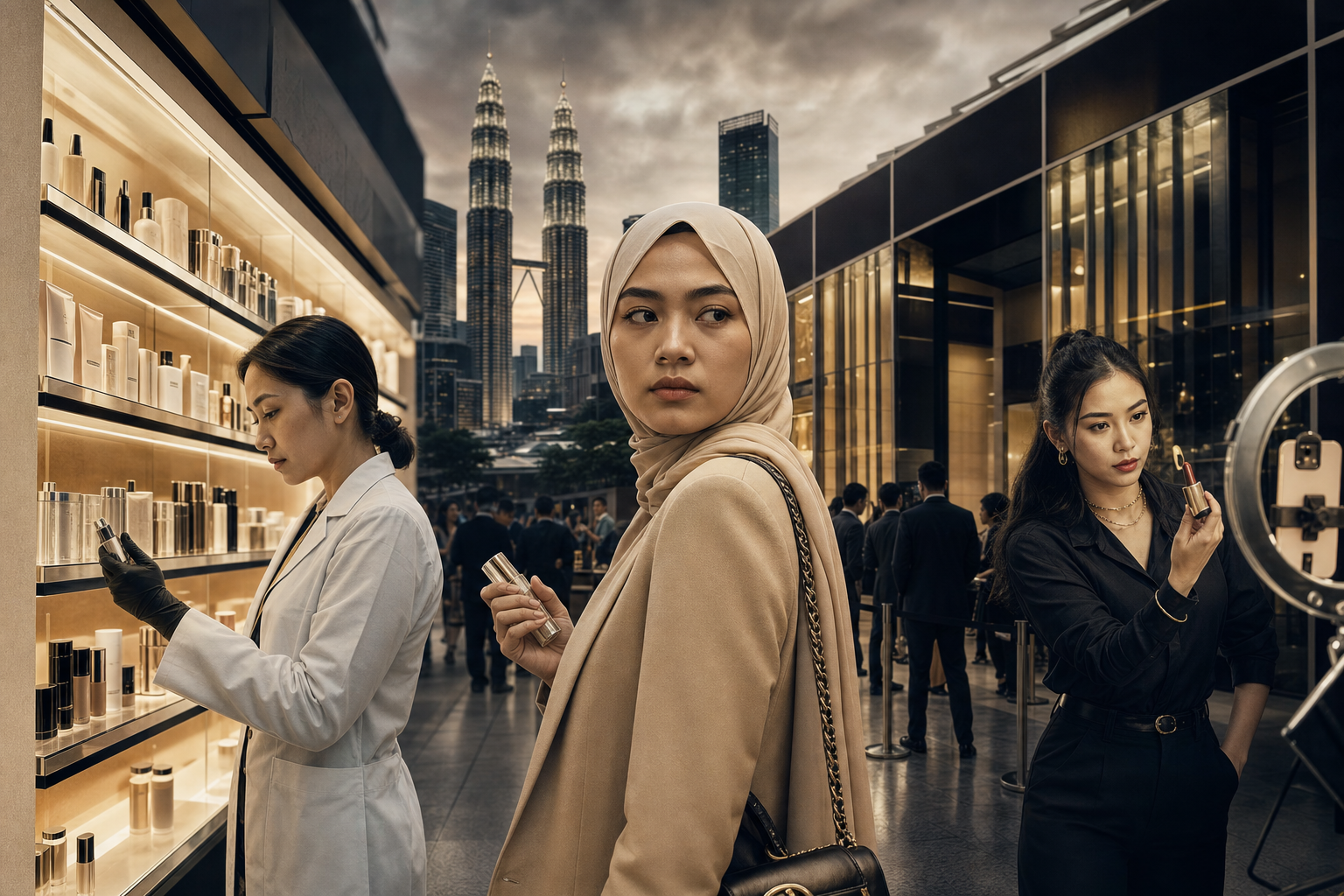
A Health Ministry ban, a Dior pop-up in KL, and YSL going live on TikTok Shop — all in the same week. Malaysia's beauty market is no longer a single story.
Malaysians have always had a complicated relationship with beauty products. We read the ingredients list after we've already bought the thing. We trust a Xiaohongshu review from a stranger in Chengdu more readily than a clinical trial. And we will queue — genuinely queue — for a limited-edition cushion compact at a mall that already has four other beauty counters selling the same shade.
That cultural texture matters now more than ever, because Malaysia's beauty market is going through a legitimately messy growth phase. Three things happened almost simultaneously this week, and together they tell you exactly where this industry is headed.
When Poison Shows Up in Your Skincare Shelf
The most urgent signal: Malaysia's Health Ministry banned the sale of Tati Skincare products containing scheduled poison, with NST Online reporting that 40 women had already raised the alarm about the product still being sold despite the prohibition. That second beat — banned but still circulating — is the part that should concern every brand and retailer in this space.
This is not a fringe issue. The beauty supplement and whitening skincare segment has long operated in a regulatory grey zone in Malaysia, where social proof moves faster than enforcement. A seller with 80,000 TikTok followers can shift product faster than the Health Ministry can process a gazette notification. The result is a consumer base that is simultaneously more educated about ingredients (retinol, niacinamide, tranexamic acid are now common vocabulary on Malaysian beauty forums) and still vulnerable to products that promise dramatic results through genuinely dangerous means.
For retailers like Watsons Malaysia and Guardian Malaysia, this creates both a burden and an opportunity. Their physical shelf is a de facto quality filter. When consumers are burned by unregulated online sellers, they come back to the pharmacy chains. But only if those chains have maintained the trust. The Tati Skincare incident is a reminder that curation — knowing what you stock and why — is a brand statement in itself.
The Luxury End Is Doubling Down on Experience
While regulators are chasing bad actors downstream, the premium segment is doing something entirely different: it is investing in memory.
Dior's Summer Riviera pop-up in Malaysia showed the playbook clearly: create a sensory environment that cannot be replicated on a phone screen, generate content that consumers want to share, and reinforce that the Sephora Malaysia counter experience is just the beginning of the relationship. Pop-ups like this are not primarily sales vehicles — they are content engines. The real ROI is measured in UGC, in the Instagram Reels that keep circulating three weeks after the event closes.
YSL Beauty's TikTok Shop launch, complete with a Bukit Bintang kopitiam takeover, is a masterclass in cultural bridging — taking a French luxury house and anchoring it in a Malaysian street-food setting. It is a little forced, yes, but it works precisely because it acknowledges that Malaysian consumers are not passive recipients of global brand narratives. They are co-authors.
For beauty brands navigating this, the implication is direct: experience-led marketing is no longer optional at the premium tier. And for the creator layer that makes those experiences discoverable, platforms like Creamatch — which connects brands with managed creator content specifically for Southeast Asian markets — are increasingly where campaigns like these find their legs beyond the event day itself.
K-Beauty Is Infrastructure Now, Not a Trend
If luxury is going experiential and the mass market is wrestling with regulation, Korean beauty has quietly become the load-bearing wall of the Malaysian skincare conversation.
Korean beauty innovation continues to meet growing demand in Malaysia, with The Star noting that the pipeline of K-beauty entrants remains strong. The latest signal: Haruharu Wonder, a Korean brand with genuine viral credentials, has been expanding its retail footprint — a move that resonates specifically because Malaysian consumers have already done the research. They arrive at the shelf pre-sold, having watched the review content, cross-checked the ingredient list, and decided they trust the formulation philosophy.
This is what makes K-beauty structurally different from other import categories. It is not driven by advertising spend in Malaysia — it is driven by an information ecosystem that Malaysian consumers actively participate in, across Xiaohongshu, TikTok, and YouTube. Actress Natalia Dyer's partnership with Purito Seoul amplifies exactly this kind of aspirational but ingredient-credible positioning, signalling that global K-beauty brands understand that their strongest lever is creator authenticity, not celebrity endorsement in the traditional sense.
Local brands are watching this closely. Safi and Sendayu Tinggi have long anchored their equity in halal certification and Malay-heritage ingredients — a genuinely differentiated position that K-beauty cannot easily replicate. But both brands know that the consumer who buys their toner in the morning might be using a Haruharu Wonder serum at night. The question is not how to compete with K-beauty; it is how to occupy a complementary space in the same consumer's routine.
What This Week's Signals Actually Mean for Marketers
Taken together, these three threads — the poison ban, the luxury experiential push, and K-beauty's continued entrenchment — point to a market that is maturing in an uneven, non-linear way. The mass market is cleaning up its supply chain (under duress). The premium tier is engineering emotional attachment. The mid-market is increasingly Korean by default.
For Malaysian beauty marketers, the actionable reads are:
- Retailer trust is a moat again. After years of being disrupted by social commerce, physical retailers like Watsons Malaysia and Caring Pharmacy are reasserting value as quality gatekeepers. Invest in that relationship.
- TikTok Shop is serious infrastructure, not a side channel. YSL's launch signals that luxury is now treating it as a primary retail environment in Malaysia, not an experiment.
- Local brands need a clearer ingredient story. With consumers increasingly fluent in actives, Velvet Vanity and SimplySiti both have opportunities to compete on formulation transparency — but only if they lead with it explicitly.
- Creator content is where discovery actually happens. Brands serious about building awareness in this environment need a sustained creator strategy, not just one-off campaigns. Creamatch operates specifically in this managed creator space for Southeast Asia, which matters when you need consistency across multiple product cycles.
- Bartech Beautee's reported push into Asian markets signals that Malaysian homegrown brands are beginning to think regionally. That ambition needs to be matched with brand storytelling that travels — not just formulations that work.
The Malaysian beauty consumer in 2026 is not a simplified buyer persona. She is simultaneously cautious about product safety, hungry for elevated brand experiences, deeply informed by Korean beauty culture, and still loyal to local brands that speak her language. The brands that will win here are the ones that resist the urge to flatten that complexity into a single campaign.
For ongoing coverage of Southeast Asian consumer and retail trends, explore Verbrol Pulse or browse the full Verbrol intelligence library.
Track Beauty trends in real-time at verbrol.com
Read more on Verbrol Intelligence: