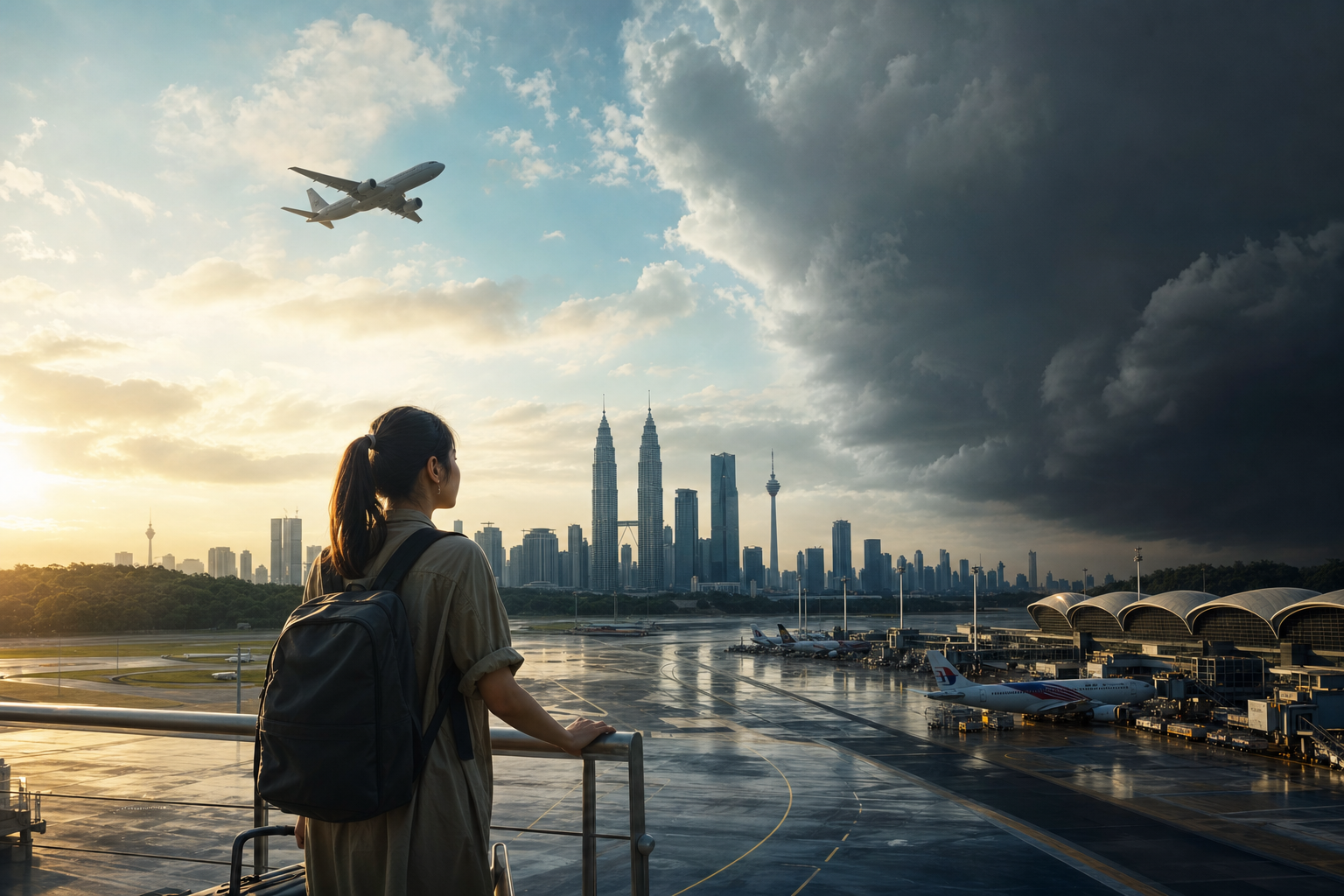
Big structural bets are being placed on Malaysia's travel future — from Wall Street listings to nomad visa races — but the real story is in what everyday Malaysians are choosing to do with their wings.
There's a telling ritual that plays out at KL Sentral every festive season. Families hauling rattan baskets, paper bags from Jalan Masjid India, and the occasional live plant that someone has decided absolutely must travel. They move with purpose — not tourists performing Malaysia, but Malaysians living it. And according to what festive travel patterns reveal about the nation's movement habits, that instinct for movement — purposeful, culturally embedded, stubbornly loyal to the journey itself — is precisely what Malaysia's travel industry is now trying to industrialise at scale.
Mid-2026 is, by any honest measure, a hinge moment. The structural bets being placed right now — on capital markets, on route networks, on the identity of who a Malaysian traveller even is — will define the next decade of this sector.
Capital A Goes to Wall Street, and What That Actually Means
The headline that landed this week is striking in its ambition: Capital A International, the holding company behind the iconic AirAsia brand, is pursuing a US stock market listing via a business combination with Aetherium Acquisition Corp. For a brand born from a Kuala Lumpur ringgit-and-hustle origin story, ringing the bell on an American exchange represents a profound repositioning — from regional budget carrier to globally listed aviation asset.
Simultaneously, AirAsia co-founder Tony Fernandes is reported to be planning an entirely new airline venture, a detail that adds a layer of intrigue to the Capital A narrative. Whether these threads are complementary or competitive remains to be seen, but together they signal that the people who built Southeast Asia's low-cost travel revolution are not finished building.
For Malaysian marketers and brand strategists, the Capital A listing matters beyond aviation. It is a statement that Southeast Asian consumer brands — built on volume, accessibility, and cultural intimacy with their home markets — are now considered viable propositions for international capital. That's a template, not just a transaction.
There is, however, a complication in the story. AirAsia is simultaneously navigating accusations from an artist alleging his creative work was used without consent, as reported by the BBC, and AirAsia X has had to postpone its high-profile Kuala Lumpur-Bahrain-London route due to regional conflict — a route announced with considerable fanfare as the brand's first strategic European hub. The postponement is a reminder that even the most ambitious route strategies are hostage to geopolitics. The Cambodia, India, Australia and Malaysia aviation-tourism pact anchored through the Kuala Lumpur hub, however, continues to advance — suggesting that regional connectivity is proving more durable than long-haul ambition right now.
The Nomad Visa Race and What Malaysia Is Quietly Competing For
While aviation restructures at the top, a different kind of traveller is being courted at the policy level. Malaysia has joined Thailand, Vietnam, Indonesia, Singapore, and the Philippines in rolling out digital nomad infrastructure and extended-stay visa frameworks — part of a regional race to capture the remote workforce boom that accelerated post-pandemic and shows no signs of softening.
The framing of this as a race is accurate. These six nations are competing for a demographic that is, by definition, footloose — people who can choose Penang over Chiang Mai, or Johor Bahru over Ho Chi Minh City, based on visa ease, cost of living, and the quality of a co-working space's coffee. Malaysia's pitch is distinctive: it offers urban infrastructure at KL scale, cultural layering that few cities in the region can match, and a food culture so embedded in national identity that even a Scottish-Malaysian chef won't leave without her essentials.
For Tourism Malaysia and for hospitality brands across the country, the digital nomad shift represents a marketing brief that is genuinely different from leisure tourism. These are not people searching for a beach holiday package. They are building a temporary life, which means they respond to content that is honest, granular, and community-driven rather than glossy and aspirational. Platforms like Creamatch, Malaysia's managed creator content platform, are well-positioned here — because reaching nomads requires creator voices that speak with lived authority about neighbourhoods, internet speeds, and hawker stall opening hours, not broadcast campaigns about sunsets.
Agoda Malaysia and Traveloka are already competing hard in the extended-stay booking segment, with both platforms investing in longer-duration inventory and flexible cancellation products. The hospitality intelligence being assembled at events like the Malaysia hospitality conference covered by Travel Daily Media increasingly reflects this pivot — the conversation has moved from occupancy rates to residency rates.
The Unlimited Pass Signal: Domestic Tourism Is the Unsung Story
Amidst the big structural moves, one quieter development deserves more attention from strategists than it is currently getting. AirAsia's new Unlimited Pass product — designed to accelerate domestic tourism recovery — speaks to a demand pattern that Verbrol Pulse has tracked consistently across Malaysian social signals: Malaysians are flying domestically with new enthusiasm, and the price sensitivity that once made driving the default choice for inter-state travel is being deliberately disrupted.
The Unlimited Pass is not just a product; it is a signal about consumer behaviour. It assumes that the barrier to domestic travel is not desire but decision fatigue around price variability. By flattening that decision into a single subscription-style commitment, AirAsia is applying a model that has worked in streaming and fitness to the movement of people. If the uptake data proves the assumption correct, every domestic tourism brand — from Langkawi resorts to Sabah eco-lodges — should be paying attention to the conversion spike that follows.
Malaysia Airlines and Firefly will be watching closely. The Unlimited Pass model, if successful, forces competitors to either match the accessibility or sharpen their differentiation on service quality and network depth.
According to Bernama, domestic connectivity remains a policy priority at the federal level — making the alignment between AirAsia's commercial instincts and government tourism goals unusually tight right now.
What Brands Should Actually Do With All of This
The signals from Malaysia's travel sector in mid-2026 are not contradictory — they are layered. A US listing, a new airline, a postponed route, a nomad visa framework, and an unlimited domestic pass are all expressions of the same underlying truth: Malaysia's travel market is in a period of genuine structural expansion, not just cyclical recovery.
For brand managers and agency professionals, the actionable read is this:
- Aviation restructuring creates audience fragmentation. As Capital A internationalises and Fernandes potentially launches a new carrier, traveller loyalty is up for grabs. Brand partnerships tied to specific loyalty programmes need to be re-evaluated.
- The nomad audience rewards authenticity over aspiration. Creator-led content strategies, particularly through platforms like Creamatch, will outperform traditional tourism advertising in this segment.
- Domestic travel is a growth channel, not a consolation prize. The Unlimited Pass positions domestic flying as a lifestyle behaviour. Brands in hospitality, F&B, and retail along domestic routes should be building campaigns that meet that energy.
- Geopolitical sensitivity is now a travel marketing variable. The Bahrain route postponement is a reminder that long-haul aspirations can stall quickly. Campaign planning needs scenario flexibility built in.
The families at KL Sentral with their rattan baskets and their plants have always known something the industry is only now catching up to: movement is not a luxury in Malaysia. It is a cultural constant. The question for every brand in this space is whether they are building for the journey, or just selling a seat.
Track Travel trends in real-time at verbrol.com
Read more on Verbrol Intelligence: