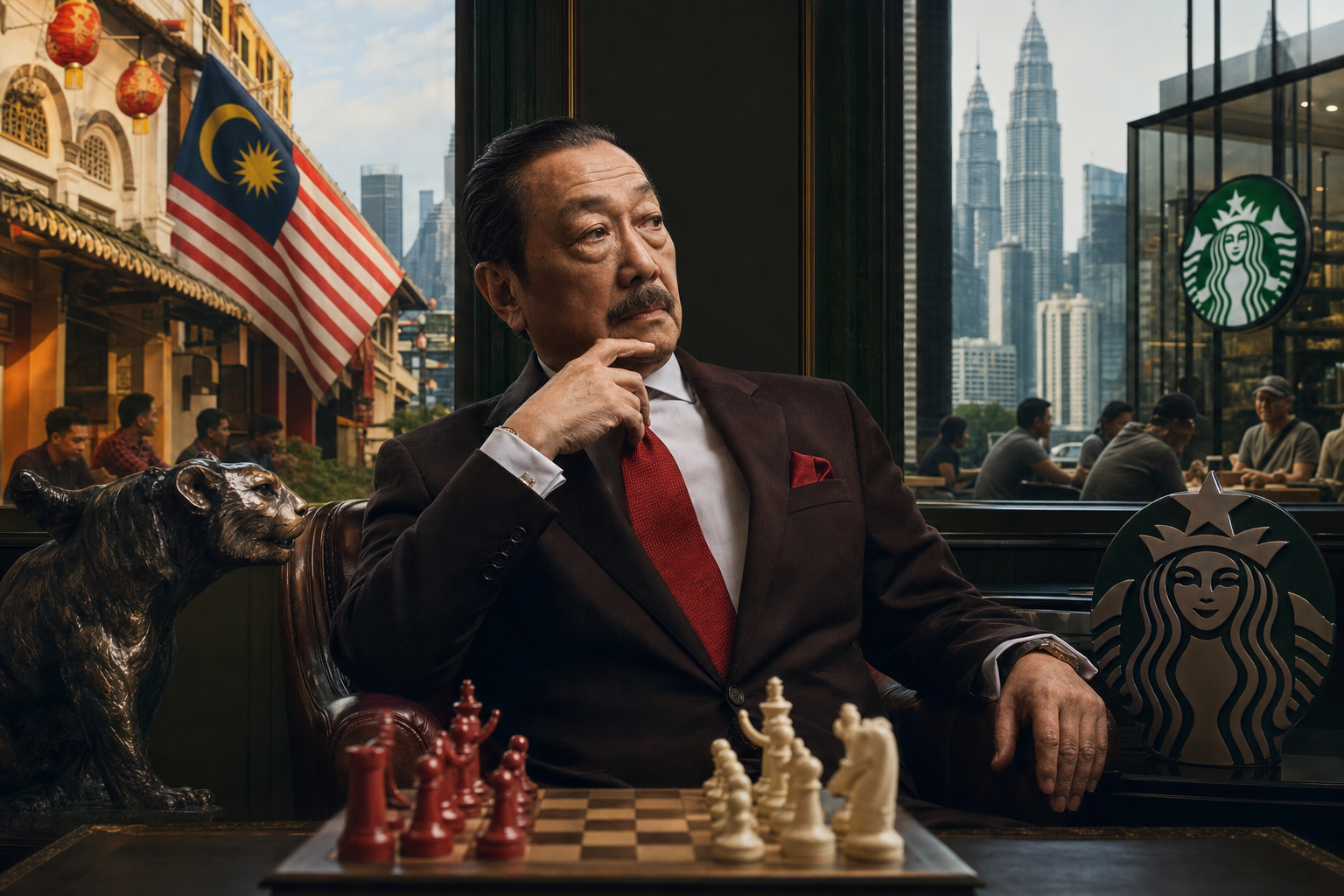
Vincent Tan is making share moves, weighing a Prudential stake sale, and defending Starbucks Malaysia — all at once. Here's what the signals reveal.
Vincent Tan's Next Move: What the Market Signals Say
By Priya Menon
A tycoon defending a coffee chain while quietly reshuffling his financial assets tells you everything about where Berjaya Group stands right now.
Over the past week, Vincent Tan has been unusually visible — and unusually active. On one front, the billionaire founder of Berjaya Corp has been vocal in public, arguing that the prolonged consumer boycott of Starbucks Malaysia is ultimately self-defeating for Malaysians. On another, he has been making a series of share transactions in Berjaya Corp, and is reportedly weighing the sale of a significant stake in Prudential Malaysia. When a dealmaker of Tan's calibre starts moving pieces on multiple boards simultaneously, the market pays attention.
The Starbucks Wound Is Real
The numbers are not kind. Berjaya Food Bhd, which operates Starbucks Malaysia under a licensee arrangement, posted a record loss that drew international coverage including a Forbes report — a distinction no operator wants. The boycott, which gained momentum in Malaysia tied to geopolitical sentiment, has proven stickier and more commercially damaging than many analysts initially expected.
Tan's public stance — that the boycott is hurting Malaysian workers and franchise operators more than any foreign corporation — is not merely a PR play. It reflects a genuine business crisis. Starbucks Malaysia employs thousands of local staff, and the franchise's losses ripple through suppliers, mall landlords, and the broader F&B ecosystem that Berjaya Food anchors.
Yet despite Tan's high-profile media appearances, consumer sentiment has remained stubborn. The market signal here is unambiguous: brand advocacy from the top, no matter how earnest, cannot override a geopolitically-driven consumer decision when the emotional stakes are this high. Berjaya Food's challenge is structural until the broader sentiment shift occurs — and that timeline is not within any CEO's or tycoon's control.
The Share Moves Signal Something Deeper
What is drawing sharper analytical attention, however, is not the Starbucks commentary — it is the share transactions. Tan has been making multiple moves involving Berjaya Corp shares in recent days. In Malaysian market intelligence circles, when a controlling shareholder trades actively in his own flagship, it typically signals one of three things: a confidence-building exercise, a restructuring prelude, or liquidity management ahead of a larger transaction.
Coupled with reports that Tan is weighing the sale of his stake in Prudential Malaysia — a premium financial services asset — the picture starts to sharpen. Divesting from a well-performing insurance business is not the move of a conglomerate in comfortable cruise mode. It suggests capital is being repositioned, possibly to shore up Berjaya Corp's balance sheet, fund a new acquisition, or reduce exposure in a period of earnings pressure from the F&B segment.
The Prudential Malaysia stake, if sold, would represent meaningful cash inflow. Prudential's Malaysian operations have been consistently profitable, with a strong bancassurance and agency network. Selling a stake in a performing asset during a period of stress in another business unit is a classic conglomerate playbook — sacrifice the winner to defend the portfolio.
32 Mentions, Mostly Noise — But the Signal Is Clear
With 32 media mentions in a single week and an overwhelmingly negative sentiment reading, Tan and Berjaya are operating under elevated public scrutiny. Much of the noise is centred on the Starbucks narrative, which tends to generate heat rather than light. But beneath that noise, the business intelligence signals — share movements, potential asset divestment, public capital repositioning — point to a group actively managing through a difficult inflection point.
Berjaya Corp's portfolio is wide: property, financial services, consumer F&B, gaming, and technology interests. The conglomerate model has always been Tan's strength, allowing cross-subsidisation when one segment stumbles. But the Berjaya Food losses are large enough that they cannot simply be absorbed quietly. The group needs a visible strategic response — and the market is watching to see whether that response comes in the form of a Prudential sale, a Berjaya Corp restructuring, or both.
What Comes Next
For investors and analysts tracking Berjaya Corp, the near-term catalysts to watch are straightforward: confirmation or denial of the Prudential Malaysia stake sale, the next Berjaya Food quarterly results, and whether Tan's share transactions in Berjaya Corp continue or stabilise.
For the broader market, the Berjaya situation is a case study in how consumer sentiment — particularly boycotts with geopolitical dimensions — can rapidly alter the calculus for even the most diversified of conglomerates. No asset mix is entirely immune.
Vincent Tan has navigated tougher cycles than this one. But the moves he makes in the next 60 to 90 days will likely determine whether Berjaya Group exits this period leaner and more focused, or enters a more prolonged period of portfolio defence. Either way, the dealmaker is clearly not standing still.
Related Reading
- Sime Darby Property Is Building More Than Houses — It's Engineering an Ecosystem
- Shopee Malaysia's Livestream Bet Is Paying Off — But the Real Story Is What Happens Next
- Lazada Malaysia di Persimpangan: Antara Kepercayaan Pengguna dan Krisis Kawalan Platform
- Malaysia's Finance Week: Rates, Ringgit, and a Restless Market
Frequently Asked Questions
Why is Vincent Tan defending Starbucks Malaysia? Vincent Tan, founder of Berjaya Corp, has publicly argued that the ongoing consumer boycott of Starbucks Malaysia is hurting local Malaysian workers and franchise operators more than any foreign corporation. Berjaya Food Bhd, which operates Starbucks Malaysia under a licensee arrangement, posted a record loss that drew international coverage including a Forbes report.
How has the Starbucks boycott affected Berjaya Group financially? The prolonged consumer boycott tied to geopolitical sentiment has proven more commercially damaging than analysts initially expected, with Berjaya Food Bhd recording a record loss. The financial impact extends beyond the company itself, rippling through local suppliers and thousands of Malaysian employees who work in the franchise.
What share transactions is Vincent Tan making in Berjaya Corp? Vincent Tan has been making a series of share transactions in Berjaya Corp while simultaneously reportedly weighing the sale of a significant stake in Prudential Malaysia. Market observers are closely watching these moves as signals of a broader financial reshuffling within the Berjaya Group.
Is Vincent Tan selling his stake in Prudential Malaysia? According to recent reports, Vincent Tan is reportedly weighing the sale of a significant stake in Prudential Malaysia as part of what appears to be a broader reshuffling of Berjaya Group's financial assets. This potential move, combined with his Berjaya Corp share transactions, has drawn significant attention from market analysts.
Who operates Starbucks Malaysia and who owns it? Starbucks Malaysia is operated by Berjaya Food Bhd under a licensee arrangement, which is part of Vincent Tan's Berjaya Group conglomerate. The franchise employs thousands of local Malaysian staff and works with a network of local suppliers, making its financial performance significant to the broader Malaysian economy.