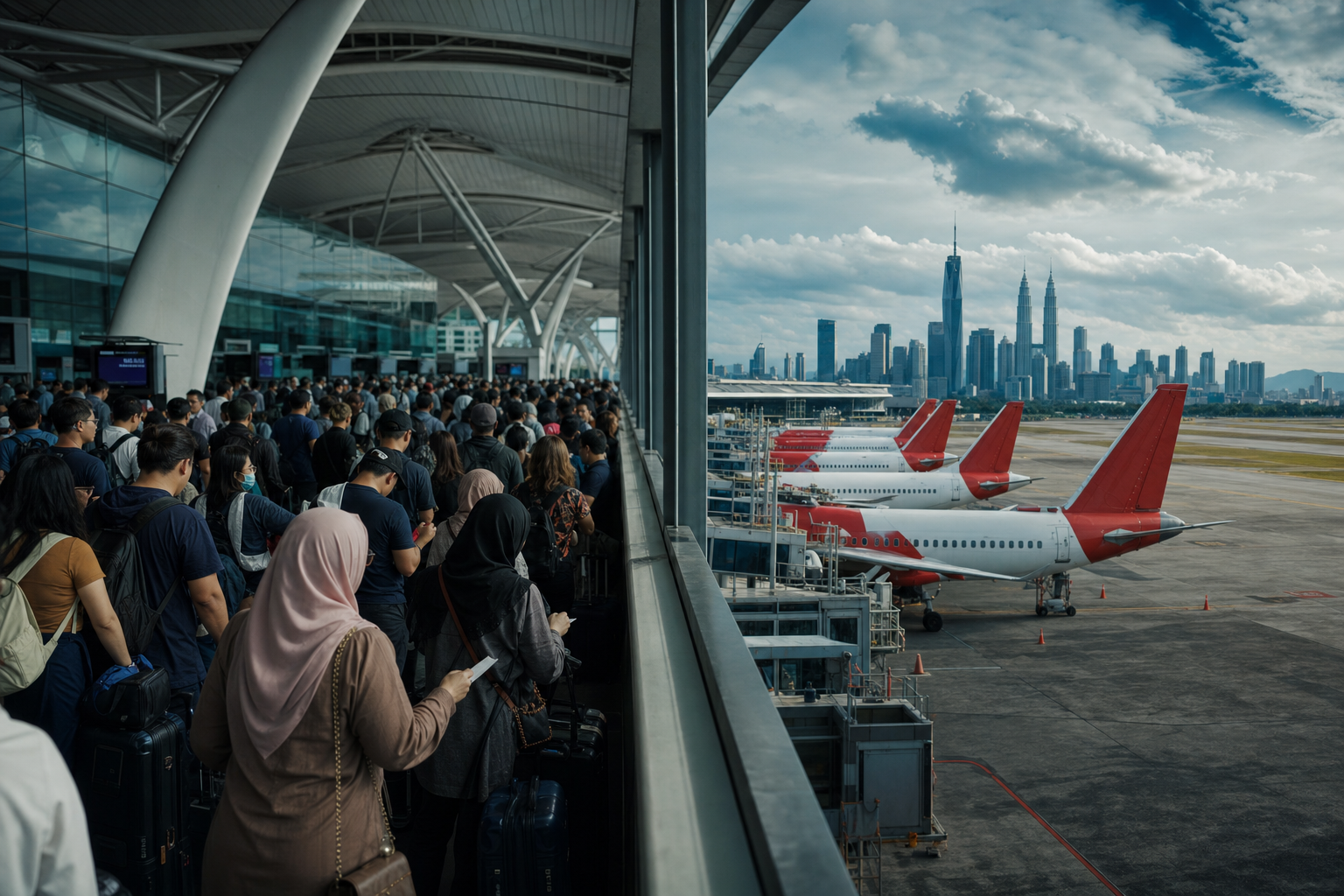
AirAsia shed RM2.35 billion in market value in a single week — and that's just the headline. The real story is what the wreckage reveals about the state of Malaysian travel heading into its biggest tourism year in a decade.
The Week That Shook Malaysia's Skies
AirAsia X lost RM2.35 billion in market value in five trading days. Not a quarter. Not a year. Five days.
For anyone watching Malaysia's travel sector from the outside, the headline looked like a turbulence event — sharp, alarming, over quickly. But for marketers, brand managers, and anyone whose business touches the movement of people around Southeast Asia, that number is less a shock and more a mirror. It reflects a travel industry that is simultaneously the most exciting it has been in years and the most structurally exposed.
The week that delivered AirAsia X's dramatic market selloff also brought a copyright accusation from an artist alleging his work was used without consent, a Philippine regulatory demand for US$14 million in unpaid dues, denials of a grounding campaign labelled a smear, news that co-founder Tony Fernandes is reportedly planning a new airline entirely, and confirmation that AirAsia X will be renamed simply AirAsia from January 2026. In any other industry, any single one of these stories would dominate the conversation for a fortnight. In Malaysian aviation, they arrived in a single news cycle.
The question worth asking is not whether AirAsia survives — it has survived worse, and Capital A's restructuring is reportedly entering its final chapter. The question is what all of this noise tells us about where Malaysian travel actually stands.
Restructuring as Narrative: What Capital A's Final Chapter Signals
Capital A's consolidation with AirAsia X — contingent on a key Thai regulatory condition waiver that was recently announced — is not merely a corporate tidying exercise. It is, in structural terms, the completion of a bet placed during the worst years of pandemic-era aviation: that the low-cost, high-frequency model would not just survive but centralise.
The rebrand of AirAsia X to AirAsia is telling in that context. A single brand across long-haul and short-haul routes signals an ambition to own the whole journey — from the RM99 Kuala Lumpur–Kota Kinabalu hop to the intercontinental leg. For travel marketers building campaign architecture around air connectivity, this consolidation simplifies some decisions and complicates others. A unified AirAsia brand carries more reach but also concentrates risk. The copyright dispute — an artist publicly accusing the airline of using his work without consent, picked up by the BBC — is a reminder that brand equity at scale requires proportionate governance around creative assets. Platforms like Creamatch, which connects brands with managed creator content in Malaysia, exist precisely because the cost of getting creative licensing wrong has never been higher.
Meanwhile, the reported plans by Tony Fernandes to launch a new airline add an intriguing subplot. If the architect of low-cost aviation in Southeast Asia believes there is a gap worth building into, the market should pay attention — not because another airline is guaranteed, but because it suggests the competitive map is not yet settled.
Tourism Malaysia's Counter-Narrative: The RM High-Value Push
While aviation burns headlines, Tourism Malaysia is quietly executing what may be its most ambitious repositioning in years. Malaysia has unveiled a high-value tourism vision anchored in luxury travel, eco-adventures, and cultural experiences — a deliberate pivot away from volume metrics toward yield-per-visitor ahead of Visit Malaysia 2026.
Sarawak is leading by example. Miri is hosting both the World National and World Asia Tapas 2026 competitions, positioning Borneo's culinary identity as a serious trade and tourism driver. This is not incidental hospitality programming; it is destination branding executed with precision, designed to generate international media coverage and B2B business event traffic simultaneously.
The festive travel data supports the momentum. Analysis of Malaysia's festive travel patterns shows a nation increasingly mobile and increasingly willing to spend — but also increasingly selective about where that spend goes. Travelers are not simply choosing cheaper; they are choosing better-matched.
Canada's recent move to expand visa-free air travel access for eligible Malaysians adds another layer to outbound confidence. When governments ease friction on movement, travelers respond — and the platforms that capture that intent earliest win. Agoda Malaysia and Traveloka, both deeply embedded in the regional search and booking ecosystem, are positioned to absorb that demand faster than any airline can reconfigure its route map.
What the Numbers Actually Say for Travel Marketers
Set aside the drama for a moment and read the signals as data.
The Verbrol tracking of Malaysian travel conversations over the past 48 hours shows a striking imbalance: aviation disruption stories are generating the clicks, but tourism growth stories are generating the decisions. The AirAsia turbulence draws eyeballs. The Sarawak culinary positioning and the Visit Malaysia 2026 pipeline draw bookings.
For brand managers, this gap matters enormously. If your media planning is calibrated to sentiment volume, you are currently reading a crisis. If it is calibrated to purchase intent signals, you are reading an opportunity.
A few specific takeaways worth acting on:
-
Domestic eco-tourism is underserved in content terms. Borneo adventure travel, river tourism, and indigenous cultural experiences are generating editorial coverage internationally but remain underrepresented in Malaysian brand campaigns. Malaysia Airlines and Firefly, both operating routes into Sabah and Sarawak, have a content arbitrage window that will not stay open indefinitely.
-
The rebrand cycle is a creative moment. AirAsia X becoming AirAsia creates a natural moment for travel brands to reassess co-marketing relationships. Uniform launches at KL Fashion Week — featuring regional craftsmanship — signal that the airline is leaning into heritage aesthetics. That is a conversation worth joining, provided the creative licensing is handled properly.
-
Youth travel intent is real but digitally complicated. Malaysia's under-16 social media ban has created new friction in how the next generation of travelers discovers destinations. Travel brands relying exclusively on social discovery funnels need to diversify — fast.
According to Bernama, Visit Malaysia 2026 is targeting 35.6 million tourist arrivals. That is an enormous number to move, and it will require a travel communications ecosystem that is significantly more coordinated than what currently exists. Free Malaysia Today has noted the mounting pressure on the aviation sector to deliver the connectivity that ambition requires — precisely when that sector is in the middle of its most complex restructuring in years.
The Road Ahead Is Still Worth Travelling
There is a version of this story that ends in alarm. RM2.35 billion gone, a founder reportedly walking away to build something new, regulatory battles in Manila, a copyright dispute on the BBC — none of it looks like calm skies.
But Malaysia's travel industry has never moved in calm skies. It was built in turbulence, by people who believed that cheap, frequent, connected movement was a democratic good. That belief has not changed. What has changed is the scale of the stage — Visit Malaysia 2026, a high-value tourism repositioning, a Borneo culinary moment, visa access expanding — and the sophistication required to perform on it.
For marketers, the opportunity is in the gap between the noise and the signal. The noise is aviation drama. The signal is a nation that wants to move, and a government that is building the infrastructure — physical, regulatory, and cultural — to let it.
Read that signal clearly, and the next twelve months in Malaysian travel are not a story of crisis. They are a story worth telling.
Track Travel trends in real-time at verbrol.com
Read more on Verbrol Intelligence:
- Malaysia's Tourism Boom Is Real — But the Ground Is Shifting
- AirAsia Is Bleeding. Malaysia's Tourism Dream Is Just Getting Started.
- AirAsia Bergolak, Visit Malaysia 2026 Mendekat — Siapa Yang Betul-Betul Bersedia?
Related Reading
- Malaysia's Tourism Boom Is Real — But the Ground Is Shifting
- Malaysia's Sky Is Reshaping: What the AirAsia Pivot Means for Travel
- Sebelum Kau Beli Tiket Untuk Visit Malaysia 2026, Baca Ini Dulu
Frequently Asked Questions
Why did AirAsia X lose so much market value in just five days? AirAsia X lost RM2.35 billion in market value over five trading days due to a combination of issues including copyright accusations, a Philippine regulatory demand for US$14 million in unpaid dues, denial of grounding campaign allegations, and news that co-founder Tony Fernandes is planning a new airline. These multiple negative stories hitting simultaneously created investor concern about the airline's stability and future.
Is AirAsia going to shut down or go out of business? No, AirAsia is expected to survive despite the turbulent week. Capital A's restructuring is reportedly entering its final chapter, and the airline has weathered serious challenges in the past, so complete failure is unlikely. However, the company is undergoing significant changes, including a rebranding where AirAsia X will be renamed simply 'AirAsia' from January 2026.
What does AirAsia's crisis mean for Malaysian travelers? AirAsia's turbulent week reveals that Malaysia's travel sector is simultaneously at its most exciting in years but also structurally vulnerable and exposed to risk. For travelers, this suggests the need to monitor developments closely, as the industry's challenges could eventually affect service quality, pricing, or route availability.
What is Tony Fernandes doing now with a new airline? Co-founder Tony Fernandes is reportedly planning to launch an entirely new airline, which signals his continued ambitions in aviation despite AirAsia's recent troubles. This move suggests he may be pursuing different business opportunities separate from Capital A's restructuring efforts.