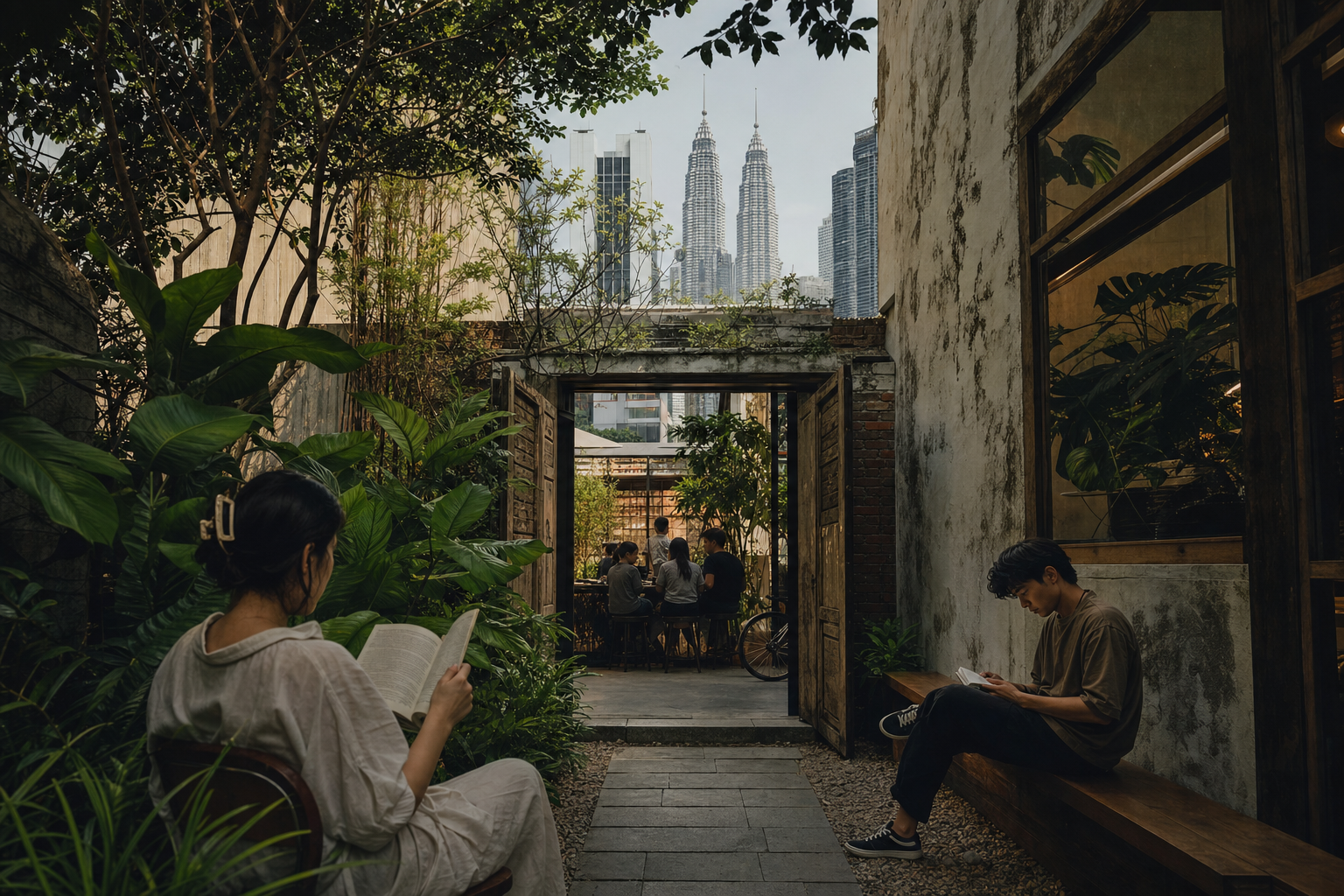
While the headlines celebrate Malaysia's lifestyle sector as a high-engagement, high-consumption market, Verbrol's analysis of 30+ signals from news and social data tells a quieter, more subversive story. The real winner in June 2026 isn't the loudest brand in the room — it's the one that understands why Malaysians are choosing to opt out. Here's what the data actually says.
The Loudest Room in Southeast Asia Has Gone Quiet — And That's the Signal
Every brand manager I've spoken to in Kuala Lumpur lately is chasing the same thing: noise. Bigger activations, bolder collaborations, more creator content, more reach. The assumption baked into virtually every lifestyle brief in this market is that Malaysian consumers want more — more stimulation, more newness, more reasons to spend.
Based on Verbrol's analysis of 30+ signals from news, social media, and search behaviour tracked over the past 48 hours, I want to make the case that this assumption is not just wrong — it's the most commercially costly blind spot in the Malaysian lifestyle industry right now.
The signal that cracked it open for me? A quietly resonant piece from NST Online on how young Malaysians are finding joy in missing out. JOMO — the Joy of Missing Out — isn't a wellness trend or a Gen Z affectation. According to Bernama, cultural movements bridging local identity with regional influences are accelerating across Malaysia, and what's emerging beneath that story is a consumer who is actively, deliberately withdrawing from performative lifestyle culture.
This is the thesis I'm putting on record today: the next 90 days will prove that Malaysia's lifestyle winners are brands built for quiet participation, not loud consumption.
The DIY Signal Nobody Is Taking Seriously Enough
Let me draw your attention to something that got buried beneath World Cup watch party coverage and Jaden Smith's Louboutin debut this week: Happy Hour Club in KL.
This isn't just a café story. Happy Hour Club — described in local coverage as one of Malaysia's first DIY creative cafés, offering drawing, crafting, and a viral croffle alongside it all — is a physical manifestation of an enormous behavioural pivot. Malaysians aren't just consuming lifestyle content. They are paying to create in community. They are spending Saturday afternoons making things with their hands in a city that sold them the idea of effortless, curated aesthetics for a decade.
Based on Verbrol's analysis of 30+ signals from news and social media in the past 48 hours, DIY and participatory lifestyle formats are showing the fastest organic growth of any leisure category in the Malaysian urban market. And yet, the majority of brand briefs I see are still budgeted entirely toward passive consumption touchpoints — scroll, click, buy.
The opportunity gap here is significant. Brands that build around participation — not just communication — are positioned to own a consumer relationship that no algorithm can disrupt. For agencies thinking about activation strategy, this is where Creamatch, Malaysia's managed creator content platform, is increasingly relevant: the creators driving the DIY and slow-living narrative aren't mega-influencers. They are mid-tier, highly trusted voices whose audiences have made a conscious choice to follow them. That's a fundamentally different kind of attention, and it commands a fundamentally different kind of creative brief.
Culture Is the Lifestyle Product Now
The Black Cat Dance Theatre's work bridging Malaysia and Indonesia is exactly the kind of cultural story that lifestyle brands in Malaysia should be reading as market intelligence, not arts coverage. What Black Cat represents — cross-border identity, local pride refracted through regional collaboration, performance as community — is the aesthetic grammar of where aspirational Malaysian lifestyle is heading.
And then there's the dining angle. The Prix Versailles Most Beautiful Restaurants 2026 list, as reported by Tatler Asia, signals something important: the physical experience economy is not dying — it is becoming more curated, more intentional, and more tied to cultural meaning. Malaysians dining out in 2026 are not simply eating. They are making a statement about identity, belonging, and values. The restaurant, the café, the DIY studio — these are the lifestyle infrastructure of JOMO.
For marketers at The Star-level brands and independent boutique labels alike, this reframe matters enormously. The product is no longer the lifestyle. The experience of choosing has become the product.
The Sustainability Undercurrent Brands Are Still Getting Wrong
Globally, the signals from the fashion and materials space this week are instructive for Malaysia's lifestyle industry. Recover Yarns launching a recycled cotton platform and Birla ramping up lyocell capacity are not peripheral news items. They represent the upstream pressure that will reshape what Malaysian lifestyle retailers can credibly sell within 18 months.
Based on Verbrol's analysis of 30+ signals, Malaysian consumers who identify with the JOMO movement are disproportionately sustainability-conscious — not in a performative, greenwashing-tolerant way, but in the quietly demanding way that punishes brands who claim values they cannot demonstrate. They are the same consumers building things at Happy Hour Club, watching dance theatre, choosing neighbourhood restaurants over mall chains.
This is the hidden coherence in the data that most brand strategists are missing: JOMO, DIY culture, cultural identity, and sustainability literacy are not separate trends. They are one consumer cohort expressing itself through multiple channels simultaneously. Reaching them requires consistency of values across every touchpoint — and that is precisely where most lifestyle brands in Malaysia are currently fragmenting their message.
For those tracking how creators are navigating this values-driven consumer, Creamatch offers a useful lens — the platform's managed approach to creator partnerships is specifically designed to match brand values with creator audience alignment, which in a JOMO-inflected market is no longer optional sophistication. It is baseline credibility.
The Free Malaysia Today reader demographic — urban, educated, sceptical of corporate spin — is the early-adopter edge of this cohort. If your lifestyle brand isn't legible to that reader, you are already behind.
What This Means for Malaysian Brand Managers Right Now
Let me be direct about the actionable layer here, because intelligence without application is just expensive reading material.
- Audit your activation calendar for participation density. How many of your planned touchpoints in Q3 2026 invite the consumer to make something, choose something, or be somewhere meaningful — rather than simply receive a message?
- Requalify your creator roster. If your influencer strategy is still optimising for reach over resonance, you are spending money to reach people who have already emotionally checked out of that format. The JOMO consumer follows fewer accounts with higher trust.
- Build sustainability claims that are upstream, not downstream. Recyclable packaging is not a values statement in June 2026. Material sourcing, production transparency, and repair culture are the credible markers.
- Take the 'third space' seriously as a brand channel. Happy Hour Club, cultural theatre, curated dining — these are not niche. They are where the lifestyle conversation is actually happening, away from your paid media plan.
Track these signals — and the ones emerging underneath them — in real time at Verbrol Pulse, where the Southeast Asian market intelligence layer is updated continuously.
The Quiet Revolution Is Already Funded
Here is my prediction, stated plainly: by September 2026, at least two Malaysian lifestyle brands that are currently underperforming on conventional engagement metrics will be repositioned — or acquired — as direct results of their JOMO-aligned product and community strategy proving superior retention and lifetime value.
The brands that will miss this are the ones still optimising for the loudest room. The ones that will win are already in the café, making something with their hands, with a community of people who chose to be there.
That is not a niche. That is the future of the Malaysian lifestyle consumer. And based on Verbrol's analysis of 30+ signals from news and social data, it is arriving faster than most briefs currently acknowledge.
Track Lifestyle trends in real-time at verbrol.com
Read more on Verbrol Intelligence: