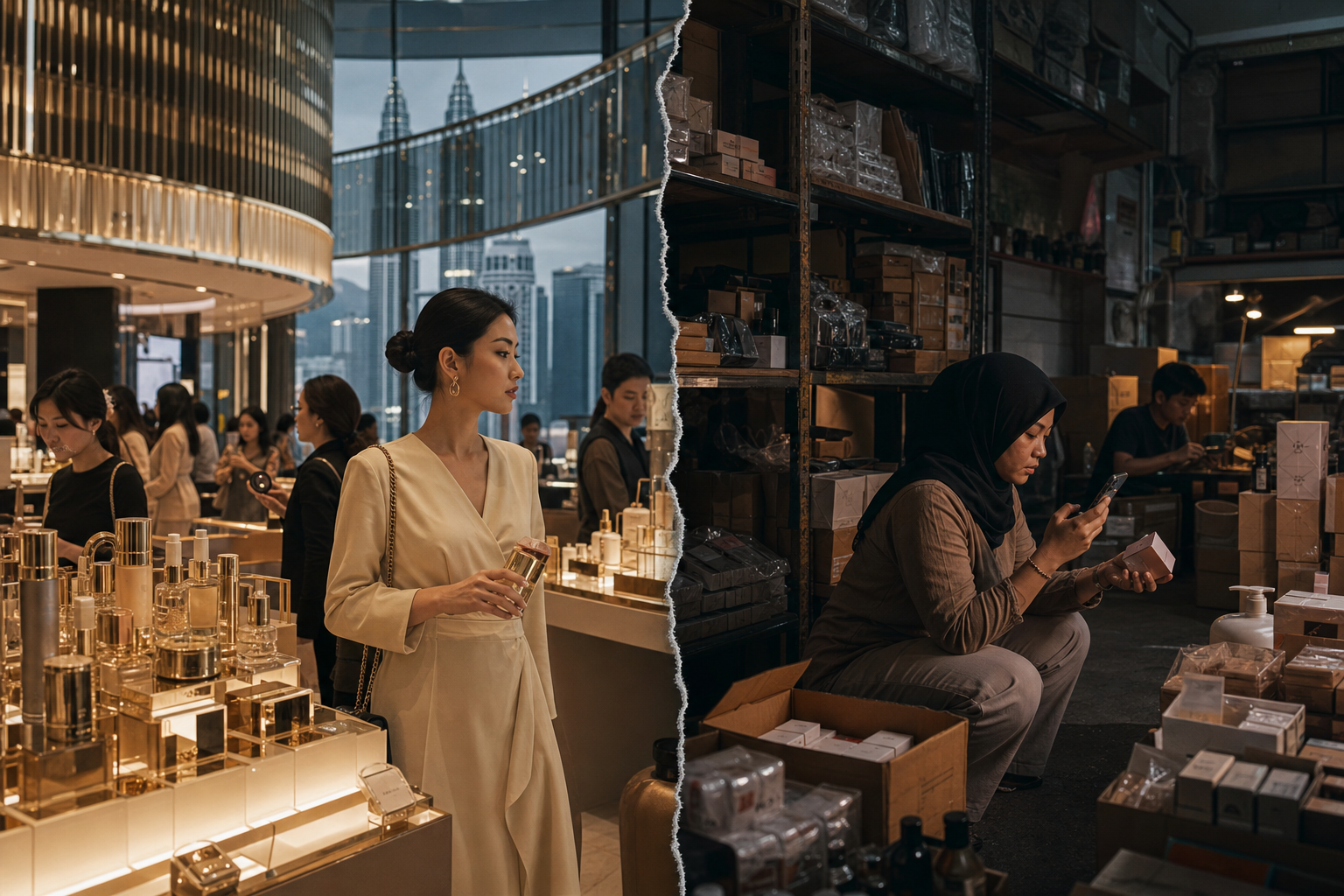
Big luxury labels are staging theatre in Bukit Bintang while banned products quietly sell out on Shopee — and the distance between those two realities is exactly where Malaysia's beauty market lives right now.
The scene at Bukit Bintang on a Thursday evening tells you everything about the state of Malaysian beauty in 2026. Crowds gather not for a sale, but for a moment — YSL Beauty has transformed a traditional kopitiam into a full sensory brand installation to mark its TikTok Shop debut. The campaign is polished, aspirational, and deeply intentional. Two kilometres away, a consumer is screenshot-sharing a product flagged by Malaysia's National Pharmaceutical Regulatory Agency — still live, still selling, still collecting five-star reviews.
These are not contradictions. They are the twin poles of a market in full, fascinating tension.
The Quiet Architecture of a Two-Speed Market
Malaysia's beauty industry has long been celebrated as one of Southeast Asia's most sophisticated — a confluence of Malay, Chinese, Indian, and expatriate consumer cultures, overlaid with a robust halal-certification ecosystem and an increasingly digitally native shopper. But 2026 has sharpened a fault line that marketers can no longer afford to treat as background noise.
On one side: a premium segment growing more theatrical, more experiential, and more globally integrated. Korean beauty innovation is arriving with serious momentum — brands like HaruHaru Wonder are entering Malaysian retail infrastructure through platforms and partnerships that signal permanence, not a trend cycle. Local marque Bartech Beautee is positioning itself for broader Asian expansion, according to reporting by Bernama, reflecting a genuine maturation of home-grown formulation capability.
On the other: a grey-market underbelly where forty consumers recently raised collective alarm over a banned skincare product continuing to circulate through online channels, as reported by NST Online via Threads. It did not quietly disappear. It kept selling. The engagement around that warning — spreading person-to-person across social feeds — speaks to how trust, once fractured, metastasises into public anxiety.
For brand managers, this split demands a strategic position, not a diplomatic middle ground.
Where the Premium Gravity Is Pulling
The retail infrastructure for premium beauty in Malaysia is consolidating around a handful of decisive players. Guardian Malaysia has just been recognised as a leader in health, beauty, and wellness retailing at the Retail Asia Awards 2026, with digital transformation and loyalty programme design explicitly cited. This is not a vanity award — it maps the direction of serious investment. Watsons Malaysia and Sephora Malaysia continue to anchor the experiential retail proposition at the luxury-accessible tier, while Caring Pharmacy holds its community-trusted position in the wellness-adjacent space.
The KLCC-based COSMOBEAUTÉ MALAYSIA & BEAUTYEXPO 2026 returns with a B2B-first mandate, signalling that the industry's gatekeepers are actively shaping distribution standards. When the trade show architecture shifts to emphasise legitimate B2B pathways, the implicit message to grey-market operators is unmistakable.
Brands like Safi and SimplySiti — deeply embedded in the halal-certified, mass-prestige segment — are navigating a consumer who simultaneously wants scientific credibility and cultural resonance. That is not an easy brief, but it is a real and growing one. According to reporting by The Star, demand for science-backed Korean formulations is creating a secondary pressure on local brands to elevate their ingredient storytelling.
The Creator Economy as Trust Infrastructure
Here is what the YSL kopitiam activation understood intuitively: in a market bifurcated between aspiration and anxiety, trust is the only currency that crosses both lanes. Experiential moments translate to creator content, creator content translates to peer validation, and peer validation is — in 2026 — the closest thing to guaranteed conversion among Malaysian consumers aged 22 to 38.
The implications for brand strategy are structural. When forty women publicly circulate warnings about a banned product, they are performing the same social trust function as forty influencers performing a haul review — only the signal is negative. The mechanics are identical. Brands that understand this stop treating creator partnerships as a promotional line item and start treating them as reputational infrastructure.
Platforms like Creamatch, Malaysia's managed creator content service, are increasingly relevant here — not simply for reach, but for the curatorial rigour they apply to brand-creator matching. In a market where one badly chosen partnership can expose a brand to the same anxiety spiral triggered by a flagged product, the quality of that matching process is no longer optional.
Actionable considerations for brand managers:
- Position explicitly, not vaguely. In a split market, neutral branding reads as evasion. Define whether you are the credentialled choice or the accessible choice — then build every touchpoint around that commitment.
- Treat regulatory compliance as a brand asset. The NST-reported alarm over banned products circulating on e-commerce platforms is a trust vacuum. Brands with documented, visible compliance records can fill it deliberately.
- Invest in creator relationships with strategic patience. Transactional influencer campaigns generate noise. Long-term creator relationships — managed with the rigour that platforms like Creamatch apply — generate authority.
- Watch the B2B layer. COSMOBEAUTÉ's institutional ambition signals that distribution standards are tightening. Early alignment with legitimate trade infrastructure is a competitive advantage, not just hygiene.
The Market Signal Brands Keep Missing
Social listening data tracked via Verbrol Pulse consistently surfaces a pattern that underwrites everything above: Malaysian beauty consumers do not separate the emotional experience of a product from the institutional credibility of the brand selling it. They want the ritual and the receipts.
The brands that will define this market's next chapter — whether homegrown ambitions like Bartech Beautee scaling across Asia, or global names localising with the sophistication YSL demonstrated in Bukit Bintang — are the ones treating trust not as a marketing outcome, but as a design principle baked into every layer of the business.
Malaysia's beauty industry is not in crisis. It is in selection. The consumers are choosing, the retailers are choosing, the trade infrastructure is choosing. The only question is whether your brand is choosing too — or waiting to see which side wins.
Track Beauty trends in real-time at verbrol.com
Read more on Verbrol Intelligence: