Malaysia's carmakers are not just launching new models — they are rewiring the entire supply chain beneath them. The next 18 months will determine whether the country assembles or actually builds.
Perodua has priced its first EV at RM63,499 — roughly the cost of a well-equipped Myvi Turbo with a sunroof and leather seats. That number alone tells you something important has shifted, not just in product strategy, but deep inside the production architecture that makes a price like that physically possible.
This is not a one-brand story. Across June 2026, a cluster of supply chain decisions — a new paint facility in Melaka, a RM140 million Thai parts-maker entering Proton's orbit, and BYD crossing 20,000 cumulative units in Malaysia — are collectively redrawing the structure of how cars are made and sold here. For brand managers, procurement heads, and anyone tracking industrial Malaysia, the signals are unusually coherent right now.
Localisation Is the Engine Behind Perodua's EV Pricing
The Perodua QV-E's revised pricing — RM63,499 with Battery-as-a-Service (BaaS) leasing, or RM87,499 for outright purchase — did not emerge from a boardroom negotiation on margin. It emerged from a localisation shift that Perodua itself described as a "major" one. When a national carmaker moves component sourcing closer to home, the bill-of-materials drops, and that compression flows directly into the sticker price.
The BaaS model deserves separate attention. By separating the battery from the vehicle price, Perodua addresses two of the most structurally stubborn barriers to EV adoption in Malaysia: residual value uncertainty and battery degradation anxiety. A buyer at RM63,499 is not committing to an asset that degrades unpredictably — they are committing to a mobility contract. This is a supply chain and commercial model innovation running simultaneously.
The confirmed 2025 launch timeline and the RM80,000 ballpark pricing that circulated earlier via Paul Tan's Automotive News have now crystallised into something more precise. The gap between that earlier estimate and the actual BaaS price reflects how aggressively localisation compressed costs in the intervening months.
As Malaysia's auto sector must shift gears beyond assembly noted by NST Online, the Deputy Minister of Investment, Trade and Industry has been explicit: assembly alone will not sustain Malaysia's automotive competitiveness. Perodua's localisation push is the industrial policy response playing out in real commercial terms.
EPMB's Melaka Facility and the Infrastructure of Scale
While Perodua commands the headline, EP Manufacturing Berhad (EPMB) is quietly laying the physical infrastructure that the next generation of Malaysian-made vehicles will depend on.
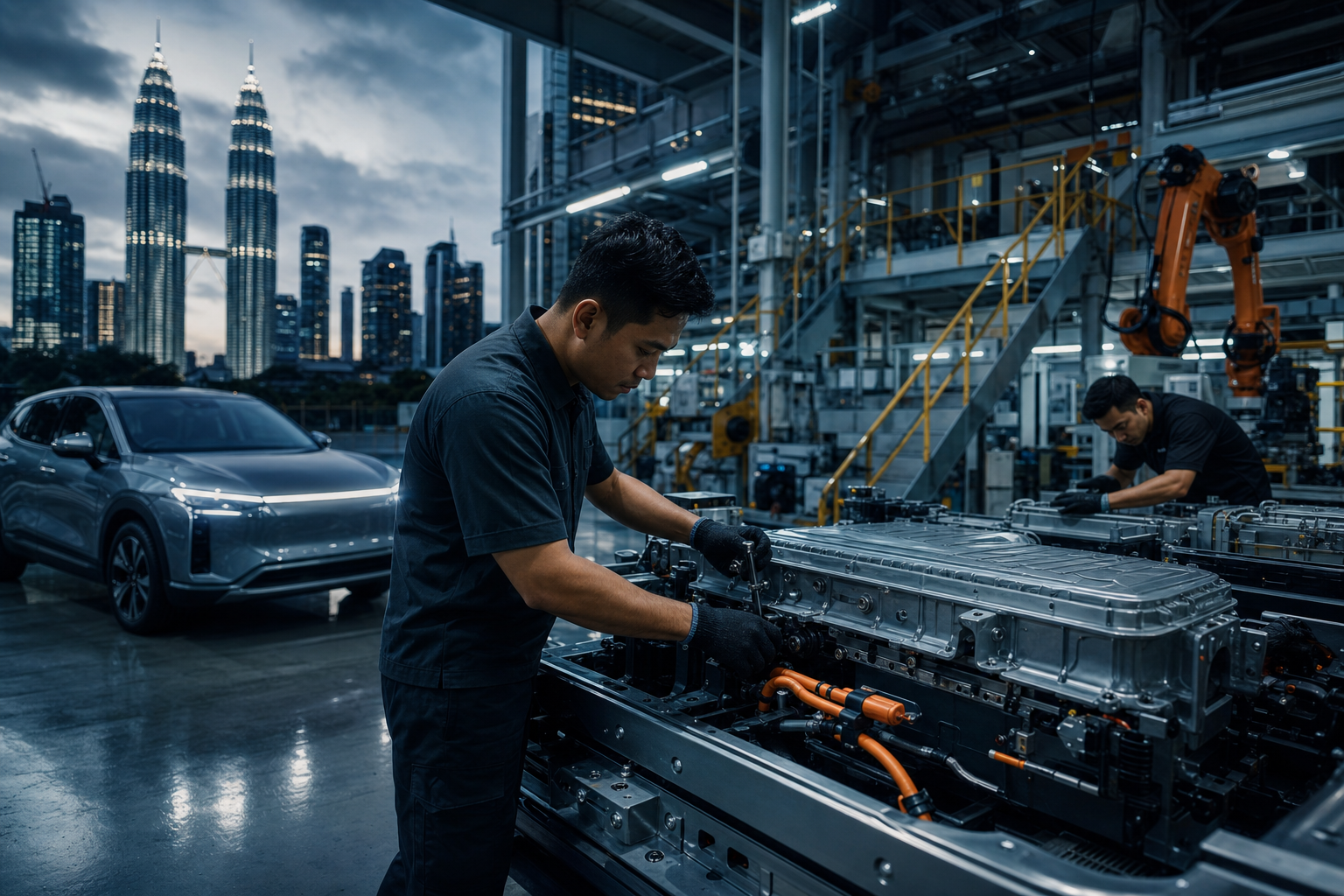
EPMB broke ground this month on a new vehicle painting facility at its Melaka CKD hub. The facility carries a RM200 million investment footprint, targets 30,000 units of annual capacity, and is scheduled to be operational by June 30, 2027. As reported by The Edge Malaysia on EPMB's expanded automotive manufacturing footprint, this represents a direct capacity bet on CKD volume growth in Malaysia.
Painting is not a peripheral process. It sits at the intersection of aesthetics, corrosion protection, and regulatory compliance — and it is one of the more capital-intensive stages in vehicle finishing. A domestic facility at this scale reduces Malaysia's dependence on imported semi-finished bodies and shortens the logistics chain for OEM partners operating locally.
For Tier 1 and Tier 2 suppliers watching this, the signal is that the mid-decade CKD pipeline is real and investable. EPMB is not building for current volume — it is building for the volume it expects between 2027 and 2032.
Proton-Aapico and the Cross-Border Parts Ecosystem
The Proton-Aapico deal announced this week adds a regional dimension to Malaysia's automotive supply chain realignment. Aapico Hitech — Thailand's largest auto parts manufacturer — is partnering with Proton to invest RM140 million into Avee Global (Miyazu), a Malaysian stamping and components operation.
This matters for several reasons. First, it brings Thai manufacturing expertise directly into the Proton supply network, which has historically leaned on Chinese and European technical partners via Geely. Second, it signals that ASEAN supply chain integration is accelerating at the parts level, not just at the trade-agreement level. Thailand's auto parts industry is among the most technically sophisticated in Southeast Asia — Aapico's entry into Malaysia is a capability transfer, not merely a capital injection.
For procurement and sourcing professionals, the Proton-Aapico structure also points toward a broader trend: national carmakers in ASEAN are no longer sourcing purely from within their home markets or from distant global Tier 1 suppliers. The middle layer — regionally capable ASEAN parts makers — is becoming strategically important.
Malaysia's automotive sector has been urged to move up the value chain by industry stakeholders — and what Aapico's entry demonstrates is that the value chain is being constructed through inbound foreign direct investment, not just domestic capability building.
BYD's 20,000-Unit Baseline and What It Means for Incumbents
BYD has now sold more than 20,000 vehicles in Malaysia, holding the top EV brand position for three consecutive years. The 2026 BYD Atto 3 facelift drew 1,000 bookings within 10 days of opening — and the 510 km Premium RWD variant is outselling the standard configuration, which suggests Malaysian EV buyers are not just price-sensitive but range-sensitive.
For Honda Malaysia and Toyota Malaysia, the BYD trajectory is an accelerating benchmark problem. Both brands have strong hybrid portfolios, but neither has a fully-electric model at volume pricing that competes with BYD's RM100,000–RM150,000 range. The gap is not just in product — it is in charging infrastructure confidence, after-sales network perception, and the battery leasing model innovation that Perodua is now pioneering domestically.
Brand managers at incumbent OEMs should be reading the Atto 3 booking data carefully. Ten days to 1,000 units on a facelift — not a new nameplate — indicates that BYD's Malaysian buyer base is now self-reinforcing through community and word-of-mouth. According to Bernama, the broader Malaysian EV registration trend has been consistently upward, and BYD's dominance suggests that early market-share capture in EVs compounds over time through service familiarity and ecosystem lock-in.
For marketing teams tracking how EV sentiment translates into purchase behaviour, Verbrol Pulse provides real-time social signal tracking across automotive categories in Malaysia — useful for monitoring how booking momentum like BYD's surfaces in organic conversation before it appears in registration data.
What This Means for the Next 18 Months
The pattern across these signals is not coincidental. Malaysia's automotive industry is executing a structural shift on three simultaneous tracks:
- Localisation depth — reducing imported content in EVs to unlock competitive pricing (Perodua QV-E)
- Manufacturing infrastructure — building domestic capacity in capital-intensive processes (EPMB Melaka)
- Regional supply chain integration — pulling ASEAN parts capability into national OEM networks (Proton-Aapico)
For brand and marketing professionals, the practical implication is that product messaging in the Malaysian auto market will need to evolve beyond feature-and-price comparisons. Buyers — particularly in the EV segment — are increasingly responding to structural confidence signals: battery ownership models, service network depth, and manufacturing provenance.
As Paul Tan's Automotive News has covered extensively, Malaysia's auto industry must move up the value chain — and the current cluster of investment decisions suggests that movement is no longer aspirational. It is being bolted to the floor in Melaka, stamped in Proton's supply network, and priced into Perodua's showroom.
If your brand or agency works in automotive content, this is a moment where supply chain credibility — communicated clearly and honestly — becomes a genuine marketing asset. Platforms like Creamatch, Malaysia's managed creator content platform, are increasingly being used to translate complex product narratives (battery leasing, localisation, range confidence) into formats that reach actual car buyers rather than just industry observers.
The assembly era is not ending — it is being upgraded. The brands and suppliers that understand this structural shift earliest will be better positioned to communicate it, and to benefit from it.
Track Auto trends in real-time at verbrol.com
Read more on Verbrol Intelligence: