Croffle stations, rage rooms, and World Cup watch parties — a quieter but more durable shift is remaking how Malaysians choose to spend their time, money, and identity.
There is a café tucked inside the bustle of Kuala Lumpur where you can spend an afternoon learning to draw, press your own waffles into croissant shapes, and leave with something you actually made yourself. Happy Hour Club, one of the city's first creative DIY cafés, is not — at its core — selling coffee. It is selling the feeling of making something, in a room full of strangers who came to do the same thing. That distinction matters more than it might first appear.
In a market where engagement metrics on brand announcements routinely hover near zero and consumer attention has fractured across a dozen platforms, the lifestyle businesses quietly pulling people off their sofas in Malaysia in June 2026 share a single quality: they offer a reason to be somewhere specific, together.
The Quiet Shift From Product to Place
For years, the conventional wisdom in Malaysian retail was that footfall was dying — that AEON and Parkson were fighting a rearguard action against e-commerce, and that the future was a last-mile logistics race. That story is not wrong, exactly. But it is incomplete.
What is actually emerging is a bifurcation. Commodity purchasing — your basic wardrobe refresh at Uniqlo Malaysia, your household staples from Mr DIY — continues its migration to convenience-first channels. But experiential spending is moving in the opposite direction, toward density, sensation, and sociability. PartyBox 360 at Lalaport Bukit Bintang City Centre, which houses a running man challenge arena, a rage room, and an escape room under one roof, is a vivid expression of this logic. These are not amenities bolted onto a retail destination. The experience is the destination.
This reorientation has structural roots. Health advocates in Malaysia are pushing for incentive frameworks that reward active, community-engaged living — an implicit acknowledgment that Malaysians are increasingly defining wellness not through individual consumption but through participation. That shift in how people conceptualise the good life is filtering directly into the choices lifestyle brands must now make.
The Football Effect: Community as a Consumption Event
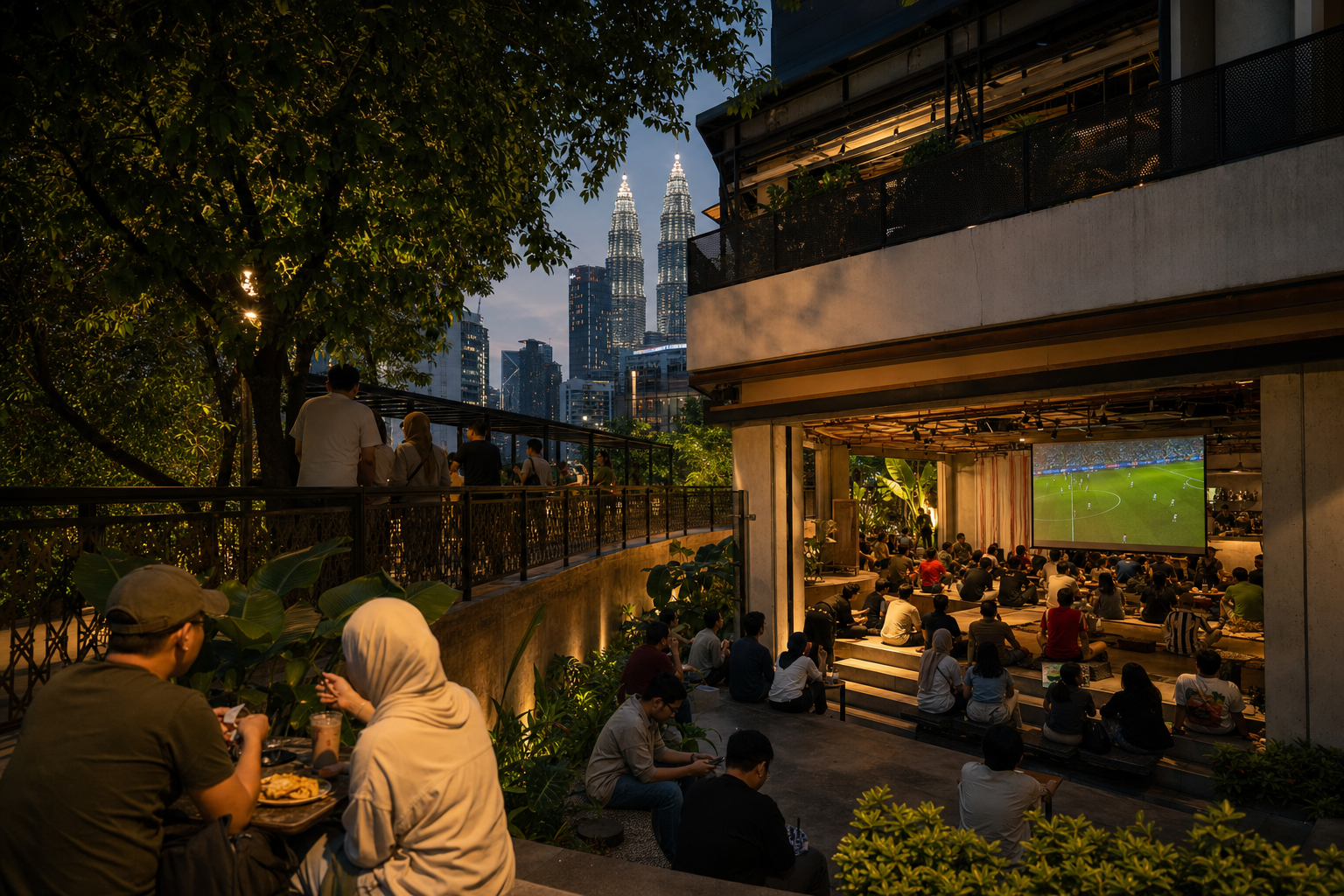
Nothing stress-tests the third-place thesis quite like a FIFA World Cup. The 2026 tournament, co-hosted across North America, has Malaysians watching at unusual hours — and the brands, venues, and platforms smart enough to meet that social hunger are the ones generating real cut-through right now.
Malaysian football fans are actively seeking curated spaces to watch the 2026 FIFA World Cup together, from sports bars to shopping mall screening events. The appetite is communal, and it is pulling discretionary spending — food, beverages, merchandise — into physical spaces that might otherwise have struggled to justify their square footage on a Tuesday night.
For brand managers, this is not a football story. It is a proof-of-concept for something broader: when Malaysians have sufficient social activation, they will show up, physically, and they will spend. The lifestyle brands winning in this environment are those who understand they are in the occasion business, not the product business.
Globally, Lisa of BLACKPINK performing at the FIFA World Cup in custom platform boots, and Katy Perry working the crowd in Aquazzura wedges, signals something relevant even for the Malaysian market: lifestyle aspiration in 2026 is inseparable from live, shared cultural moments. The international noise filters through platforms like RedNote — a channel that, according to South China Morning Post reporting on Malaysia's growing appeal to Chinese digitally-fatigued youth, is fast becoming a lifestyle discovery engine for the region.
Craft, Heritage, and the Search for Soulful Products
Not every third-place impulse is about spectacle. Some of it is slower and more deliberate — and, arguably, more durable.
Ferragamo's Father's Day campaign leaning into artisanal craft, and Black Cat Dance Theatre building cultural bridges between Malaysia and Indonesia, both reflect a consumer appetite that Verbrol has been tracking consistently across Southeast Asian markets: people are gravitating toward things that carry a story, a hand, a provenance. Bonia, Malaysia's own leather goods house, has long understood this instinct — the brand's persistence in a market saturated with fast-fashion accessories speaks to the enduring value of craft identity in a local context.
Padini, meanwhile, occupies interesting territory here. Its success has always rested on accessible, reliable basics — but as the experiential economy pulls aspirational spending upward and commodity spending downward, mid-market lifestyle brands face the challenge of articulating why a customer should build loyalty rather than simply comparison-shop. The brands navigating this most effectively are those investing in in-store experience and community touchpoints, not merely price competitiveness.
For content and creator strategy, this is a productive tension. Platforms like Creamatch, which connects brands with managed creator content in Malaysia, are increasingly seeing briefs shift away from simple product showcases toward lifestyle integration — creators embedded in experiences, occasions, and communities, not just holding a product to camera.
What Brand Managers Should Do With This
The practical read from the signals accumulating across Malaysia's lifestyle sector this June is not complicated, but it does require a shift in planning instinct:
- Design for the occasion first, the product second. Whether you are activating around the World Cup, a public holiday, or a weekend afternoon in KL, the question is: what does your brand make possible for a group of people?
- Invest in the physical third place, even if your product is digital. Happy Hour Club's croffle and drawing sessions generate content, community, and conversion in ways a static feed post never will. If you have retail presence, treat it as programming, not just shelving.
- Heritage and craft are not niche signals. Across categories — fashion, food, gifting — consumers are demonstrating consistent preference for products with legible origin stories. This is an opportunity for Malaysian brands with genuine craft credentials to own narrative ground that international fast-fashion cannot occupy.
- Track the platforms where lifestyle discovery is actually happening. RedNote's growing relevance in Malaysia is not a footnote; it is an early signal of where the next cohort of lifestyle consumers is forming their preferences. According to The Star and Free Malaysia Today, cross-cultural digital migration is reshaping not just media habits but purchasing identity among younger Malaysians.
The lifestyle industry in Malaysia in mid-2026 is not contracting — it is concentrating, around moments of genuine shared experience. The brands, venues, and creators who understand that they are architects of occasion, not just suppliers of product, are the ones already building the next chapter.
Track Lifestyle trends in real-time at verbrol.com
Read more on Verbrol Intelligence: