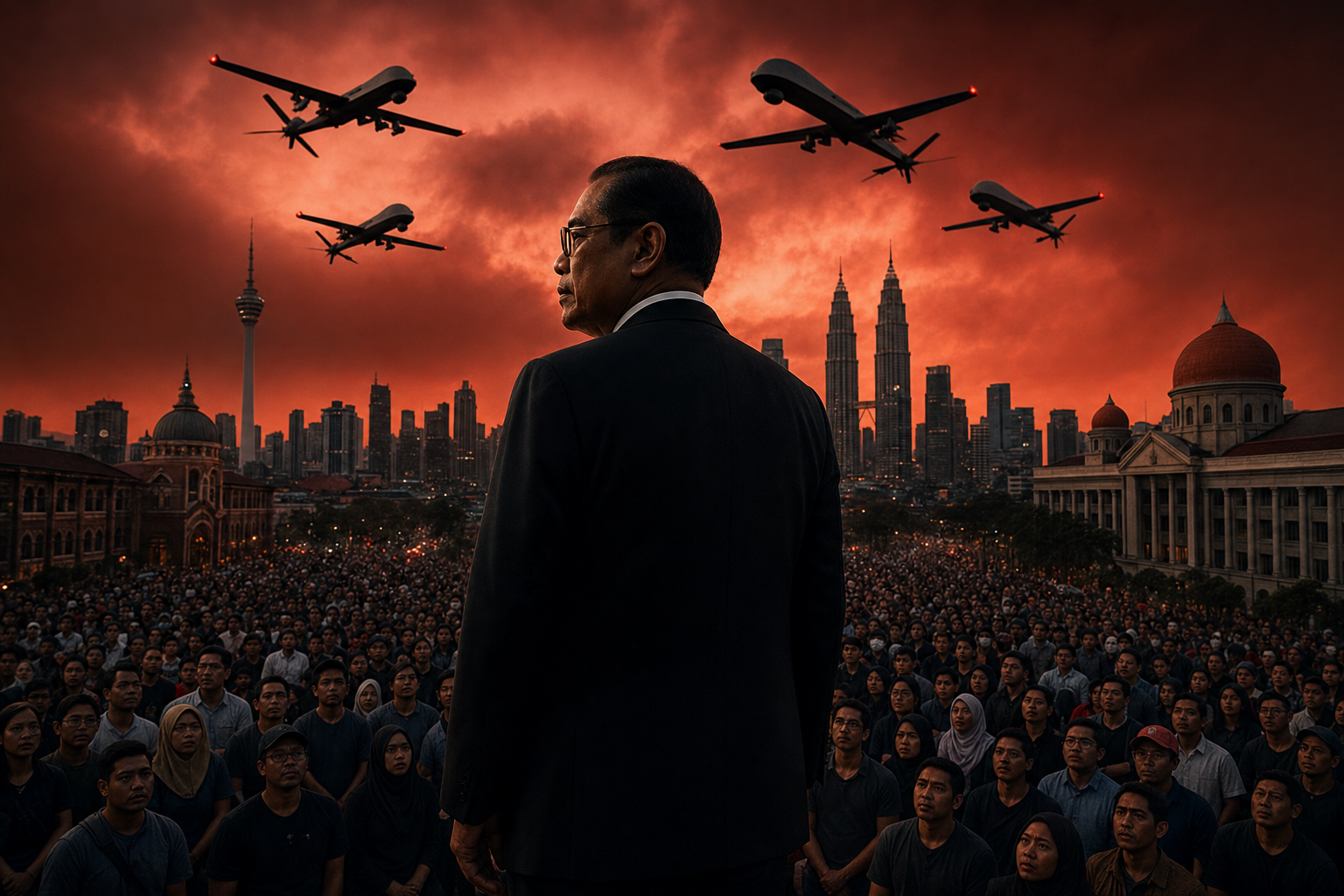
Khaled Nordin's ANKA-S drone acquisitions and six-pillar TUDM modernisation plan signal a multi-year defence procurement cycle with real business implications.
Three Turkish drones landing on Malaysian soil — and the man signing off on the next batch is already asking for more.
Defence Minister Khaled Nordin's recent moves around the Royal Malaysian Air Force (TUDM) are generating more than just military headlines. The procurement of three ANKA-S Medium Altitude Long Endurance (MALE) unmanned aerial systems, combined with active signals toward a second-phase acquisition, represents a quietly significant shift in how Malaysia's defence budget is being deployed — and which industries stand to benefit.
The Drone Deal as a Business Signal
The ANKA-S is not an off-the-shelf purchase from a global superpower. It is a Turkish-manufactured system, built by Turkish Aerospace Industries (TAI), and its arrival in Malaysia's fleet marks a deliberate pivot toward mid-tier defence partnerships that balance cost, capability, and geopolitical neutrality.
For Malaysian businesses watching procurement cycles, this matters. Defence acquisitions of this scale rarely travel alone. They typically carry with them maintenance contracts, local integration requirements, training programmes, and — increasingly under Malaysia's defence industrial policy — technology transfer expectations. The ANKA-S deal opens a conversation about whether Malaysian aerospace and defence contractors, from the Subang-based maintenance ecosystem to emerging drone-tech firms, are positioned to capture downstream value.
Khaled's public framing of the acquisition — describing ANKA-S operations as a leap in maritime surveillance capability — also signals where the ministry sees its spending justified. The South China Sea remains the primary theatre, and any asset deployed there carries strategic weight that translates directly into sustained operational budgets.
Six Pillars, One Strategic Roadmap
Beyond the drone procurement, Khaled has been publicly articulating a six-pillar framework to modernise TUDM as it marks its 68th year — a structure the ministry is branding under the banner of 'Air Power, Shield of the Nation.' The language is aspirational, but the underlying architecture is procurement-driven.
For the defence industry, a structured multi-pillar modernisation plan is essentially a forward-looking tender roadmap. It tells suppliers, integrators, and technology partners what categories of capability the ministry intends to build out, and over what approximate horizon. Surveillance, interoperability, and unmanned systems appear to sit at the top of that priority stack based on recent acquisition activity.
Investors tracking Malaysian defence-adjacent stocks — from companies involved in systems integration to those with aerospace MRO exposure — would do well to map their portfolios against these six pillars. The ministry rarely announces procurement intentions this clearly.
Layang-Layang and the Cost of Sovereignty
Khaled's firm public statement on Pulau Layang-Layang — that Malaysia will defend its sovereignty, sovereign rights, and strategic interests in both land and maritime territories — is not merely a diplomatic talking point. It is a budget justification.
Every assertion of territorial commitment in a contested zone like the South China Sea comes with an implicit requirement for persistent surveillance, rapid response capability, and credible deterrence. The ANKA-S acquisition fits directly into that logic. Long-endurance drone coverage over contested maritime areas reduces the operational tempo required from crewed aircraft and surface assets — a cost efficiency argument as much as a military one.
For businesses in the maritime services, satellite communications, and coastal infrastructure sectors, Layang-Layang and adjacent features represent a sustained operational footprint that requires supply, logistics, and support. Malaysia's continued emphasis on presence — not just claim — in that region keeps those commercial supply chains active.
The Turkey Connection
The choice of Turkish technology is worth unpacking from a trade and investment perspective. Malaysia-Turkey defence ties have been warming quietly, and the ANKA-S deal positions TAI as a credible supplier in Southeast Asia — with Malaysia as the reference customer.
This has downstream implications. If the second-phase acquisition proceeds, it strengthens the case for a deeper bilateral industrial arrangement, potentially including joint maintenance facilities or regional hub positioning in Malaysia. For local aerospace firms, early engagement with TAI's supply chain could prove strategically valuable before the market gets crowded.
It also signals that Khaled's ministry is comfortable working outside the traditional Western and Chinese supplier duopoly — a posture that reflects Malaysia's broader foreign policy balancing act and opens doors for a wider set of commercial partnerships.
What Comes Next
With 27 mentions in a single week and a consistently positive sentiment profile, Khaled Nordin is operating at an unusually high signal frequency for a defence minister. That volume of public communication — across drone deliveries, sovereignty statements, and strategic frameworks — suggests a ministry building a coherent public narrative around a multi-year spending cycle.
For Malaysian businesses, the message is relatively clear: defence modernisation is no longer a background budget line. It is an active procurement market, with a minister who is talking loudly about what he intends to buy next.
The real question is not whether the contracts will come. It is which Malaysian companies are already in the room.
Related Reading
- What Teo Nie Ching's Latest Moves Mean for Malaysia's Digital Business Environment
- Bersatu vs PAS, Anwar in Kazan: Malaysia's Politics Is Splitting in Real Time
- Malaysia's Political Week: Divorce, Distraction, and What's Actually at Stake
- Malaysia's Political Noise Is Getting Louder While the Economy Quietly Moves On
Frequently Asked Questions
Who is Khaled Nordin and what is his role in Malaysia? Khaled Nordin is Malaysia's Defence Minister, responsible for overseeing the country's military procurement and defence policy decisions. He has recently made headlines for signing off on the acquisition of Turkish ANKA-S drone systems for the Royal Malaysian Air Force (TUDM).
What is the ANKA-S drone and why did Malaysia buy it? The ANKA-S is a Medium Altitude Long Endurance (MALE) unmanned aerial system manufactured by Turkish Aerospace Industries (TAI). Malaysia acquired three of these drones as part of a strategic shift toward mid-tier defence partnerships that balance cost, capability, and geopolitical neutrality.
What does Malaysia's ANKA-S drone deal mean for local businesses? The procurement is expected to generate downstream business opportunities including maintenance contracts, local integration requirements, and training programmes for Malaysian aerospace and defence contractors. Under Malaysia's defence industrial policy, technology transfer expectations may also create openings for emerging drone-tech firms.
Is Malaysia planning to buy more ANKA-S drones? Yes, Defence Minister Khaled Nordin has signalled interest in a second-phase acquisition beyond the initial three units already delivered. This suggests the ANKA-S deal is intended as a longer-term procurement relationship rather than a one-time purchase.
Why is Malaysia choosing Turkish drones over systems from major global powers? Malaysia's selection of the Turkish-made ANKA-S reflects a deliberate policy of geopolitical neutrality, avoiding over-reliance on any single major power for defence equipment. The choice also reflects competitive pricing and capability considerations that mid-tier suppliers like Turkey can offer.