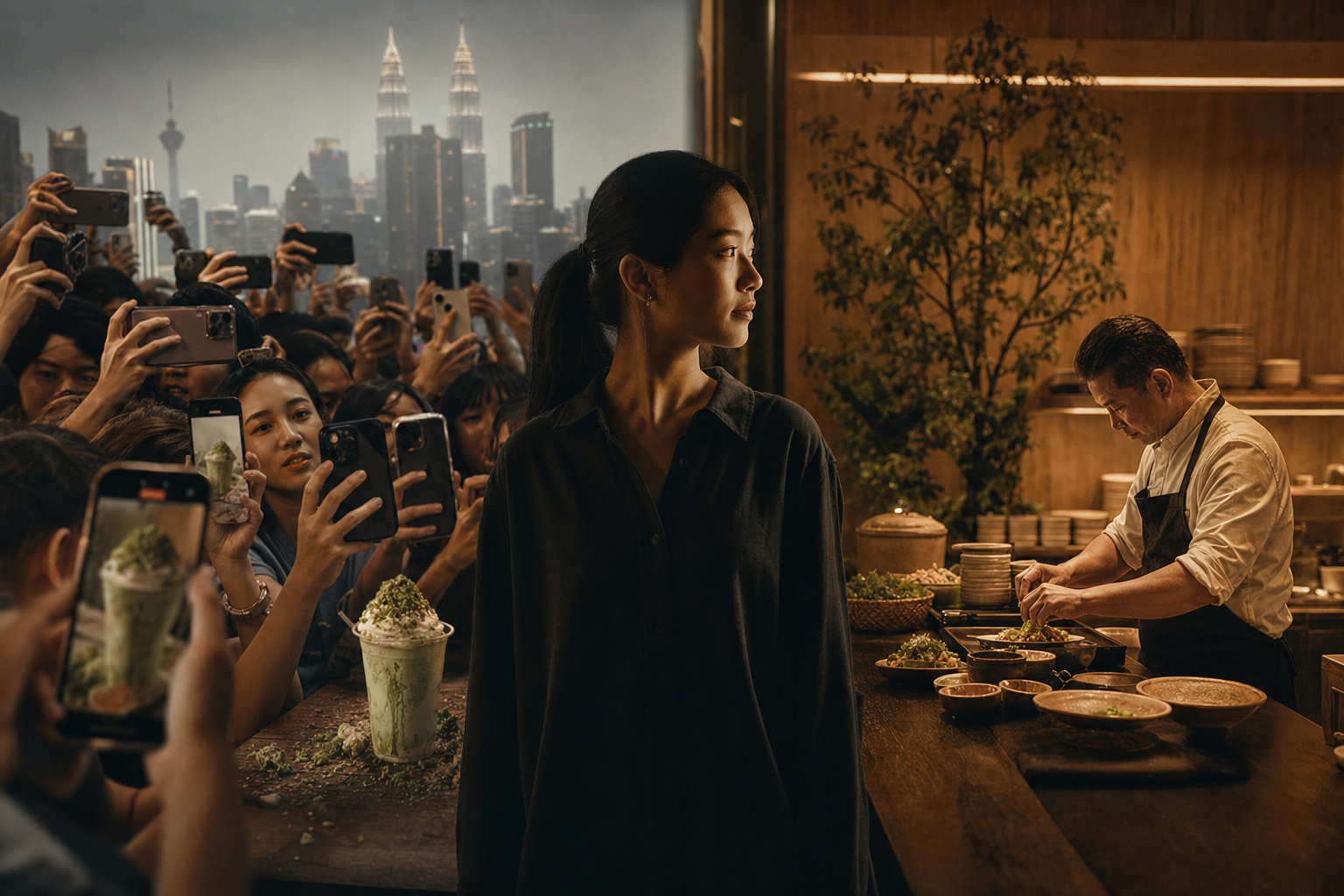
Everyone is watching Malaysia's pistachio-matcha trend and celebrity restaurant openings. But based on Verbrol's analysis of 30+ signals from news, YouTube, and social media, the real force reshaping Malaysia's F&B market in June 2026 is not flavour — it's identity. The brands that understand this first will own the next two years.
Malaysia's F&B Identity Fault Line: The Brands That Read the Room Will Win Everything
By Dewi Kusuma Wardani | Verbrol Intelligence
Let me say something that most Malaysian marketing portals won't publish this week: the biggest threat — and the biggest opportunity — in Malaysia's F&B market right now has nothing to do with pistachios.
Yes, the pistachio-matcha wave is real. Yes, Khairul Aming's Rembayung sold out on opening day and the internet screamed tambah nasi. Yes, ZUS Coffee is pushing into Indonesia while McDonald's Malaysia races toward 200 green restaurants by 2025. These are all legitimate signals. But based on Verbrol's analysis of 30+ signals from news, YouTube conversations, and social media engagement over the past 48 hours, a far more powerful current is running beneath all of it — one that will determine which F&B brands Malaysians trust, spend with, and defend online for the next two years.
That current is cultural identity, and it has just become a purchasing decision.
The Boycott Signal Everyone Misread
When videos about boycotting Restoran Pagi Sore began circulating this week, most observers framed it as a simple consumer dispute — a Malaysian customer felt disrespected, Indonesians pushed back, and social media did what social media does. The engagement numbers look modest on the surface: individual YouTube videos pulling between 1 and 8 interactions in our sample window.
But read the comment layer carefully, and the signal is loud.
"Bukan pasal makanan enak ke tak enak... pasal maruah bangsa Malaysia," wrote one commenter. Translation: this is not about whether the food is good or bad — it's about the dignity of Malaysians. Another thread captured a Sarawak group cancelling a Bandung trip entirely, rerouting to Shanghai. These are not food decisions. These are identity decisions that happen to express themselves through food.
This is the counter-narrative that the F&B battle for Malaysian taste buds coverage at The Edge Malaysia hints at but doesn't fully commit to: the next battleground in Malaysian F&B is not the menu — it is the values the brand is perceived to hold.
The Chikuro Moment: Brand Ownership as a Flashpoint
The Chikuro story is almost comical on the surface. An Indonesian chicken roll brand from Bandung goes viral. Someone in Malaysia starts selling it. Indonesian netizens erupt: "Malaysia is claiming our brand!" The YouTube video making this claim pulled 127 engagements — the highest single engagement figure in our entire 48-hour dataset tracked by Verbrol Pulse.
For Malaysian F&B brand managers, this is not a story about one chicken roll brand. This is a live case study in how quickly brand provenance becomes a loyalty weapon in the social media era.
The nuance buried in the comments is instructive: "Chikuro itu nama brand bukan nama makanannya" — Chikuro is a brand name, not the name of the food itself. The product (chicken roll) is generic. The brand is the IP. The Malaysians selling it were arguably selling a product category, not stealing intellectual property. But in the court of social media sentiment, that distinction collapsed instantly.
Actionable takeaway for brand managers: In 2026, your brand name is your product. If you are operating in any food category that has cultural roots — Indonesian, Thai, Japanese, Indian — you need documented provenance and proactive storytelling before someone else writes your origin story for you.
For F&B brands looking to build that storytelling at scale with authentic local creators, platforms like Creamatch, Malaysia's managed creator content platform, are increasingly where this narrative work gets done before a crisis hits, not after.
Pistachio, FOMO, and the Attention Economy of Food
Now, the trend everyone is talking about — and for good reason. The pistachio and matcha wave has officially crossed from Instagram aesthetic into mainstream Malaysian menus. Keli bakar with pistachio. Ayam gepuk with matcha. Nasi lemak reimagined with both. The rising trend of pistachio and matcha across Malaysian menus is documented, and the consumer psychology driving it is even more interesting than the flavour combinations.
One YouTube commenter in our dataset framed it precisely: "Banyak makanan yang rame di sosmed bukan karena enak, tapi karena orang-orang pingin nyobain yang lagi tren." Many viral foods are popular not because they taste good, but because people want to experience what is trending.
This is the FOMO economy of food, and it is both an opportunity and a trap:
- The opportunity: Trend adoption drives trial, footfall, and UGC content at almost zero marketing cost for the first 4–6 weeks.
- The trap: Brands that lead on trend but have no identity beneath it are forgotten the moment the next trend arrives. According to Statista's revenue data for Malaysia's F&B services industry, the sector has grown consistently — but growth is not evenly distributed. Brands with community loyalty retain customers across trend cycles; trend-only brands do not.
Khairul Aming's Rembayung is the clearest counter-example. It sold out on day one not because of a flavour gimmick, but because Khairul has spent years building identity capital — Malaysians feel they know him. The food could have been plain white rice and people would have queued. As Malay Mail reported, Malaysia said tambah nasi — and that is a cultural statement as much as a food order.
The Hidden Winner: Anti-Waste, Anti-Pretension Value
While the industry debates pistachios and boycotts, a quieter signal is gaining traction: anti-waste F&B platforms. The initiative enabling Malaysians to grab restaurant meals at big discounts before they go to waste is emerging at exactly the right cultural moment. As dining nationalism rises and consumers become more selective about where their ringgit goes, value-with-values propositions will resonate deeply.
Combine this with the rising appetite for F&B deals among Malaysian consumers and the pattern becomes a prediction: by Q4 2026, the F&B brands gaining loyalty in Malaysia will be those that demonstrably stand for something — sustainability, local pride, community — not just taste. Conscious dining is no longer a niche. It is becoming the default frame through which Malaysian consumers evaluate whether a brand deserves their identity.
For a deeper look at how these sentiment shifts are tracked across Southeast Asia's F&B sector, Verbrol monitors real-time social signal layers that go well beyond hashtag volume — including the kind of identity-coded language that the Pagi Sore and Chikuro conversations revealed this week.
What Every Malaysian F&B Brand Manager Should Do This Month
- Audit your brand's cultural position. Not your flavour profile. Your values position. In a market where customers are making purchasing decisions based on maruah (dignity), you need to know where you stand.
- Build provenance stories proactively. Don't wait for a Chikuro moment. Document your origins, your community ties, your local sourcing — and publish that narrative through trusted creators. Creamatch connects Malaysian F&B brands with creator partners who can build this authenticity layer before you need it defensively.
- Treat trend participation as an entry ticket, not a strategy. Pistachio gets you in the door. Identity keeps customers coming back.
- Watch the anti-waste and value-deal segment. It is where the next wave of community loyalty is forming, and Tourism Malaysia data consistently shows that domestic dining loyalty is one of the strongest drivers of sustained F&B revenue growth.
- Monitor SEA cross-border sentiment. The Pagi Sore and Chikuro stories originated from Indonesia but landed hard in Malaysia within 48 hours. Your brand can be caught in a regional sentiment storm you didn't start. Use Verbrol Pulse to track these cross-border signals before they become crises.
Malaysia's F&B market is not short of energy, creativity, or appetite — literally or figuratively. But the brands that will capture lasting loyalty in the next 18 months are those smart enough to recognise that Malaysians are not just ordering food right now. They are ordering identity.
Make sure your brand is one they are proud to be seen with.
Dewi Kusuma Wardani is a market intelligence writer at Verbrol covering Southeast Asian consumer and brand trends. She writes from Kuala Lumpur and Jakarta.
Based on Verbrol's analysis of 30+ signals from news, YouTube, and social media platforms over a 48-hour monitoring window, June 2026.
Track F&B trends in real-time at verbrol.com
Read more on Verbrol Intelligence: