A foreign EV brand has outsold every local nameplate for three straight years — and Malaysia's own carmakers are only now finding the right response.
BYD has now sold more than 20,000 electric vehicles in Malaysia — making it the country's top EV brand for three consecutive years. That figure matters not because it is large in absolute terms, but because of what it represents structurally: a Chinese OEM, assembled locally through a Sime Darby partnership, has claimed the segment that Proton and Perodua spent decades building political capital to dominate.
I tracked automotive signals out of Malaysia over the past 48 hours. What I found was not a single story but a cluster of simultaneous moves — pricing, manufacturing, parts supply, and product launches — that, taken together, describe an industry in serious transition.
BYD's Booking Velocity Is a Demand Signal, Not Just a Sales Number
The 2026 BYD Atto 3 facelift crossed 1,000 bookings within 10 days of launch, with the higher-specification 510 km Premium RWD variant drawing more orders than the base trim. That sequencing matters. Consumers are not buying down to afford an EV — they are buying up to get range. It is the same demand pattern seen in Korea and Germany before local incumbents adjusted their product ladders.
For brand managers tracking the segment, this is a useful reference point: premium EV trim penetration in Malaysia is running ahead of what early adoption curves would predict. Price sensitivity exists, but it sits below a range-anxiety threshold that BYD has now explicitly targeted.
Perodua's Repricing Move — Localisation as a Cost Lever
The more operationally significant signal from the past 48 hours is Perodua's. The national carmaker cut the QV-E's outright purchase price to RM87,499 and introduced a RM63,499 Battery-as-a-Service option following what it describes as a major localisation shift. The implication is precise: Perodua has rerouted component sourcing, absorbed more fabrication domestically, and passed the margin back to the consumer as a price reduction rather than a profit capture.
This is textbook value chain migration — the kind that Malaysia's deputy minister of investment, trade and industry has explicitly called for. The government's position, echoed across multiple industry forums this month, is unambiguous: assembling imported kits is no longer a viable industrial strategy. Malaysia's automotive sector must move up the value chain — into design, software integration, and precision manufacturing — or cede ground permanently to better-capitalised foreign entrants.
For the QV-E specifically, the repricing positions it directly against the Proton eMas 5. That comparison is drawing serious analytical attention given the eMas 5 has also seen pricing adjustments. Two national-interest EVs competing on localisation-driven cost efficiency, within the same price band, in the same quarter — that is not accidental. It reflects coordinated industrial policy pressure.
Manufacturing Investment Is Accelerating on the Ground
While the product narrative dominates headlines, the supply chain moves underneath it are more durable indicators of long-term trajectory.
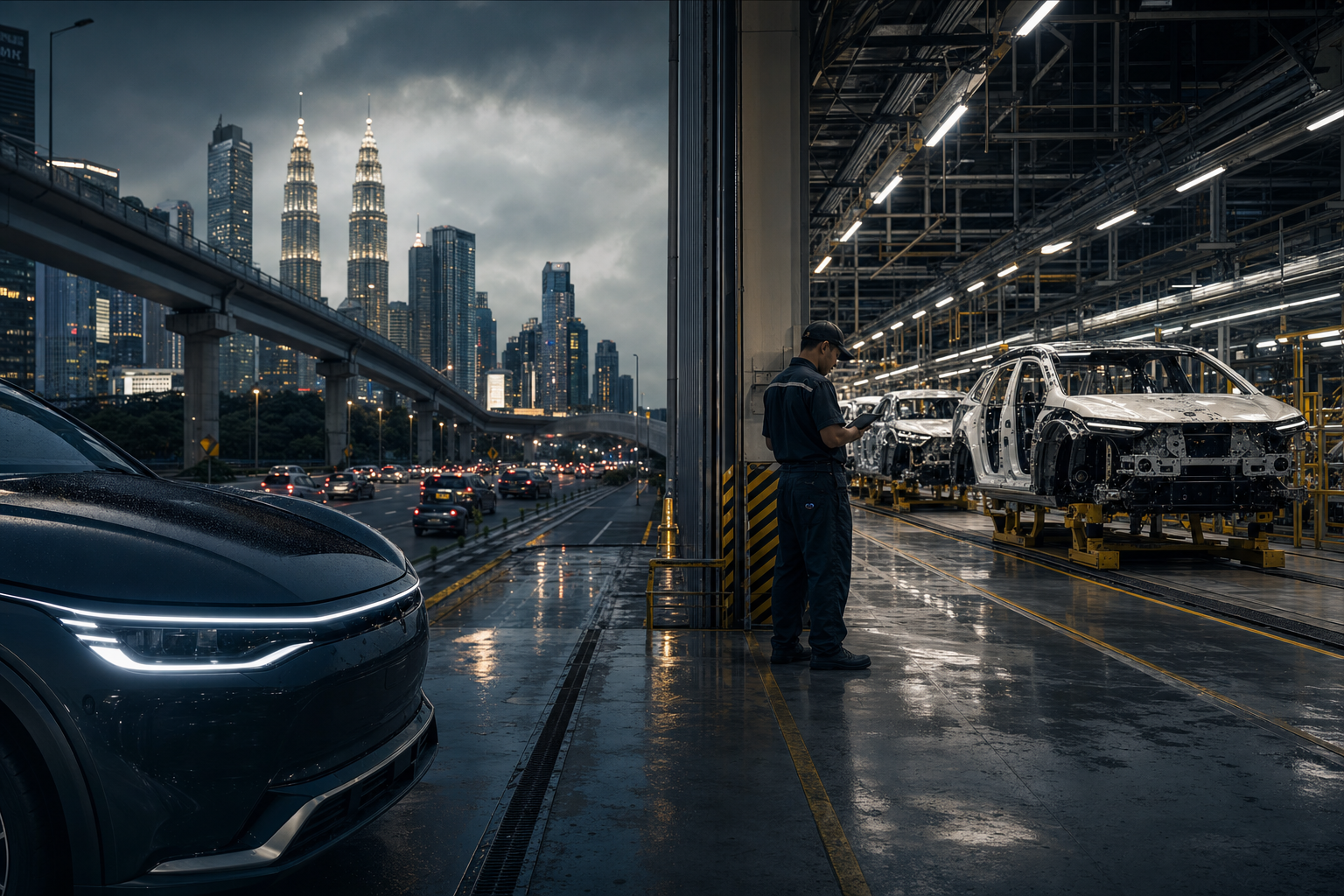
EP Manufacturing Berhad broke ground this week on a new vehicle painting facility at its Melaka CKD hub. Targeting 30,000-unit annual capacity with an operational date of June 30, 2027, the RM200 million investment is one of the more concrete commitments to surface in the sector this cycle. EPMB's expansion of its automotive manufacturing footprint signals that at least one Tier-1 supplier has underwritten continued volume growth — and is betting on Melaka as a viable manufacturing geography for the medium term.
Separately, Aapico — Thailand's largest auto parts manufacturer — has announced a RM140 million partnership with Proton to invest in Avee Global (Miyazu). This is a cross-border parts supply chain integration that deserves more attention than it has received. Aapico's entry into the Proton ecosystem connects Malaysian OEM ambitions directly to ASEAN-scale component networks. It also creates a precedent: if Thai Tier-1 suppliers are co-investing in Malaysian production infrastructure, the regional supply chain interdependency runs deeper than tariff frameworks alone suggest.
For anyone monitoring ASEAN automotive flows, Bernama and The Star have both tracked this deal as part of a broader Proton internationalisation narrative worth following.
What Marketers and Brand Managers Should Actually Do With This
The automotive signals from this week are unusually coherent in their direction. Here is what they mean in practical terms for Malaysian brands operating in or adjacent to this sector:
-
Localisation is now a consumer-facing message, not just an industrial policy box to tick. Perodua's price drop was made possible by sourcing decisions. Communicating that supply chain story — authentically, with specifics — builds trust in a market that has grown skeptical of EV price opacity.
-
EV demand in Malaysia is not price-gated at the level many assumed. The BYD Atto 3 Premium RWD variant outperforming the base model in early bookings suggests the target consumer for EVs here is more affluent and more specification-sensitive than mass-market framing implies. Brand positioning and content should reflect that.
-
Infrastructure storytelling matters. The RM600 million MRT Corp–IJM Land transit-oriented development in Cheras is a mobility infrastructure signal, not just a property story. As urban transit density increases, EV adoption framing shifts from "charging anxiety" to "urban efficiency" — a different emotional register entirely.
-
Creator and influencer content for auto brands needs to track this repositioning. The EV consideration journey in Malaysia is longer, more research-intensive, and more community-driven than ICE vehicle purchases. Platforms like Creamatch, Malaysia's managed creator content platform, offer structured ways to deploy authentic content at the right points in that journey — particularly for brands that need to explain technical differentiation without sounding like a spec sheet.
The Verbrol Pulse tracker has been flagging the Perodua–Proton EV price corridor as a watch item since late May. The repricing confirmation this week closes that loop.
The Structural Question Nobody Has Answered Yet
The Sun Malaysia's framing — that the automotive sector is being urged to move up the value chain — is accurate but incomplete. The question is not whether Malaysia should move up the value chain. The question is whether the capital formation, skills pipeline, and institutional coordination exist to make that move at the pace the market is demanding.
EPMB's paint facility will be operational by mid-2027. Aapico's partnership with Proton is a capital commitment, not a product launch. Perodua's localisation gains are real but incremental. These are 18-to-36-month plays in a market where BYD is already three years in and still accelerating.
The assembly era is not over. But it is no longer sufficient. The brands, suppliers, and marketers who understand that distinction — and build for what comes after assembly — are the ones who will still be relevant when this transition cycle completes.
Track Auto trends in real-time at verbrol.com
Read more on Verbrol Intelligence: