Big infrastructure money is finally connecting with residential demand — but the developers who position first along Malaysia's transit corridors will define the next decade of the market.
The Commute Is Now the Product
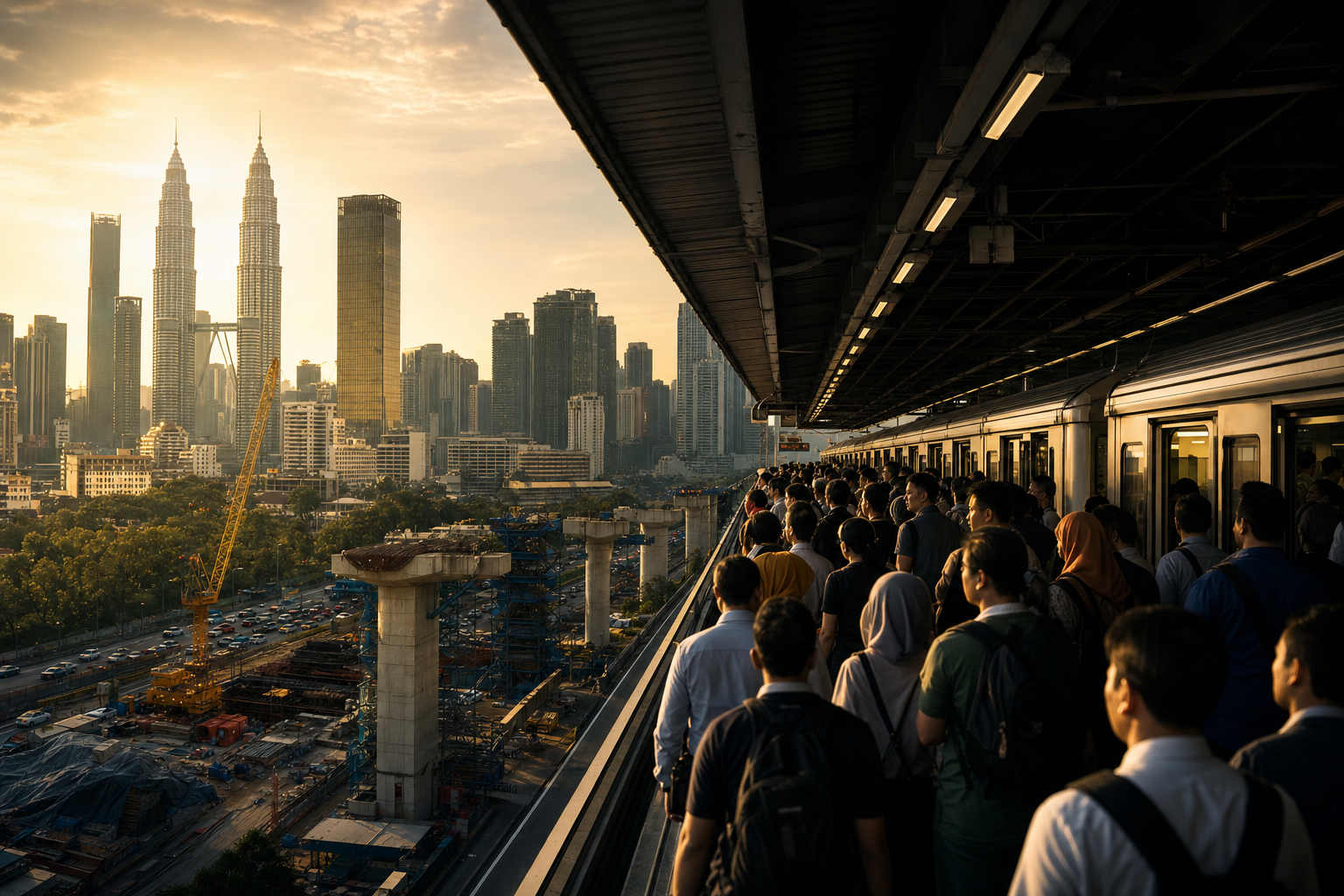
Malaysians have always organised their lives around the question of getting somewhere. Traffic on the Federal Highway. Gridlock in Damansara. The long crawl from Puchong into the city at 7 a.m. For decades, property developers sold location as proximity to a highway interchange. That calculation is changing — and changing fast.
In June 2026, MRT Corp and IJM Land jointly unveiled The Linque, a RM600 million transit-oriented development integrated directly with the Cochrane MRT station. The project is not merely adjacent to a station — it is structurally embedded within one. Residents will access rail infrastructure from within their building podium. That is a fundamental reordering of what "location" means in Malaysian residential real estate.
This is not an isolated launch. It is the visible surface of a structural shift that has been building across the sector for the better part of three years.
Transit-Oriented Development Is No Longer a Niche Strategy
The Malaysian government's long-term commitment to expanding the Klang Valley MRT and LRT networks has created a predictable infrastructure backbone that developers are now racing to anchor themselves to. The logic is straightforward: in a market where traffic congestion reliably depresses quality of life, guaranteed rail connectivity commands a measurable premium.
For IJM Land, The Linque represents the maturation of a positioning strategy — connectivity as the primary value proposition, not merely an amenity. This is a meaningful departure from the suburban township model that defined Malaysian residential development through the 1990s and 2000s, when developers like SP Setia and Mah Sing built their brands on self-contained communities with their own commercial precincts, schools, and recreational facilities.
The township model answered the question: how do we make distance tolerable? The TOD model asks a different question entirely: how do we eliminate the distance problem?
Those are different products for different buyers, and the market is now supporting both simultaneously — which is precisely what makes the current period so structurally interesting to track.
Technology Is Rewriting the Premium Tier
If transit is redefining mid-to-upper residential, technology is rewriting what "luxury" means at the top end. According to Yahoo News Malaysia's recent analysis of smart home adoption in 2026, smart home integration is transitioning from a developer marketing talking point into a baseline buyer expectation. Energy management systems, automated air quality monitoring, and app-controlled access are being specified at launch rather than retrofitted post-purchase.
This has direct implications for pricing architecture. Developers who have invested in proprietary technology ecosystems — or who have formed partnerships with established platforms — are commanding per-square-foot premiums that would have been difficult to justify to a Malaysian buyer five years ago. The underlying driver is not gadgetry; it is perceived control over the living environment and reduced long-term utility costs, both of which resonate sharply with an increasingly cost-conscious upper-middle segment.
At the same time, branded residences are adding a distinct new layer to Malaysia's luxury property landscape. International hospitality brands lending their identity to residential towers are no longer exclusive to the KLCC corridor. The model is spreading into Johor, Penang, and selected Selangor nodes — wherever sufficient foreign buyer interest and domestic high-net-worth demand intersect. Sunway, which has long operated at the intersection of hospitality and property, is well-positioned within this trend. The branded living model effectively monetises trust: buyers are purchasing the operating standards and design language of a known brand, not merely square footage.
Transaction data tracked through NAPIC will likely reflect these premiums clearly in Q2 and Q3 2026 reporting, particularly in the above-RM1 million segment where technology and brand differentiation carry the most pricing weight.
Johor: The Long Game Becomes Immediate
No single announcement has reframed the geographic imagination of Malaysian property developers more sharply in 2026 than Genting Property's unveiling of an RM80 billion Johor Tech Smart City in Kulai. At that scale, this is not a property project in the conventional sense — it is a deliberate attempt to create a new economic geography in the southern corridor, anchored to the Johor-Singapore Special Economic Zone and the expanded rail links connecting the two countries.
For Gamuda and UEM Sunrise, both of which have carried significant Johor land banks for years, the Genting announcement materially changes the competitive environment. It compresses the timeline on which Johor's southern nodes must deliver credible commercial and residential ecosystems. The speculative holding period is shortening.
Buyers researching options across the Klang Valley and Johor can find detailed project comparisons and price-per-square-foot benchmarking on iProperty, where listing velocity in the Iskandar-adjacent corridors has visibly accelerated through Q1 and Q2 2026.
The legal infrastructure underpinning these large-format transactions is also becoming more complex. Shearn Delamore's recent advisory work on a Malaysian residential-retail agreement signals that mixed-use integrated schemes are generating sufficiently novel contractual structures to engage top-tier legal practices — an indicator that deal complexity, and therefore deal value, is rising across the sector.
Three Structural Takeaways for 2026 and Beyond
Read together, the signals from the past quarter point in a consistent direction. For marketers, brand managers, and agencies operating within or adjacent to Malaysian property:
-
Transit adjacency is the new land bank. Developers without a credible TOD pipeline — or a partnership with an infrastructure-linked player — face a structurally weakening value proposition in the urban residential segment. EcoWorld's positioning in rail-connected townships reflects an early read of this shift.
-
Technology integration must be specified at launch, not added as an afterthought. Buyers researching smart home features on platforms like iProperty are making side-by-side comparisons that penalise developers who treat technology as optional. Verbrol monitoring of search and engagement patterns in the Malaysian property segment confirms that smart living content consistently outperforms conventional project launch content in organic reach.
-
Johor is no longer a futures trade. The SEZ framework, the Genting announcement, and accelerating cross-border investment flows mean that developers and buyers treating Johor as a long-horizon speculative position need to revise their timing assumptions. The development clock has moved forward.
For brands operating content strategies within the property sector — developer marketing teams, agency partners, and property media — the shift toward infrastructure-integrated, technology-led narratives creates genuine content opportunities. Platforms such as Creamatch, Malaysia's managed creator content platform, are increasingly relevant for property brands that need to translate complex project propositions — integrated living, smart home ecosystems, transit connectivity — into accessible, high-reach content for end buyers.
The property market in Malaysia is not simply recovering from post-pandemic correction. It is reorganising around a new set of structural anchors: rail infrastructure, technology integration, and concentrated southern corridor investment. Developers who have positioned along those anchors early — IJM Land, Genting Property, and the broader Johor SEZ ecosystem — are not riding a cycle. They are setting the terms of the next one.
Track Property trends in real-time at verbrol.com
Read more on Verbrol Intelligence: