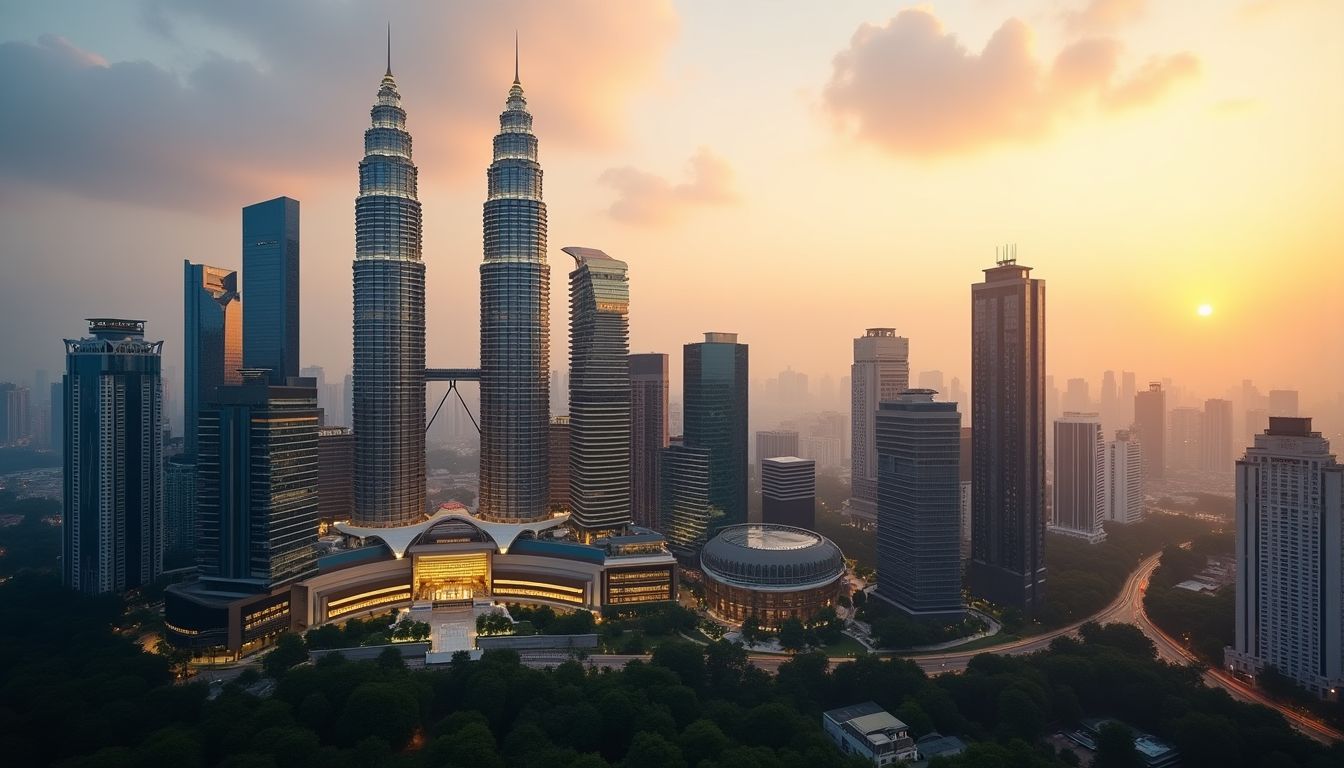
Big capital is clustering at opposite ends of the market — trophy assets and industrial land — while the mid-tier struggles to find its identity. The structural split is now too clear to ignore.
The Market Is No Longer Moving as One
In the first half of 2026, two conversations are happening simultaneously in Malaysia's property sector — and they barely overlap. At the top end, international hotel brands are lending their names to residential towers, and a single Johor development announcement carries an RM80 billion price tag. At the transactional middle, developers are scrambling to hold margins while SME buyers need fintech partnerships just to access collateral-backed financing. This is not a cycle. It is a structural bifurcation, and understanding which track your capital sits on matters more than it did twelve months ago.
The divergence has been building for several quarters. According to transaction data tracked by NAPIC, the Malaysian property market has seen sustained pressure on mid-range residential absorption while luxury and industrial segments post relative resilience. What June 2026 is clarifying is the mechanism behind that split — and three distinct forces are now doing the driving.
Branded Living Is Rewriting the Luxury Value Equation
The most structurally significant shift in the upper segment is the arrival of the branded residence model at scale. The rise of branded living in Malaysia's luxury property landscape is no longer an emerging trend — it is an active repricing mechanism. When a hospitality brand like GROHE SPA opens a dedicated showroom in Malaysia specifically to serve this segment, as LIXIL announced recently, it signals that the supply chain around branded living is maturing domestically, not just the demand side.
The core value proposition is straightforward: a branded address provides internationally legible status and, critically, a defensible premium at resale. For developers, the brand licensing cost is offset by the ability to price 20–35% above comparable unbranded product in the same micro-market. For buyers — particularly the cross-border investor pool that Kuala Lumpur increasingly attracts — the brand functions as a risk proxy when local market intelligence is limited.
The reputational dimension cuts both ways, however. The scrutiny currently directed at Renaissance and Four Points by Sheraton KL amid investigations into S Alam's property empire illustrates that brand association does not insulate assets from governance risk. Investors in branded product still require developer-level due diligence — the badge on the lobby does not replace it.
EVs and the Industrial Property Supercycle
While the luxury residential segment generates the visible headlines, the more durable structural story may be in industrial real estate. Malaysia's positioning as a preferred destination for electric vehicle supply chain investment — driven by both government incentives and regional diversification strategies among Asian manufacturers — is translating directly into land and shed demand in specific corridors.
The link between EV investment and Malaysia's industrial property boom is now well-documented at the policy level, but the asset-class implication is sharper than most residential-focused analysts acknowledge. Logistics and light manufacturing facilities within 30 kilometres of major EV-adjacent investment zones are trading at occupancy rates that compress yields and accelerate development timelines. Developers with existing industrial landbanks in Selangor, Penang, and Johor — Gamuda and IJM both hold material positions here — are sitting on assets that have appreciated on the back of tenant demand they did not need to create.
The Genting Property announcement of an RM80 billion Johor Tech Smart City in Kulai places this trend into sharp relief. A development of this scale — integrating technology, logistics, and mixed-use components — is a direct bet that the industrial and institutional demand driven by EV and data infrastructure investment will sustain long enough to justify a multi-decade land play. It also signals that Johor's gravitational pull, amplified by the Special Economic Zone framework, is now attracting capital at a scale that changes regional land pricing dynamics.
SME Financing and the Mid-Market Access Problem
The segment drawing less capital attention but carrying significant systemic weight is the middle. Here, the issue is not demand — it is financing access. The partnership between Funding Societies and Boost Bank to expand property-backed business financing for Malaysian SMEs points to a gap that conventional banking has not efficiently filled: collateral-rich but cash-flow-variable businesses that need to unlock property equity for operational capital.
This matters for the property market because it shapes the buyer composition in the RM400,000–RM800,000 segment, which remains the volume backbone of the residential market. When SME owners cannot efficiently access working capital, discretionary property investment gets deferred. The fintech-bank collaboration model is a partial correction to this — but scale will determine impact. According to market data on iProperty, demand intent in this mid-range tier has remained relatively stable in search volume terms even as actual transaction conversion has lagged, suggesting a financing gap rather than a preference gap.
Developers such as Mah Sing and EcoWorld, whose product mix skews toward affordable and mid-range residential, have a structural interest in seeing this financing layer mature. The extent to which property-backed SME financing frees up household balance sheets will have a downstream effect on mortgage appetite.
What This Means for Capital Allocation in H2 2026
The bifurcated market is not a problem to be solved — it is a condition to be read correctly. Three operating principles follow from the current signals:
-
Luxury residential requires brand scrutiny, not just brand premium. Governance exposure at the developer level can unwind a branded premium faster than the market appreciates. The due diligence framework needs to extend to ownership structure, not just product specification.
-
Industrial and logistics exposure deserves re-weighting. The EV supply chain story has a longer runway than the current property cycle, and the developers with existing industrial land in the right corridors hold an asymmetric advantage that residential-focused valuation models do not fully capture.
-
Mid-market health depends on financing infrastructure. The segment's recovery is not primarily a developer strategy problem — it is a credit access problem. Policy attention and fintech innovation here have more leverage than further product repositioning by individual developers.
The Malaysian property market in mid-2026 is not uniform and it is not directionless. It is segmenting with clarity. The analytical task — for investors, developers, and market-watchers alike — is to stop treating it as a single asset class and start applying the differentiated lens the data now demands. Verbrol Pulse continues to track sentiment and signal movement across these segments as the second half of the year develops.
Track Property trends in real-time at verbrol.com
Read more on Verbrol Intelligence:
- Malaysia's Property Market in June 2026: Three Forces Reshaping the Industry
- Malaysia's Property Market Is Splitting in Two — And the Gap Is Widening
- Malaysia's Property Sector Is Upgrading Its Infrastructure — And Its Ambitions
Related Reading
- Malaysia's Property Market in June 2026: Three Forces Reshaping the Industry
- Malaysia's Property Market Is Splitting in Two — And the Gap Is Widening
- Malaysia's Property Boom Is Real — But the Risk Map Has Shifted
Frequently Asked Questions
What does it mean that Malaysia's property market is splitting into two worlds? Malaysia's property market is experiencing a structural divide where the luxury and industrial segments are thriving with branded residences and large-scale developments, while the mid-range residential market struggles with absorption and buyer financing challenges. This isn't a temporary cycle but a fundamental shift in how the market operates at different price points.
What is the branded residence model and why is it changing the luxury property market? Branded residences are luxury residential towers that use international hotel and lifestyle brand names to enhance their value proposition, similar to how luxury hotels operate. This model is rewriting the luxury value equation in Malaysia by attracting high-end buyers who value the brand prestige and associated amenities.
Why are mid-range property buyers struggling in Malaysia right now? Mid-range residential developers are facing margin pressures while SME buyers increasingly need fintech partnerships and collateral-backed financing just to access mortgages, making the segment less attractive. This contrasts sharply with the luxury market, where capital flows more freely.
Which Malaysian property developers are most affected by this market split? Developers like Gamuda, IJM, Mah Sing, and EcoWorld are navigating this bifurcated market, with their performance varying depending on whether their portfolio focuses on luxury branded developments or mid-range residential segments. Understanding which track each developer operates on has become crucial for investors.