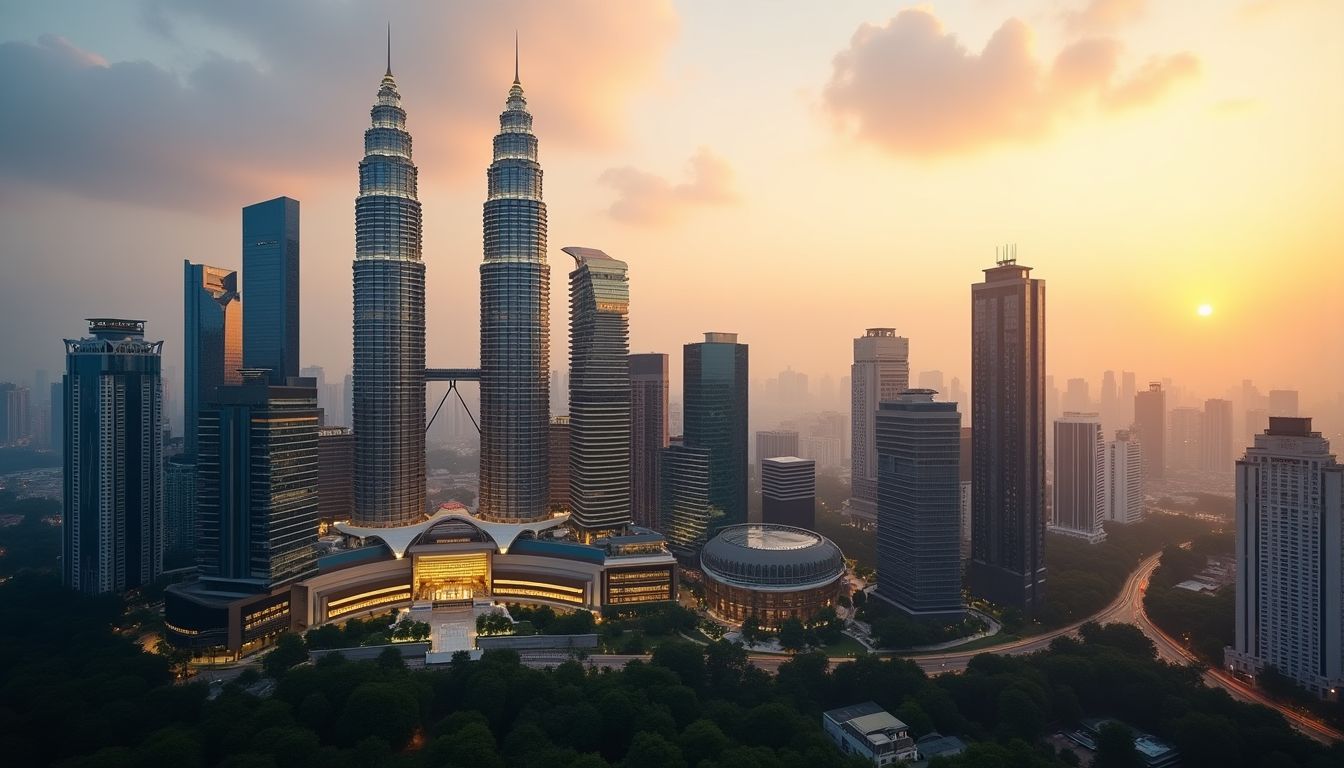
Big money is moving into Malaysia's property sector from two very different directions — and the market sitting in the middle is getting squeezed harder than any headline is admitting.
The Number That Frames Everything
RM1.25 billion. That is the figure Sime Darby Property committed to a new fund targeting data centres and industrial assets — a developer whose core business has historically been landed residential townships in the Klang Valley. When a company of that scale redirects that kind of capital away from its traditional product, it is telling you something about where the returns are not coming from.
Set that figure against what The Malaysian Reserve has been reporting with increasing urgency: oversupply and elevated household debt are structurally weighing on the mid-range residential segment. These are not two unrelated stories. They are the same story — a market cleaving into two distinct economies, moving in opposite directions, with very different sets of winners.
The Oversupply Problem Is Structural, Not Cyclical
Malaysia's residential property overhang has been documented for years, but the framing keeps softening it into a short-term correction narrative. The data does not support that reading.
According to transaction monitoring tracked through NAPIC, the volume of unsold completed residential units — particularly in the RM500,000 to RM800,000 price band — has remained persistently elevated across Selangor, Johor, and Kuala Lumpur. Household debt-to-GDP in Malaysia sits above 80%, one of the highest ratios in Southeast Asia, which directly constrains loan approvals for first and second-time buyers in the middle-income bracket.
The consequence: developers who built aggressively in the RM400,000–RM700,000 range between 2018 and 2022 are now sitting on inventory that the financing environment cannot clear fast enough. SP Setia, which carries significant exposure to high-rise residential in Klang Valley, has publicly acknowledged margin pressure in this segment. Mah Sing has pivoted more aggressively toward affordable housing — units priced below RM500,000 — precisely because that end of the market still has demand velocity, underpinned by government schemes like PR1MA and the revised My Home programme.
The structural read here is uncomfortable but arithmetically clear: the mid-range segment built for an aspirational middle class is caught between buyers who cannot qualify for financing and developers who priced on pre-pandemic land cost assumptions.
Where Capital Is Actually Going: Luxury and Industrial
While the mid-range stagnates, two segments are recording genuine momentum — and they have almost nothing in common except the fact that both attract money that does not depend on bank loan approvals.
Luxury branded residences are the louder story right now. The rise of branded living in Malaysia's luxury property landscape — residences co-branded with hospitality names, carrying hotel-grade services and global brand recognition — is rewriting the ceiling price per square foot in KLCC and Mont Kiara. How the luxury property market in Malaysia will move in 2026 points to cross-border ultra-high-net-worth buyers — particularly from China — as the primary demand driver. Malaysia My Second Home (MM2H) revisions, combined with Malaysia's relative affordability versus Singapore and Hong Kong, have made Kuala Lumpur a serious conversation in wealth management circles in Shenzhen and Shanghai.
Tatler Asia framed it directly: Malaysia is becoming "the unexpected darling of China's ultra-rich property hunters." UEM Sunrise, which manages premium developments in the KLCC corridor and Iskandar Malaysia, is positioned to capture meaningful share of this segment if execution keeps pace with demand signalling.
Industrial property is the quieter but arguably more durable story. The EV supply chain migration into Malaysia — anchored by investments in Selangor, Penang, and Johor — is generating sustained demand for Grade A industrial space, cold-chain logistics facilities, and data centre land banks. EdgeProp's analysis of how EV investments are powering Malaysia's industrial property boom is not theoretical — the CAPEX numbers are landing. Gamuda and IJM, both of which carry substantial infrastructure development arms, are structurally well-placed to convert construction pipelines into industrial land plays as the sector matures.
Sime Darby Property's RM1.25 billion fund commitment is the cleanest expression of where institutional capital reads the next five years.
What the Savills and Knight Frank Data Is Signalling
The Savills Klang Valley Residential Property Monitor for Q4 2024 recorded growth in both transaction volume and value — a headline that sounds encouraging until you disaggregate it. Volume growth was concentrated in the sub-RM400,000 and above-RM1 million segments. The RM400,000–RM800,000 band — the mid-market — showed the flattest recovery curve. This is exactly the structural bifurcation pattern that makes the aggregate number misleading.
Knight Frank Malaysia's announcement that its property management division now oversees more than 100 buildings is a different kind of signal. It reflects the growing complexity of managing ageing strata stock — a downstream consequence of the over-building years. As unsold units eventually enter the secondary rental market and strata management demands increase, the asset management layer of the industry is quietly becoming a growth vertical in its own right.
For marketers and brand managers tracking real-time property sentiment via Verbrol Pulse, the consistent media weight on luxury and industrial narratives in the past 48 hours — versus the muted engagement on oversupply reporting — mirrors this split. The stories that generate reader energy are aspirational or infrastructural. The structural debt-and-overhang story is covered but not clicked.
That gap between what the data shows and what audiences engage with is itself actionable intelligence. Property developers, marketing agencies, and investment platforms all need to calibrate their content strategy to this reality. Platforms like Creamatch — Malaysia's managed creator content platform — are increasingly being used by property brands to reach specific demographic segments with content that converts, particularly as luxury and industrial property marketing demands more targeted, credibility-driven distribution than traditional display advertising delivers.
Three Positions to Hold Heading Into H2 2026
-
Luxury and branded residential will continue attracting foreign capital, particularly Chinese UHNW buyers, as long as MM2H and regional geopolitics hold their current configuration. IOI Properties and UEM Sunrise are the names to watch for KLCC and southern corridor positioning respectively.
-
Industrial and logistics is the structural growth bet. EV supply chain investment is not a one-quarter story — it is a 10-year infrastructure commitment. Developers with land banks adjacent to existing industrial clusters and port access are holding appreciating assets regardless of residential market conditions.
-
Mid-range residential needs a demand-side fix, not a supply-side one. Without meaningful movement on financing accessibility or income levels for the M40 bracket, the overhang in this band will persist. Developers still concentrated here — without a pivot strategy — face the most prolonged margin pressure.
Malaysia won recognition at FIABCI's international real estate awards — a sign that the country's best developments benchmark globally. But global recognition and domestic market health are two separate ledgers, and right now they are not reconciling at the same rate. The iProperty market data on search intent and listing engagement continues to show the luxury and affordable segments generating the most qualified traffic, with mid-market listings sitting longer before conversion.
The property industry in Malaysia is not in crisis. It is in transition — and transitions favour the investors and developers who read the segmentation correctly, not the ones waiting for a uniform recovery that the structural numbers suggest is not coming.
Track Property trends in real-time at verbrol.com
Read more on Verbrol Intelligence: