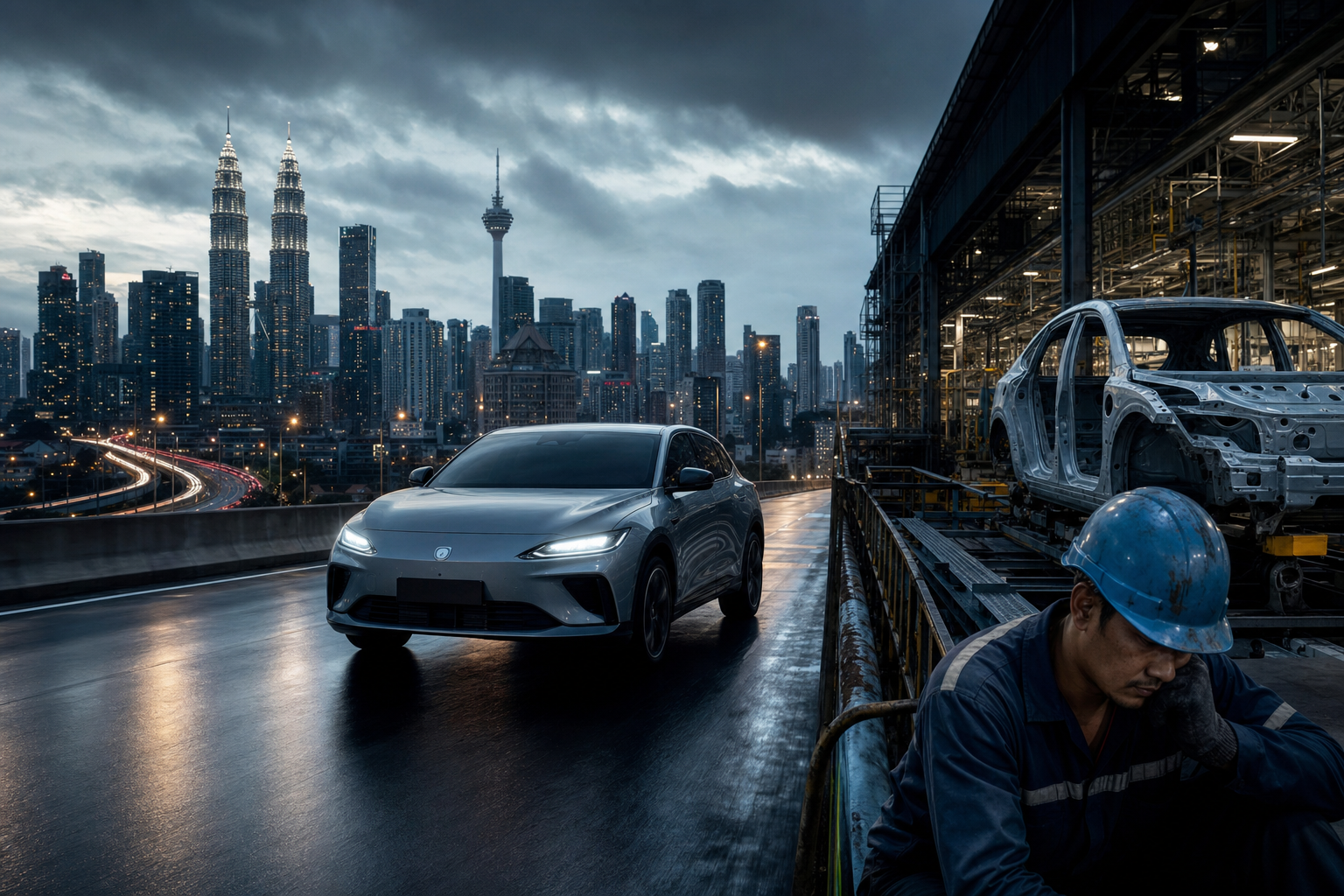
Two national carmakers are charging toward electrification at full speed — but upstream, their supplier networks are showing serious strain.
The Proton e.MAS 5 just became the first electric vehicle to crack Malaysia's top five bestselling cars, capturing nearly 50% of the country's EV market in the process. That is a remarkable commercial milestone — and it lands in the same week that one of Proton's own suppliers filed a legal claim over unpaid dues.
That tension — rapid product expansion running ahead of supply chain readiness — is the defining story of Malaysia's auto industry in mid-2026.
Proton's Geely Era: The Numbers Are Genuinely Impressive
The scale of Proton's transformation since the Geely partnership took hold is not in dispute. Since 2018, the brand has launched 34 new models, expanded its showroom network by 146 outlets, achieved what it describes as a tenfold improvement in quality metrics, and posted a 144% sales rebound from its all-time low — reaching a 15-year sales high. The Proton Saga MC3 alone delivered 8,207 units in April 2026, up 50.9% over March, with year-to-date volumes of 29,977 units representing a 42.8% YoY increase.
These are not marginal gains. They reflect a structural reset of the brand's competitive position.
The forward pipeline reinforces that ambition. According to Paul Tan's automotive coverage, Proton has confirmed production of the AMA02 — an A-segment SUV positioned to rival Perodua's Ativa — beginning in Q4 2026, with further models AMA05 and AMA06 in development alongside a next-generation GMA EV platform. Mid-cycle refreshes of the S70 and X90 are also incoming.
For brand managers and retail marketers operating in the Malaysian auto space, this product cadence means Proton is no longer filling gaps — it is applying sustained pressure across segments.
Perodua's EV Calculus: Affordable Entry, Structural Innovation
Perodua's approach to electrification is architecturally different from Proton's, and deliberately so. Where Proton entered the EV market through the premium-adjacent e.MAS platform, Perodua is targeting volume with an entry price of approximately RM80,000 — paired with a battery leasing model that addresses two chronic EV adoption barriers in Malaysia: residual value anxiety and battery degradation.
The leasing structure, however, introduces a new friction point. As NST Online reported, Perodua's EV can be remotely locked out over unpaid battery fees — a feature that will require careful consumer communication to avoid backlash in a market where ownership psychology still skews strongly toward full asset control.
Perodua's collaboration with an international partner to co-develop the vehicle — confirmed by Focus Malaysia — signals that the brand is not attempting to engineer the EV transition alone. That is a pragmatic position. The Malaysian Vehicles Market data published by Focus2Move shows the national marques still dominate volume, but the ground beneath them is shifting.
The Supply Chain Problem Nobody Has Priced In
Malaysia's auto sector conversation in 2026 is dominated by product launches and EV penetration rates. The upstream conversation is quieter — and more concerning.
Proton's legal dispute with a supplier over unpaid dues is not, by itself, a crisis signal. Disputes of this nature are routine in high-volume manufacturing. What it does flag is the stress that rapid model proliferation places on supplier relationships, cash flow cycles, and quality assurance infrastructure. When you triple your model count in six years, your tier-one and tier-two supplier base has to scale commensurately. In Malaysia, that capacity is uneven.
Malaysia's Deputy Minister has publicly stated that the auto sector must shift gears beyond assembly — a structural critique that points to the same gap. Malaysia assembles vehicles competently; it does not yet manufacture the critical components that define an EV's value stack: battery cells, power electronics, and the semiconductors that govern both.
A PwC analysis of semiconductor integration in Malaysian automotive identifies the integration challenge clearly: the transition to electrification is also a transition to software-defined, semiconductor-intensive manufacturing, and Malaysia's existing auto supply base was not built for that paradigm.
Chinese Brands: Four Years, Exponential Share Gains
Overlaying all of this is the accelerating entry of Chinese automotive brands into the Malaysian market. Four years ago, Chinese marques held 0.08% of the market. They now account for 7.6% — a 95-fold increase in market share within a single electoral cycle.
This is not a niche story. Brands like Chery, BYD, and others have entered with competitive EV and hybrid pricing that directly pressures Proton and Perodua on value propositions. For Toyota Malaysia and Honda Malaysia, the competitive pressure is different but equally real — Chinese brands are now competing credibly in the C-segment space that Japanese marques have long owned in Malaysia.
According to Bernama, total industry volume is trending toward record territory in 2026, which means the market is growing fast enough to accommodate new entrants without necessarily cannibalising incumbents — for now. The Star's reporting on record auto sales volumes supports that reading. But supply-side constraints — supplier financial stress, semiconductor shortages, battery component dependencies — could erode that headroom faster than the demand curve suggests.
What Marketers and Brand Managers Should Watch
For professionals operating in Malaysia's auto marketing ecosystem, three operational signals matter most right now:
- Battery leasing as a brand communication challenge. Perodua's remote lockout capability needs a consumer education layer before it becomes a headline risk. The framing around financial protection versus punitive control will define early EV adopter sentiment.
- Proton's model velocity creates content volume demand. Thirty-four models in six years, with more incoming, means the content and campaign infrastructure required to support each launch is substantial. Platforms that connect brands with high-quality creators at scale — such as Creamatch, Malaysia's managed creator content platform — become operationally relevant for auto brands managing multi-model calendars without equivalent headcount growth.
- Chinese brand positioning is moving up-market. The 7.6% market share figure understates the strategic intent. Brands entering at volume pricing are already investing in showroom experience and after-sales infrastructure that signals longer-term premium ambitions.
The Verbrol Pulse data across Malaysia's auto news cycle shows that the volume of coverage on Proton and Perodua EVs has outpaced coverage of supply chain and component sourcing by a significant margin — a gap between narrative and operational reality that brand managers should be actively monitoring.
The Structural Question Behind the Sales Numbers
Malaysia's auto industry in mid-2026 presents a genuine bifurcation. At the consumer-facing layer, the numbers are strong: record volumes projected, EV penetration accelerating, national brands posting credible growth. At the supplier and component layer, the stress fractures are visible — legal disputes, semiconductor integration gaps, battery supply dependencies on overseas partners.
The brands that navigate this period most effectively will be those that treat supply chain resilience as a brand asset, not just an operations function. When a vehicle launch is delayed or a quality issue surfaces, the consumer's response is shaped by accumulated brand trust, not by the engineering explanation.
Proton's Geely era has demonstrated that product transformation at scale is achievable. The next test is whether the infrastructure behind the product — supplier relationships, component sovereignty, after-sales depth — can sustain the pace. According to Free Malaysia Today, industry observers are increasingly framing this as the central question for Malaysia's automotive competitiveness through 2030.
The sales numbers are real. The supply chain gaps are real. Both can be true simultaneously — and for anyone making strategic decisions in this market, that tension is the only place worth looking.
Track Auto trends in real-time at verbrol.com
Read more on Verbrol Intelligence:
- Malaysia's Auto Industry Is Rebuilding Itself — From the Inside Out
- Malaysia's Auto Market Is Rewriting Itself — And the Numbers Prove It
- Malaysia's Auto Market Is Rewriting Itself — One EV at a Time
Related Reading
- Malaysia's Auto Market Is Rewriting Itself — One EV at a Time
- Malaysia's Auto Industry Is Rebuilding Itself — From the Inside Out
- Kereta China Ambil 7.6% Pasaran Malaysia Dalam 3 Tahun. Apa Yang Proton Dan Perodua Buat Sekarang?
Frequently Asked Questions
What is the Proton e.MAS 5 and why is it significant? The Proton e.MAS 5 is an electric vehicle that recently became Malaysia's first EV to crack the top five bestselling cars, capturing nearly 50% of the country's EV market. This represents a major commercial milestone for Proton's electric vehicle strategy.
How has Proton performed since partnering with Geely? Since 2018, Proton has launched 34 new models, expanded its showroom network by 146 outlets, achieved a tenfold improvement in quality metrics, and posted a 144% sales rebound from its all-time low. The company has reached its highest sales levels in 15 years with this partnership.
What supply chain problems is Malaysia's auto industry facing with EV expansion? Malaysia's auto industry is experiencing a tension between rapid product expansion and supply chain readiness, as evidenced by Proton suppliers filing legal claims over unpaid dues even as the company launches new EV models. This suggests the supply chain infrastructure is struggling to keep pace with the accelerated production demands.
What new EV models is Proton planning to release? Proton has confirmed production of the AMA02, an A-segment SUV to rival Perodua's Ativa, beginning in Q4 2026, with further models AMA05 and AMA06 in development. The company is also working on a next-generation GMA EV platform alongside mid-cycle refreshes of existing models.